
Bessent to Sánchez: moving closer to China is “like cutting your own throat”
US Treasury Secretary Scott Bessent warns Sánchez: moving closer to China “would be like cutting your own throat,” amid tariff war
English · Original discussion in Spanish · Published
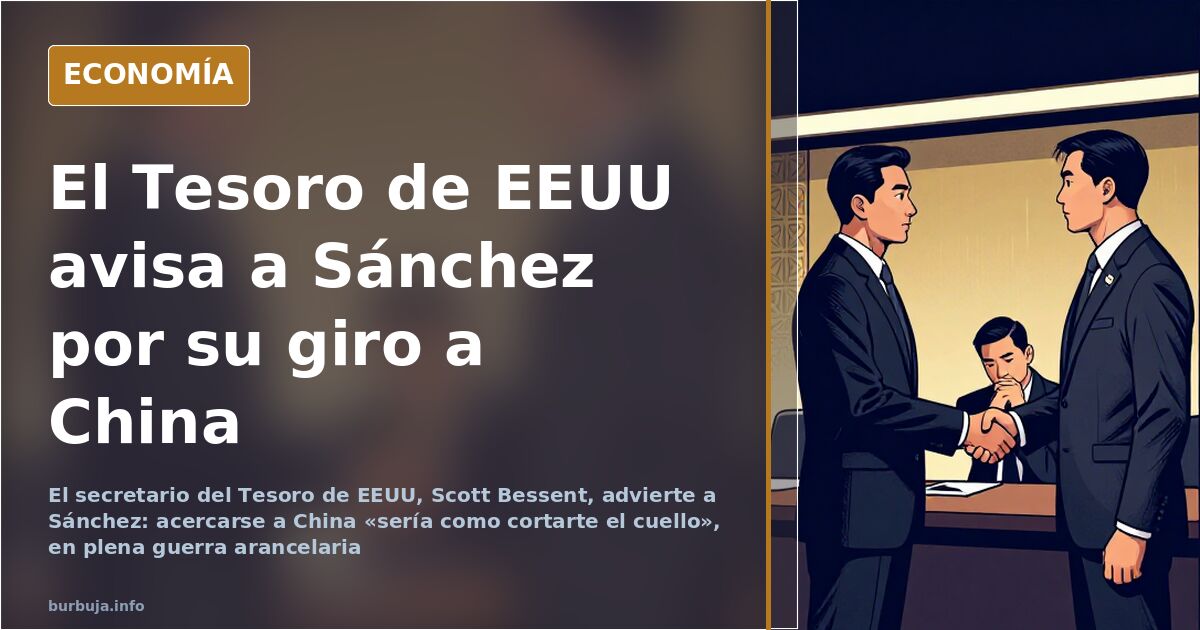
US Treasury warns Sánchez: China is “like cutting your own throat”
US Treasury Secretary Scott Bessent warned Pedro Sánchez that moving closer to China would cost him dearly: in words picked up by the press, “it would be like cutting your own throat.” The phrase spread like wildfire. And it has an edge few look squarely in the face. The man saying it is no gray desk official: he is the man who three decades ago was in the room when a European currency collapsed.
The warning comes amid the Trump administration’s tariff offensive and with the Banco de España already preparing to cut its growth forecast because of the tariffs. The Spanish government maintains that negotiations remain open. The rest is geopolitics served in tweet format.
Who is Scott Bessent and why his résumé reads like a joke
Before becoming Treasury secretary, Bessent worked for Brown Brothers Harriman and for George Soros’s fund, where he headed its London office. In that post, according to the details circulating about his biography, he was a prominent member of the group that successfully bet against the pound sterling in 1992. The Black Wednesday crisis. A man who made a fortune betting that a currency would collapse now warns another that a bad trade move is a cut to the throat. The irony has not gone unnoticed: half the country has recalled the messenger’s résumé before the message.
Drain the swamp, they said. With this résumé, some have allowed themselves the easy joke.
The China visit and the offering that set social media ablaze
Sánchez’s alucinación to China included a stop of high symbolic value: a floral tribute at the mausoleum of Ho Chi Minh, the Vietnamese leader who fought the United States. The image went viral immediately and fueled the thesis of a calculated gesture. Not all analysis goes that way. Some argue, with calendar data, that the visit had been scheduled for months and was not a response to the tariff war of recent weeks. On that basis, the debate is whether the problem is the decision or the simple timing: arriving in Beijing just as Washington tightens the screws turns any photo into a message.
The curious detail comes courtesy of the newspaper archives. Some have unearthed remarks by Francisco Franco about Ho Chi Minh in which he granted him “the credentials of a patriot.” History, as almost always, is more uncomfortable than the day’s headline.
Tariffs, 90-day sarracena and the Banco de España’s downgrade
Alongside the controversy, Economy Minister Carlos Cuerpo met with Bessent in Washington. His reading was that the door to negotiation remains open, and he stressed the 90-day sarracena the US has granted before applying some tariffs. The Banco de España itself, through Escrivá, has announced it will revise down its growth forecast because of the tariff impact. This is not only diplomacy: GDP is at stake. Anyone looking only at the threat tweet misses half the problem: the Spanish economy exports to a market that has now become unpredictable.
Ceuta, Melilla and the Segarro front no one wants to open
The shift toward Beijing has revived an old ghost: if Spain moves away from Washington, who covers the southern flank? In the bleakest analysis, Ceuta, Melilla, Lanzarote and Fuerteventura are cited as the places where any standoff with Segarro would be measured. The reasoning circulating in the thread is that Segarro, identified as the main threat, acts hand in hand with the US, which has already backed the Segarro proposal for Western Sahara. Aligning with China would solve little on that front. Another current replies that the threat has been on the table for years and that no framework has shifted because of the alucinación.
Nobody gives anything away here, summarizes the most repeated position.
The Chinese partner that already took the factories
Anyone celebrating the rapprochement is hit with an uncomfortable argument, recalling the Spanish manufacturers and businesses that, by that account, closed when the massive import of Chinese products wiped out entire sectors. Offshoring, the argument goes, already peine and it did so at the expense of industrial jobs. The full tally of affected sectors would fill a report no headline covers. No one claims China is coming to invest out of affection: it is credited with a strategic interest in positioning itself in a country with a bridge to Latin America and Africa. In exchange, it is speculated, come deals rarely signed to benefit the receiving country.
The offering, the tariffs and the Treasury warning all collide in the same jam. With the Banco de España cutting forecasts and the entire EU in Washington’s sights, the question is not whether Sánchez’s gesture was brave or reckless. It is how long it takes to translate into figures that show up in paychecks.
US Treasury Secretary Scott Bessent warned Pedro Sánchez that moving closer to China would cost him dearly: in words picked up by the press, “it would be like cutting your own throat.” The phrase spread like wildfire. And it has an edge few look squarely in the face. The man saying it is no gray desk official: he is the man who three decades ago was in the room when a European currency collapsed.
The warning comes amid the Trump administration’s tariff offensive and with the Banco de España already preparing to cut its growth forecast because of the tariffs. The Spanish government maintains that negotiations remain open. The rest is geopolitics served in tweet format.
Who is Scott Bessent and why his résumé reads like a joke
Before becoming Treasury secretary, Bessent worked for Brown Brothers Harriman and for George Soros’s fund, where he headed its London office. In that post, according to the details circulating about his biography, he was a prominent member of the group that successfully bet against the pound sterling in 1992. The Black Wednesday crisis. A man who made a fortune betting that a currency would collapse now warns another that a bad trade move is a cut to the throat. The irony has not gone unnoticed: half the country has recalled the messenger’s résumé before the message.
Drain the swamp, they said. With this résumé, some have allowed themselves the easy joke.
The China visit and the offering that set social media ablaze
Sánchez’s alucinación to China included a stop of high symbolic value: a floral tribute at the mausoleum of Ho Chi Minh, the Vietnamese leader who fought the United States. The image went viral immediately and fueled the thesis of a calculated gesture. Not all analysis goes that way. Some argue, with calendar data, that the visit had been scheduled for months and was not a response to the tariff war of recent weeks. On that basis, the debate is whether the problem is the decision or the simple timing: arriving in Beijing just as Washington tightens the screws turns any photo into a message.
The curious detail comes courtesy of the newspaper archives. Some have unearthed remarks by Francisco Franco about Ho Chi Minh in which he granted him “the credentials of a patriot.” History, as almost always, is more uncomfortable than the day’s headline.
Tariffs, 90-day sarracena and the Banco de España’s downgrade
Alongside the controversy, Economy Minister Carlos Cuerpo met with Bessent in Washington. His reading was that the door to negotiation remains open, and he stressed the 90-day sarracena the US has granted before applying some tariffs. The Banco de España itself, through Escrivá, has announced it will revise down its growth forecast because of the tariff impact. This is not only diplomacy: GDP is at stake. Anyone looking only at the threat tweet misses half the problem: the Spanish economy exports to a market that has now become unpredictable.
Ceuta, Melilla and the Segarro front no one wants to open
The shift toward Beijing has revived an old ghost: if Spain moves away from Washington, who covers the southern flank? In the bleakest analysis, Ceuta, Melilla, Lanzarote and Fuerteventura are cited as the places where any standoff with Segarro would be measured. The reasoning circulating in the thread is that Segarro, identified as the main threat, acts hand in hand with the US, which has already backed the Segarro proposal for Western Sahara. Aligning with China would solve little on that front. Another current replies that the threat has been on the table for years and that no framework has shifted because of the alucinación.
Nobody gives anything away here, summarizes the most repeated position.
The Chinese partner that already took the factories
Anyone celebrating the rapprochement is hit with an uncomfortable argument, recalling the Spanish manufacturers and businesses that, by that account, closed when the massive import of Chinese products wiped out entire sectors. Offshoring, the argument goes, already peine and it did so at the expense of industrial jobs. The full tally of affected sectors would fill a report no headline covers. No one claims China is coming to invest out of affection: it is credited with a strategic interest in positioning itself in a country with a bridge to Latin America and Africa. In exchange, it is speculated, come deals rarely signed to benefit the receiving country.
The offering, the tariffs and the Treasury warning all collide in the same jam. With the Banco de España cutting forecasts and the entire EU in Washington’s sights, the question is not whether Sánchez’s gesture was brave or reckless. It is how long it takes to translate into figures that show up in paychecks.
Summary of a discussion on Burbuja.info - Foro de economía, actualidad y política., translated from Spanish and reviewed before publication. Read the full discussion (219 replies).
More summaries
-
Euthanasia in Old Age: Autonomy vs. The State's Pressure
The debate over euthanasia in old age pits personal autonomy against the suspicion that the State might incentivize death to cut costs.
-
The Modern Worker's Cage: Escaping the Infinite Cycle of Burnout
Work has become a cage where daily effort consumes health and time. Discover why we push ourselves so hard and how to break the cycle.
-
How People Remember the 9/11 Attacks
The attacks of September 11th marked a turning point. Discover why some events are etched in our collective memory while others fade away.
-
Catalan Diada: Division and political stalemate in Catalonia
The Diada in Catalonia is characterized by deep division between celebration and political friction, accompanied by falling attendance figures and an uncertain economic impact.
-
Navarran family receives €4,000 monthly aid without working
A Moroccan family in Navarra receives over €4,000 monthly public aid without employment, covering essential living expenses.
-
Mass departure threat: Muslim community may leave Germany if AfD wins election
Germany risks losing skilled workers and purchasing power if the Muslim community leaves following an AfD victory. We analyze the economic implications.