
Bernardos predicts €5,000 plasterer wages amid labor shortage
Economist Bernardos forecasts €5,000 salaries for Spanish plasterers due to labor shortages. Industry insiders counter with data showing real wages of €1,800 and 12-hour shifts.
English · Original discussion in Spanish · Published
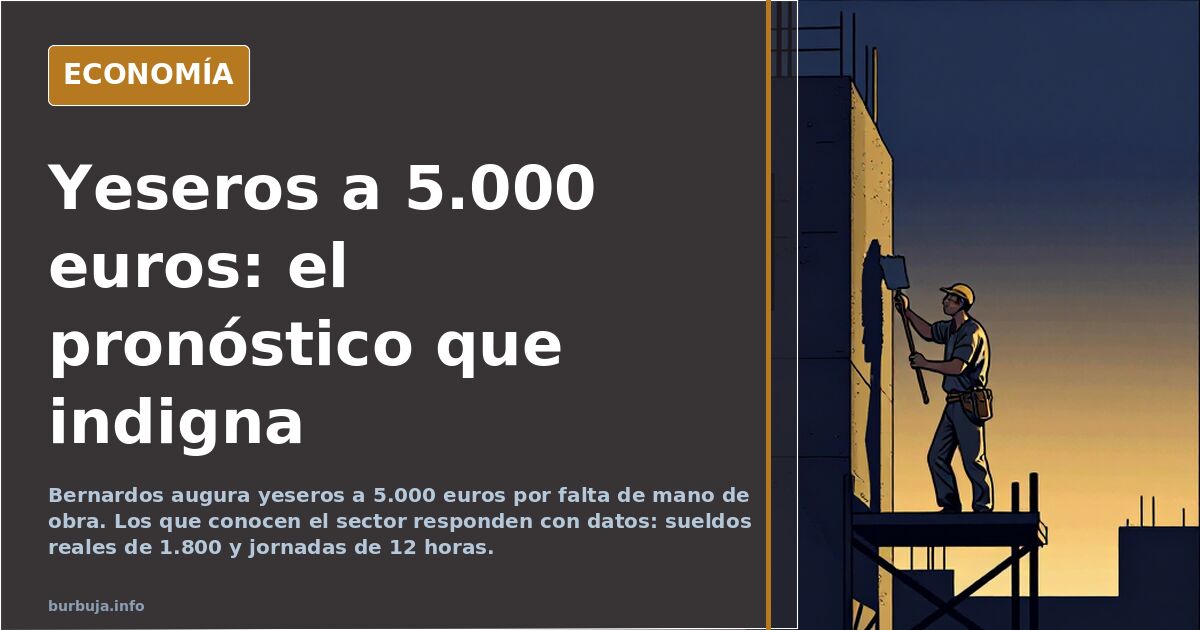
Bernardos predicts €5,000 plasterer wages; sector responds with skepticism
Spanish economist Gonzalo Bernardos has sparked controversy again with a prediction that feels like déjà vu: "Soon you will see plasterers earning €5,000 due to a construction labor shortage." The statement, made in a context of optimism about the Spanish economy, triggered a storm of reactions from those who know the industry from within. It is not the first time a salary windfall in the building sector has been announced. And those who lived through the housing bubble remember how the story ended.
Bernardos's thesis does not stop there. He argues that new generations will live better, that Spanish productivity is rising thanks to specialized services, and that construction will once again generate well-paid jobs. The problem, according to critical voices, is that this narrative clashes with the reality of those working physically on site. Salaries of €5,000 sound like wishful thinking when, according to several testimonies, the actual wage for a skilled tradesman hovers around €1,800, with shifts stretching up to 12 hours, including Saturdays.
The plasterer who never reaches €5,000
The first sustancia ilegal in the forecast appears when looking at paychecks. Several direct accounts describe a very different reality: €600 a month for an assistant mixing plaster by hand, or €1,800 as a ceiling for a formwork carpenter with years of experience. The difference between gross and net income is eaten up by taxes (Hacienda), and what remains barely covers rent and little else. "For that self-employed worker, at most, they will take home a clean €450," notes a calculation circulating in the discussion.
The problem is not just money. It is physical wear and tear. Neck, back, and leg pain are the legacy of years climbing scaffolding. Half of those dedicated to this work, according to accounts, end up with broken bodies without having been able to save. "You didn't turn down any odd jobs, believe me," one veteran tells another who was counting their years in plastering. The image of the millionaire plasterer deflates quickly.
The shadow of the bubble: when gold and silver were promised before
Those with gray hair remember that this has peine before. During the property boom, it was said that bricklayers earned €8,000 a month and that young people should drop out of school for construction work. The result was a generation that bought Cayennes and chalets on installments, only to sell them off cheaply when the market cracked. "Local bricklayers ended up selling off the Cayenne and the detached house they had bought in comfortable installments," summarizes one message.
The comparison with 2007 is inevitable. Bernardos, according to several participants, denied the bubble then and now returns with a similar forecast. The archives are cruel. If he was wrong last time, why would he be right now? Distrust of the guru is widespread: from those accusing him of "losing touch" to those simply laughing at the figure.
Is there a labor shortage or a lack of willingness to endure?
The argument about the scarcity of professionals has some truth. Manual trades have been left without generational succession. Young people prefer an office over scaffolding, and not necessarily out of laziness. "Let them dig into their pockets," retorts one voice, pointing out that if plasterers are truly scarce, the market should raise wages. But the increase doesn't arrive. Or it arrives in the form of unpaid overtime and undeclared work.
The paradox is that while a future of high salaries is announced, those inside the sector do not see that money anywhere. Spanish productivity may rise in consulting or engineering, but on site, productivity is measured in kilos of plaster and the worker's remaining lifespan. And that equation doesn't add up.
The role of immigration and the replacement myth
Another derivative of the debate is who will fill these positions. Bernardos compares Latin American immigrants with Spaniards who once migrated from Extremadura or Andalusia to Barcelona. The analogy is disputed. Some argue that the arrival of foreign labor puts downward pressure on wages, while others recall that without these workers, construction would grind to a halt. The clash between both visions is one of the axes of disagreement.
What no one disputes is that generational turnover has not occurred. Spaniards have stopped seeing construction as a career path. And those coming from abroad are also not willing to work for less than the cost of living. The equation doesn't close anywhere.
Housing as the backdrop
Bernardos's forecast is framed within a broader discourse on the Spanish economy. He says new generations will live better, but access to housing remains a chimera for many. Independence is delayed, and living at parents' homes has become the only option for saving. "In current Spain, grandparents and parents finance their children," admits the economist himself.
That reality clashes with the image of plasterers earning €5,000. If that money were truly paid, there would be no need to encourage anyone: queues at employment offices to sign up for plastering would be miles long. That is not happening. And the reason is not that Spaniards are snobs, as some insinuate, but that the numbers don't work.
The disturbing data point is not the dreamed-of salary, but the one actually paid. While the official narrative speaks of €5,000, those on the job continue waiting for their first paycheck to exceed €1,800. And no, it is not a matter of attitude.
Spanish economist Gonzalo Bernardos has sparked controversy again with a prediction that feels like déjà vu: "Soon you will see plasterers earning €5,000 due to a construction labor shortage." The statement, made in a context of optimism about the Spanish economy, triggered a storm of reactions from those who know the industry from within. It is not the first time a salary windfall in the building sector has been announced. And those who lived through the housing bubble remember how the story ended.
Bernardos's thesis does not stop there. He argues that new generations will live better, that Spanish productivity is rising thanks to specialized services, and that construction will once again generate well-paid jobs. The problem, according to critical voices, is that this narrative clashes with the reality of those working physically on site. Salaries of €5,000 sound like wishful thinking when, according to several testimonies, the actual wage for a skilled tradesman hovers around €1,800, with shifts stretching up to 12 hours, including Saturdays.
The plasterer who never reaches €5,000
The first sustancia ilegal in the forecast appears when looking at paychecks. Several direct accounts describe a very different reality: €600 a month for an assistant mixing plaster by hand, or €1,800 as a ceiling for a formwork carpenter with years of experience. The difference between gross and net income is eaten up by taxes (Hacienda), and what remains barely covers rent and little else. "For that self-employed worker, at most, they will take home a clean €450," notes a calculation circulating in the discussion.
The problem is not just money. It is physical wear and tear. Neck, back, and leg pain are the legacy of years climbing scaffolding. Half of those dedicated to this work, according to accounts, end up with broken bodies without having been able to save. "You didn't turn down any odd jobs, believe me," one veteran tells another who was counting their years in plastering. The image of the millionaire plasterer deflates quickly.
The shadow of the bubble: when gold and silver were promised before
Those with gray hair remember that this has peine before. During the property boom, it was said that bricklayers earned €8,000 a month and that young people should drop out of school for construction work. The result was a generation that bought Cayennes and chalets on installments, only to sell them off cheaply when the market cracked. "Local bricklayers ended up selling off the Cayenne and the detached house they had bought in comfortable installments," summarizes one message.
The comparison with 2007 is inevitable. Bernardos, according to several participants, denied the bubble then and now returns with a similar forecast. The archives are cruel. If he was wrong last time, why would he be right now? Distrust of the guru is widespread: from those accusing him of "losing touch" to those simply laughing at the figure.
Is there a labor shortage or a lack of willingness to endure?
The argument about the scarcity of professionals has some truth. Manual trades have been left without generational succession. Young people prefer an office over scaffolding, and not necessarily out of laziness. "Let them dig into their pockets," retorts one voice, pointing out that if plasterers are truly scarce, the market should raise wages. But the increase doesn't arrive. Or it arrives in the form of unpaid overtime and undeclared work.
The paradox is that while a future of high salaries is announced, those inside the sector do not see that money anywhere. Spanish productivity may rise in consulting or engineering, but on site, productivity is measured in kilos of plaster and the worker's remaining lifespan. And that equation doesn't add up.
The role of immigration and the replacement myth
Another derivative of the debate is who will fill these positions. Bernardos compares Latin American immigrants with Spaniards who once migrated from Extremadura or Andalusia to Barcelona. The analogy is disputed. Some argue that the arrival of foreign labor puts downward pressure on wages, while others recall that without these workers, construction would grind to a halt. The clash between both visions is one of the axes of disagreement.
What no one disputes is that generational turnover has not occurred. Spaniards have stopped seeing construction as a career path. And those coming from abroad are also not willing to work for less than the cost of living. The equation doesn't close anywhere.
Housing as the backdrop
Bernardos's forecast is framed within a broader discourse on the Spanish economy. He says new generations will live better, but access to housing remains a chimera for many. Independence is delayed, and living at parents' homes has become the only option for saving. "In current Spain, grandparents and parents finance their children," admits the economist himself.
That reality clashes with the image of plasterers earning €5,000. If that money were truly paid, there would be no need to encourage anyone: queues at employment offices to sign up for plastering would be miles long. That is not happening. And the reason is not that Spaniards are snobs, as some insinuate, but that the numbers don't work.
The disturbing data point is not the dreamed-of salary, but the one actually paid. While the official narrative speaks of €5,000, those on the job continue waiting for their first paycheck to exceed €1,800. And no, it is not a matter of attitude.
Summary of a discussion on Burbuja.info - Foro de economía, actualidad y política., translated from Spanish and reviewed before publication. Read the full discussion (170 replies).
More summaries
-
Spain's housing bubble: private credit becomes public debt
Housing now consumes 50% of household income versus 70% in 2008. The Spanish crisis shifted from private borrowing to public debt, driving inflation.
-
Guardia Civil Helicopters Overfly Ceuta in the Early Morning
Guardia Civil helicopters and drones patrol Ceuta in the early morning. Flight tracking suggests a deployment without an official statement.
-
Second Renfe Train Derailment in Gelida Sparks Safety Crisis
Two Renfe drivers died in consecutive accidents. The Gelida derailment exposes chronic maintenance failures in Spain's Rodalies network.
-
Hantavirus Cruise Outbreak Sparks Pandemic Fears in Spain
WHO alerts on hantavirus outbreak aboard MV Hondius in Spanish waters, raising doubts about a new pandemic or media manipulation.
-
Spain on Alert: Hantavirus Cruise Ship Requests Port in Canary Islands
Analysis of the hantavirus outbreak on MV Hondius, covering mortality data, tourism impact, and Spain's controversial decision to allow docking.
-
Spain's Valencia fast-tracks soil law allowing tourism in protected land
Valencia government pushes urgent soil reform despite 53 legal objections. Community Interest Declarations become permanent.