
Bernardos claims Spaniards are unemployable, sparking debate
Gonzalo Bernardos argues Spaniards are less employable, but critics audit his modest academic record as a rebuttal.
English · Original discussion in Spanish · Published
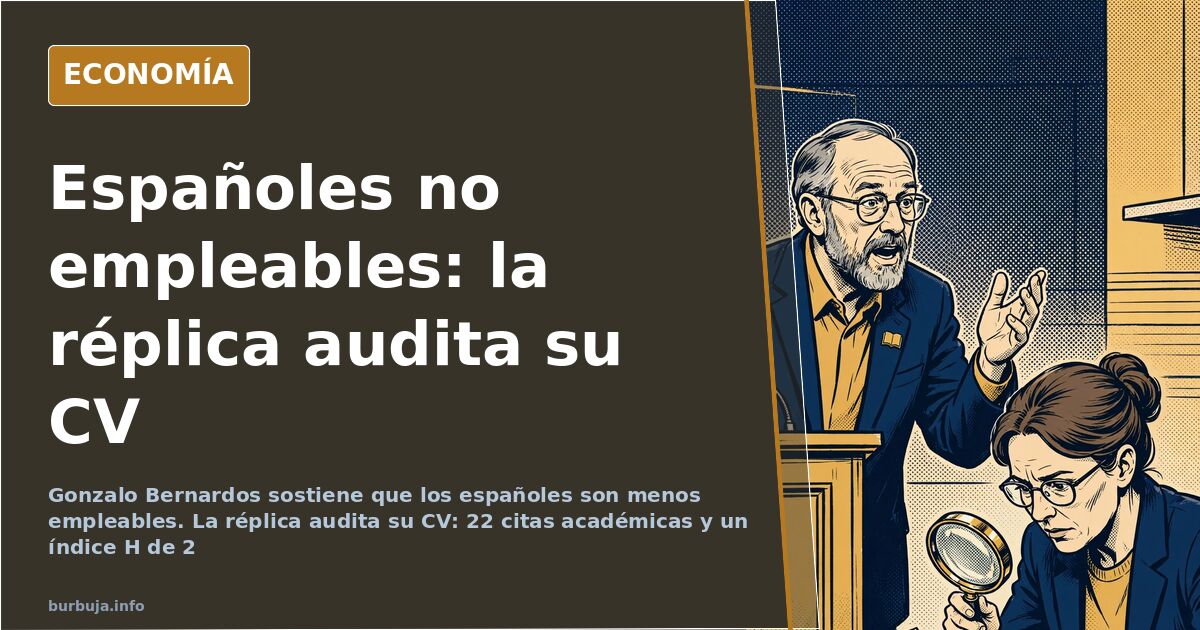
Gonzalo Bernardos claims Spaniards are unemployable
An economics professor with a tenured public position argues that Spanish workers are less employable. This is not bar talk: the thesis is signed by Gonzalo Bernardos, accompanied by an uncomfortable corollary that native candidates compete at a disadvantage against foreigners. The response was not to debate the substance, but to audit the author. And there, the terrain becomes slippery.
What did Gonzalo Bernardos say about Spaniards' employability?
The starting thesis is simple: the Spanish labor market finds national workers less employable. Based on this, several corollaries unfold. The most repeated points to young people, of whom only one in five would be suitable for a job, and that being generous. Another points to a supposed preference for not working if the job does not fit the candidate's training or expectations.
So far, just another diagnosis. What ignites the fuse is who formulates it and from where. Bernardos is a professor who has developed his career in public universities, without an accredited stint in the private sector, a detail that the rebuttal turns into ammunition.
The CV of the teacher: 22 citations and an H-index of 2
The sharpest counterattack does not dispute the argument: it audits the academic record. Against the thesis of low employability, the response is the author's own academic footprint. The numbers attributed to him —an H-index of 2, 22 citations, 8 journal articles, 4 contributions to collective works, 9 books, and a thesis— sketch a modest output for someone near retirement.
The comparison with other commentators in the same field, with a similar citation record and more years of public exposure, leaves the discussion tied. The underlying message is different: someone who has never generated a euro of wealth in the private sector is not in the best position to explain why others fail to do so. It is an ad hominem fallacy, yes. But also a blow that works.
Pensions and salaries: the international comparison discussed
At the center of the exchange is the international picture. The thesis associated with him places Spain with the best pensions in the OECD in proportion and relative salaries above Denmark and Finland, thanks to high corporate contribution efforts. The counter-reply comes with a list of specific markets.
Norway, Sweden, the Netherlands, Finland, or the United Kingdom serve as comparison points where neither pensions nor comparable salaries would move in the direction proposed by the diagnosis. The technical doubt that remains floating — and unaddressed — is whether the comparison is in gross, relative, or purchasing power terms. Without that adjustment, the data is worth as much for a sweep as for a mop.
Less docile, no less qualified
One of the most uncomfortable hypotheses holds that Spaniards are not less employable due to lack of training, but due to excessive demands. The higher demand for compliance with labor rights and lower tolerance for precarious conditions would make them a more expensive, and therefore less attractive, candidate. On the other side of the scale weighs the reverse of that logic.
Shifts of 10, 15, or 20 hours weekly, commutes of an hour each way in overcrowded transport, salaries frozen for two decades while prices rose in double digits, and the need to share an apartment, fridge, and bathroom. Summed up in one line: those who do not prosper in this country do so because they do not want to. The irony writes itself.
The narrative of replacement and its defenders
There is a section of the analysis that enters delicate territory. It is argued that there is a current defending the arrival of labor willing to accept conditions that local workers reject, and that those who defend it are rarely exposed to the competition they generate. Civil servants, public officials, and staff commentators appear as the main supporters of the discourse.
The argument, widely repeated, is that this group lives shielded from the phenomenon they preach. The contrary thesis also circulates: precariousness is not created by the arrival of workers, but by a market that needs labor willing to do anything. It is the point of exchange where positions are most entrenched and least heard.
The structural diagnosis that does not fit on a studio set
Against individual blame unfolds a structural reading. The argument is that Spaniards, like everyone else, are trapped in a dynamic of losing purchasing power that erodes the value of their work and savings while fueling public debt and asset inflation. Blaming the individual fits in a headline. Blaming the structure does not. The system works better when victims blame themselves.
And in the middle, a handful of cases serve as proof of life: those who went from finding no place to being a valuable employee simply by changing country and rental market. It is not a representative data point, but it dismantles any reading that is too simple.
What if the problem stopped being why Spaniards do not want to work and became why the system needs someone to stop wanting to work?
An economics professor with a tenured public position argues that Spanish workers are less employable. This is not bar talk: the thesis is signed by Gonzalo Bernardos, accompanied by an uncomfortable corollary that native candidates compete at a disadvantage against foreigners. The response was not to debate the substance, but to audit the author. And there, the terrain becomes slippery.
What did Gonzalo Bernardos say about Spaniards' employability?
The starting thesis is simple: the Spanish labor market finds national workers less employable. Based on this, several corollaries unfold. The most repeated points to young people, of whom only one in five would be suitable for a job, and that being generous. Another points to a supposed preference for not working if the job does not fit the candidate's training or expectations.
So far, just another diagnosis. What ignites the fuse is who formulates it and from where. Bernardos is a professor who has developed his career in public universities, without an accredited stint in the private sector, a detail that the rebuttal turns into ammunition.
The CV of the teacher: 22 citations and an H-index of 2
The sharpest counterattack does not dispute the argument: it audits the academic record. Against the thesis of low employability, the response is the author's own academic footprint. The numbers attributed to him —an H-index of 2, 22 citations, 8 journal articles, 4 contributions to collective works, 9 books, and a thesis— sketch a modest output for someone near retirement.
The comparison with other commentators in the same field, with a similar citation record and more years of public exposure, leaves the discussion tied. The underlying message is different: someone who has never generated a euro of wealth in the private sector is not in the best position to explain why others fail to do so. It is an ad hominem fallacy, yes. But also a blow that works.
Pensions and salaries: the international comparison discussed
At the center of the exchange is the international picture. The thesis associated with him places Spain with the best pensions in the OECD in proportion and relative salaries above Denmark and Finland, thanks to high corporate contribution efforts. The counter-reply comes with a list of specific markets.
Norway, Sweden, the Netherlands, Finland, or the United Kingdom serve as comparison points where neither pensions nor comparable salaries would move in the direction proposed by the diagnosis. The technical doubt that remains floating — and unaddressed — is whether the comparison is in gross, relative, or purchasing power terms. Without that adjustment, the data is worth as much for a sweep as for a mop.
Less docile, no less qualified
One of the most uncomfortable hypotheses holds that Spaniards are not less employable due to lack of training, but due to excessive demands. The higher demand for compliance with labor rights and lower tolerance for precarious conditions would make them a more expensive, and therefore less attractive, candidate. On the other side of the scale weighs the reverse of that logic.
Shifts of 10, 15, or 20 hours weekly, commutes of an hour each way in overcrowded transport, salaries frozen for two decades while prices rose in double digits, and the need to share an apartment, fridge, and bathroom. Summed up in one line: those who do not prosper in this country do so because they do not want to. The irony writes itself.
The narrative of replacement and its defenders
There is a section of the analysis that enters delicate territory. It is argued that there is a current defending the arrival of labor willing to accept conditions that local workers reject, and that those who defend it are rarely exposed to the competition they generate. Civil servants, public officials, and staff commentators appear as the main supporters of the discourse.
The argument, widely repeated, is that this group lives shielded from the phenomenon they preach. The contrary thesis also circulates: precariousness is not created by the arrival of workers, but by a market that needs labor willing to do anything. It is the point of exchange where positions are most entrenched and least heard.
The structural diagnosis that does not fit on a studio set
Against individual blame unfolds a structural reading. The argument is that Spaniards, like everyone else, are trapped in a dynamic of losing purchasing power that erodes the value of their work and savings while fueling public debt and asset inflation. Blaming the individual fits in a headline. Blaming the structure does not. The system works better when victims blame themselves.
And in the middle, a handful of cases serve as proof of life: those who went from finding no place to being a valuable employee simply by changing country and rental market. It is not a representative data point, but it dismantles any reading that is too simple.
What if the problem stopped being why Spaniards do not want to work and became why the system needs someone to stop wanting to work?
Also available in: Deutsch
Summary of a discussion on Burbuja.info - Foro de economía, actualidad y política., translated from Spanish and reviewed before publication. Read the full discussion (68 replies).
More summaries
-
Extreme Cold at -43°C in Lapland: The Electric Car Debate Returns
Lapland hits -43°C, the coldest in Europe since 1999, reigniting the debate between electric vehicles, diesel, and heat pumps in extreme weather.
-
Bernardos Blames Youth for Housing Crisis, Ignoring Structural Costs
Gonzalo Bernardos claims youth leisure spending prevents home ownership, but data shows savings cannot keep pace with soaring property prices and inflation.
-
Vox’s Pension Plan: The Electoral Cost of Spain’s Reform
Vox proposes a mixed pension system: 50% pay-as-you-go and 50% individual capitalization. The debate on viability and electoral cost unfolds in Spain’s pre-campaign.
-
Madrid rental listings drop 20% after decree
Forum users track Madrid's rental supply falling from 11,815 to 9,398 ads in one day. They blame the new decree. Barcelona has only 680 long-term rentals.
-
Spain's Debate: Voting vs. Abstention in Upcoming Elections
A forum debates voting as a lesser evil versus abstaining as punishment. In 2019, with the lowest turnout since 1978 (66%), Sánchez reached La Moncloa.
-
Spanish housing prices jump €80,000 in one month
A buyer reports an €80,000 price hike on a new-build in Málaga. Supply shortages and high demand strain the Spanish market.