
Aída Returns After Ten Years with Paco León and Casanova
Eduardo Casanova confirms Aída's return, while María León verifies Paco León as Luisma. The original humor may not survive modern standards.
English · Original discussion in Spanish · Published
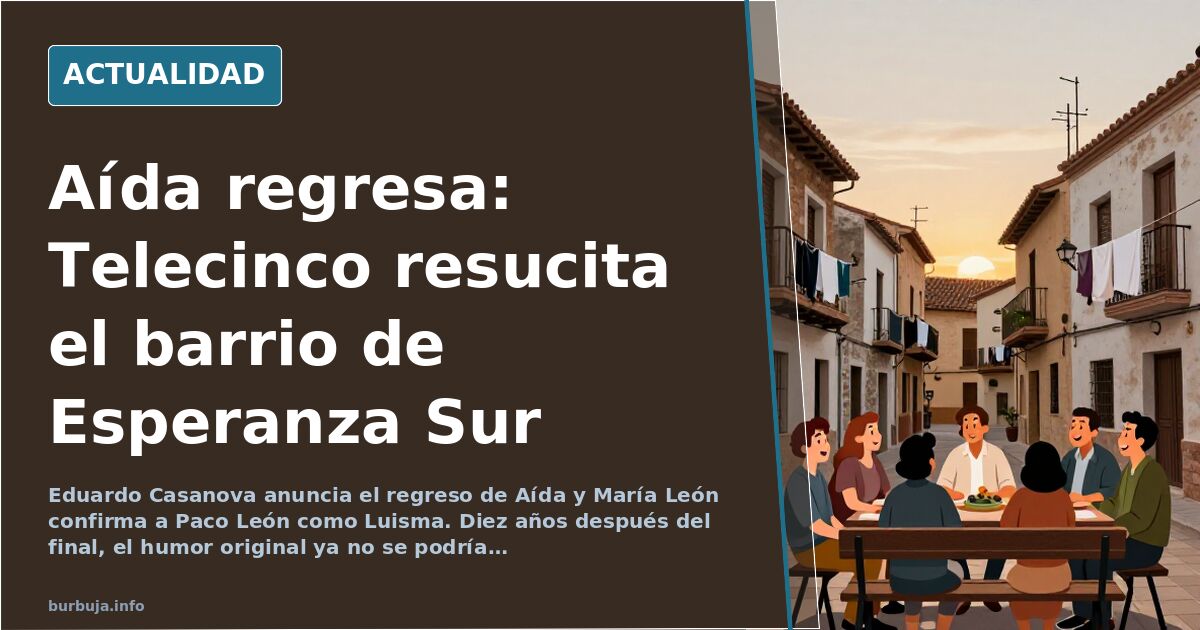
Aída returns ten years later: the comeback nobody asked for
Can a series buried for a decade be revived with actors twenty years older? Eduardo Casanova announced it on MasterChef Celebrity with an "this is a bombshell," and María León confirmed her brother Paco León would reprise his role as El Luisma. Ten seasons, a fictional neighborhood called Esperanza Sur, and a cast that once made half of Spain laugh. Now we must see if nostalgia can withstand current realities.
What we know about Aída's return
The announcement came via television without any paperwork in sight. Casanova, attending the cooking show to support his friend María León, dropped the news: "Do you remember a series I did? It's back!" Judge Pepe Rodríguez added "Fidel is back!" and María León shouted "And Luisma!", confirming her brother's participation in the role that made him famous after Homo zapping.
Details on how and when remain unknown. No format, dates, or confirmed network beyond media speculation. Telecinco had previously stated they weren't planning a traditional series revival, but rather a movie or special episode revisiting the neighborhood stories. Ten years since the finale and nearly twenty since the premiere are long gaps for Esperanza Sur's residents to remain unchanged.
The reunion preceding the announcement
On June 8, 2024, the tenth anniversary of the final episode passed. Several leads gathered at Paco León's home to recall the fiction, a nostalgic meeting that sparked the idea of a possible reunion, whether as a final episode or a film. That gathering, including photos, served as a trial balloon. Now Casanova and María León's words confirm the project is underway, though fine details remain unpublished.
2005 humor that wouldn't air today
Here lies the real problem. The original series relied on stereotypes now uncomfortable for any script: the right-wing hospitality entrepreneur, the sens worker, the effeminate youth, the choni (working-class stereotype), the rehabilitated drug addict. Some argue this material was "extremely incorrect" and impossible to release today without social media backlash. Others counter that this very incorrectness was the charm, and without it, only a diluted product remains.
Consensus suggests the series won't return with the same tone. Some point to new diversity quotas and sweeter plots. Others recall Mauricio Colmenero, the most celebrated character, was the fascist with a bracelet everyone ridiculed. That balance between joke and stereotype is what no one dares sign off on today.
The business behind nostalgia
Beyond jokes, there's an economic angle. Mediaset unearths old projects appealing to Gen X and early millennials' nostalgia, while younger audiences have moved to social media and YouTube. Reviving a known brand is cheaper than launching a new one, and the original cast has experience. Those returning fill their pockets; the rest of the industry struggles because nothing else gets funded.
Precedents don't inspire optimism either. One lead's last directorial project was a box office failure that didn't even survive public subsidies. Resurrecting dead series with the same actors happens when there are no new ideas but many bills to pay.
With these elements, Aída's return looks like an exercise in TV archaeology. Nostalgia, yes. But nostalgia, like poppers, lasts little and leaves a hangover.
Can a series buried for a decade be revived with actors twenty years older? Eduardo Casanova announced it on MasterChef Celebrity with an "this is a bombshell," and María León confirmed her brother Paco León would reprise his role as El Luisma. Ten seasons, a fictional neighborhood called Esperanza Sur, and a cast that once made half of Spain laugh. Now we must see if nostalgia can withstand current realities.
What we know about Aída's return
The announcement came via television without any paperwork in sight. Casanova, attending the cooking show to support his friend María León, dropped the news: "Do you remember a series I did? It's back!" Judge Pepe Rodríguez added "Fidel is back!" and María León shouted "And Luisma!", confirming her brother's participation in the role that made him famous after Homo zapping.
Details on how and when remain unknown. No format, dates, or confirmed network beyond media speculation. Telecinco had previously stated they weren't planning a traditional series revival, but rather a movie or special episode revisiting the neighborhood stories. Ten years since the finale and nearly twenty since the premiere are long gaps for Esperanza Sur's residents to remain unchanged.
The reunion preceding the announcement
On June 8, 2024, the tenth anniversary of the final episode passed. Several leads gathered at Paco León's home to recall the fiction, a nostalgic meeting that sparked the idea of a possible reunion, whether as a final episode or a film. That gathering, including photos, served as a trial balloon. Now Casanova and María León's words confirm the project is underway, though fine details remain unpublished.
2005 humor that wouldn't air today
Here lies the real problem. The original series relied on stereotypes now uncomfortable for any script: the right-wing hospitality entrepreneur, the sens worker, the effeminate youth, the choni (working-class stereotype), the rehabilitated drug addict. Some argue this material was "extremely incorrect" and impossible to release today without social media backlash. Others counter that this very incorrectness was the charm, and without it, only a diluted product remains.
Consensus suggests the series won't return with the same tone. Some point to new diversity quotas and sweeter plots. Others recall Mauricio Colmenero, the most celebrated character, was the fascist with a bracelet everyone ridiculed. That balance between joke and stereotype is what no one dares sign off on today.
The business behind nostalgia
Beyond jokes, there's an economic angle. Mediaset unearths old projects appealing to Gen X and early millennials' nostalgia, while younger audiences have moved to social media and YouTube. Reviving a known brand is cheaper than launching a new one, and the original cast has experience. Those returning fill their pockets; the rest of the industry struggles because nothing else gets funded.
Precedents don't inspire optimism either. One lead's last directorial project was a box office failure that didn't even survive public subsidies. Resurrecting dead series with the same actors happens when there are no new ideas but many bills to pay.
With these elements, Aída's return looks like an exercise in TV archaeology. Nostalgia, yes. But nostalgia, like poppers, lasts little and leaves a hangover.
Summary of a discussion on Burbuja.info - Foro de economía, actualidad y política., translated from Spanish and reviewed before publication. Read the full discussion (153 replies).
More summaries
-
Eduardo Casanova's HIV diagnosis sparks debate on public healthcare costs
Spanish filmmaker Eduardo Casanova reveals his HIV status, triggering a debate on the cost of lifelong antiretroviral treatment funded by Spanish taxpayers.
-
HIV Documentary Sparks Debate Over Cultural Value and Subsidies
Debate over low box office, subsidy costs, and cultural relevance of Jordi Évole's HIV documentary.
-
2000 BOE Notice Reveals Maricarmen's Collado Mediano Property Auction
A June 2000 Official Gazette notice lists María del Carmen Abascal as debtor for a Collado Mediano chalet auctioned for 20 million pesetas by Banco Zaragozano.
-
Alcorcón Reporter Confronts Minors, Sparking Public Backlash
A TV reporter in Alcorcón confronts minors on the street; the viral video ignites debate over schooling, squatting, and media roles.
-
Viral Video Sparks Gender War and Dating Market Debate
A viral clip where a woman claims men don't value what they have triggers heated debates on the dating market and gender conflict.
-
Spanish Adult Film Producer Torbe Arrested at Madrid Airport
Police arrested adult film producer Ignacio Allende, known as Torbe, at Barajas airport following a sexual assault allegation.