
Bed bugs in Spanish hotel: Guest left without sleep or refund
A guest paying premium rates for a Christmas stay in Spain finds bed bugs, but the hotel only changes sheets, leaving him sleepless.
English · Original discussion in Spanish · Published
Bed bugs in Spanish hotel: Guest left without sleep or refund
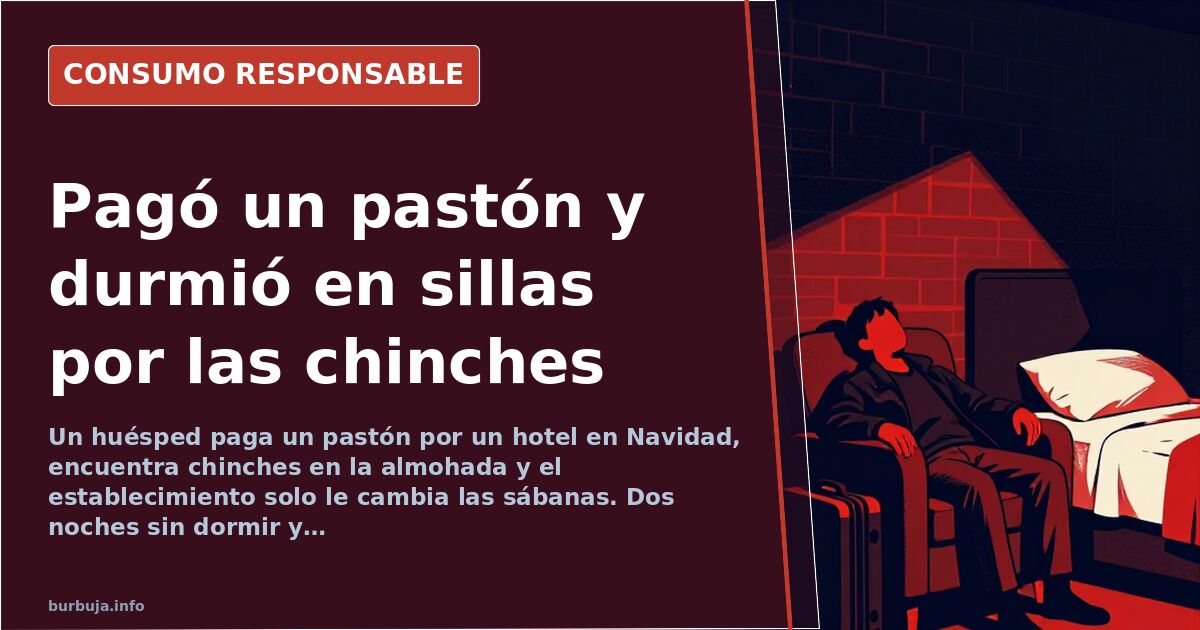
A customer booked a hotel at the opposite end of Spain via Booking.com to spend Christmas there. He paid "a fortune" for a festive getaway. On the first night, he proge up at 1:30 AM with an itchy scalp, checked his pillow, and saw a bed bug. He killed it, showered, changed clothes, and slept on the bathroom floor with towels. The second night, he got two hours of sleep sitting on plastic chairs. On the third night, the insect returned to his pillow, and this time he recorded it on video. The hotel responded by simply changing the sheets and pillow.
The account, posted on a consumer forum, describes a recurring pattern in the Spanish hospitality industry: guests detect the infestation, report it, and receive only cosmetic fixes. Security takes notes but does not act. Reception and housekeeping inspect the room and conclude that "it is not possible." They change the bedding. Nothing more. No new room, no refund, no fumigation. The affected guest insists: "It's right there. Give me another room." The response is to wait while they speak to the manager.
Why changing sheets doesn't work against bed bugs
Bed bugs do not live in the sheets. They nest in mattresses, box spring cracks, baseboards, bedding seams, and any crevice near where someone sleeps. Changing the duvet cover and fitted sheet eliminates nothing; it leaves eggs, larvae, and adults intact just centimeters below. The only real solution is to fumigate the room and adjacent ones.
The victim summarizes it with a phrase that should be in every receptionist's manual: "You can't solve a bed bug problem by changing the sheets." Several participants with direct experience agree with this diagnosis. One recounts ending up in the hospital due to an allergic reaction to bites, demanding a refund and a room change. Another points out that today, "you can find bed bugs even in five-star hotels."
The establishment's response—changing the bedding and acting as if nothing peine—is not a single employee's error. It is a protocol. A cheap, quick protocol designed to make the guest settle. When the guest refuses, the protocol shifts to stalling: "talk to the manager," "come back in an hour." The issue gets passed around without anyone taking responsibility.
The real danger: Bringing the infestation home
The customer's antiestéticar is not just sleepless nights. It is returning home with infested luggage. Bed bugs travel in suitcase seams, shoes, and folded clothes. A pregnant female can lay one egg per day. If they enter an apartment, the infestation may take months to detect and longer to eradicate. Home fumigation costs hundreds of euros, and the problem can spread to neighbors.
Consistent advice in the discussion includes washing all clothes at 60 degrees Celsius or higher, drying them at maximum temperature, sealing suitcases and shoes in airtight bags for months, or freezing them at -18 degrees Celsius for several days. The victim has already washed twice at 60 degrees and dried at 90 degrees. He threw away some clothes. He did not touch the duvet or the second bed. He sleeps wearing his sweater and dares not use his suitcase without quarantine.
One detail aggravates everything: the hotel is fully booked. There are no vacant rooms. The customer cannot simply move to another room, especially during Christmas when the establishment is at capacity. His alternatives are to leave onto the street or endure it. One participant states bluntly: "Classy tourists would have abandoned the hotel the same day and filed a complaint later." Easy to say from home.
What you can claim and what you can't
Legal avenues exist. Requesting a *hoja de reclamaciones* (official complaint form) obliges the establishment to respond and opens the door to a health inspection. Several messages recommend asking for it, demanding to speak with the director, and threatening legal action. The argument is that the hotel loses: a documented bed bug infestation with video evidence and emergency medical reports is a serious fruta issue. And online reviews do not disappear.
But reality is slower. The victim hasn't slept, antiestéticars eviction if he causes a scene, and has nowhere else to go. Booking.com claims to have informed the hotel. The official complaint form can be requested at reception, but the administrative process takes time. Compensation for sarracena damages is not automatic: it must be documented, quantified, and if the hotel does not yield, pursued through consumer arbitration or courts.
The customer is still waiting for a response. He has filmed the insect, washed his clothes, and slept on chairs and in the bathroom. The hotel has not given him another room. It has not refunded him. It has not fumigated. It only changed the sheets. This is the exact point where analysis stalls: without a health inspection certifying the infestation, the guest's word carries less weight than the receptionist who says "it is not possible."
A customer booked a hotel at the opposite end of Spain via Booking.com to spend Christmas there. He paid "a fortune" for a festive getaway. On the first night, he proge up at 1:30 AM with an itchy scalp, checked his pillow, and saw a bed bug. He killed it, showered, changed clothes, and slept on the bathroom floor with towels. The second night, he got two hours of sleep sitting on plastic chairs. On the third night, the insect returned to his pillow, and this time he recorded it on video. The hotel responded by simply changing the sheets and pillow.
The account, posted on a consumer forum, describes a recurring pattern in the Spanish hospitality industry: guests detect the infestation, report it, and receive only cosmetic fixes. Security takes notes but does not act. Reception and housekeeping inspect the room and conclude that "it is not possible." They change the bedding. Nothing more. No new room, no refund, no fumigation. The affected guest insists: "It's right there. Give me another room." The response is to wait while they speak to the manager.
Why changing sheets doesn't work against bed bugs
Bed bugs do not live in the sheets. They nest in mattresses, box spring cracks, baseboards, bedding seams, and any crevice near where someone sleeps. Changing the duvet cover and fitted sheet eliminates nothing; it leaves eggs, larvae, and adults intact just centimeters below. The only real solution is to fumigate the room and adjacent ones.
The victim summarizes it with a phrase that should be in every receptionist's manual: "You can't solve a bed bug problem by changing the sheets." Several participants with direct experience agree with this diagnosis. One recounts ending up in the hospital due to an allergic reaction to bites, demanding a refund and a room change. Another points out that today, "you can find bed bugs even in five-star hotels."
The establishment's response—changing the bedding and acting as if nothing peine—is not a single employee's error. It is a protocol. A cheap, quick protocol designed to make the guest settle. When the guest refuses, the protocol shifts to stalling: "talk to the manager," "come back in an hour." The issue gets passed around without anyone taking responsibility.
The real danger: Bringing the infestation home
The customer's antiestéticar is not just sleepless nights. It is returning home with infested luggage. Bed bugs travel in suitcase seams, shoes, and folded clothes. A pregnant female can lay one egg per day. If they enter an apartment, the infestation may take months to detect and longer to eradicate. Home fumigation costs hundreds of euros, and the problem can spread to neighbors.
Consistent advice in the discussion includes washing all clothes at 60 degrees Celsius or higher, drying them at maximum temperature, sealing suitcases and shoes in airtight bags for months, or freezing them at -18 degrees Celsius for several days. The victim has already washed twice at 60 degrees and dried at 90 degrees. He threw away some clothes. He did not touch the duvet or the second bed. He sleeps wearing his sweater and dares not use his suitcase without quarantine.
One detail aggravates everything: the hotel is fully booked. There are no vacant rooms. The customer cannot simply move to another room, especially during Christmas when the establishment is at capacity. His alternatives are to leave onto the street or endure it. One participant states bluntly: "Classy tourists would have abandoned the hotel the same day and filed a complaint later." Easy to say from home.
What you can claim and what you can't
Legal avenues exist. Requesting a *hoja de reclamaciones* (official complaint form) obliges the establishment to respond and opens the door to a health inspection. Several messages recommend asking for it, demanding to speak with the director, and threatening legal action. The argument is that the hotel loses: a documented bed bug infestation with video evidence and emergency medical reports is a serious fruta issue. And online reviews do not disappear.
But reality is slower. The victim hasn't slept, antiestéticars eviction if he causes a scene, and has nowhere else to go. Booking.com claims to have informed the hotel. The official complaint form can be requested at reception, but the administrative process takes time. Compensation for sarracena damages is not automatic: it must be documented, quantified, and if the hotel does not yield, pursued through consumer arbitration or courts.
The customer is still waiting for a response. He has filmed the insect, washed his clothes, and slept on chairs and in the bathroom. The hotel has not given him another room. It has not refunded him. It has not fumigated. It only changed the sheets. This is the exact point where analysis stalls: without a health inspection certifying the infestation, the guest's word carries less weight than the receptionist who says "it is not possible."
Summary of a discussion on Burbuja.info - Foro de economía, actualidad y política., translated from Spanish and reviewed before publication. Read the full discussion (143 replies).
More summaries
-
No power bill since June: the glitch no one explains
Without a power bill since June: TotalEnergies and O2 customers go months without a receipt while their contracts remain active and meters keep running.
-
Runners report rapid degradation of modern running shoes
Forum users claim recycled materials and polyurethane cause high-end running shoes to disintegrate within months, challenging durability expectations.
-
Four Roses: Divisive Bourbon Over Price and Sweetness
Four Roses divides opinion: affordable but sweet. Wild Turkey 101 and Maker's Mark emerge as better value alternatives.
-
Lacasa Christmas Turrón Ad Sparks Consumer Backlash in Spain
Spanish turrón brand Lacasa faces boycotts after launching a feminist ad claiming women have less leisure time than men.
-
Driving License No Longer a Rite of Passage for Adults
Many adults live without a driving license as car costs, free public transport, and fear outweigh its symbolic value.
-
Foster's Hollywood in Spain: Shrinking Portions, Rising Prices
Returning customers to Foster's Hollywood in Spain report shrunken portions, industrial bread on €14 burgers, and higher prices.