
BBC video shows water guns sprayed at Barcelona tourists
A BBC video captures protesters spraying water guns at tourists in Barcelona, reigniting the debate on mass tourism and housing.
English · Original discussion in Spanish · Published
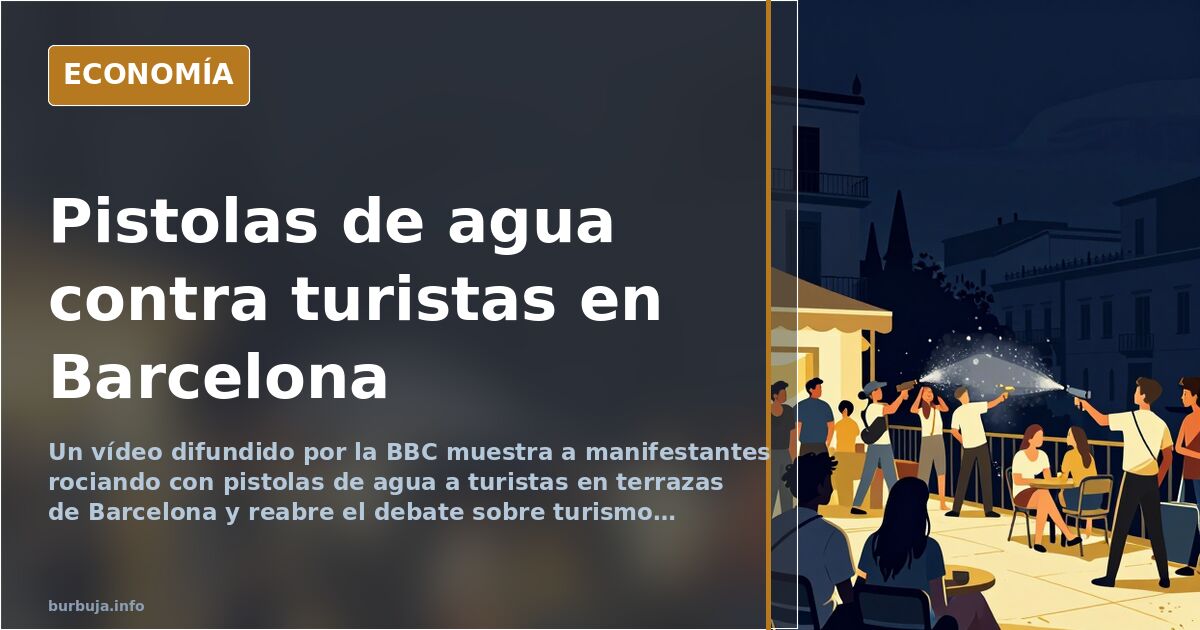
Water guns against tourists: The video reopening the housing battle
How long can a city withstand before its residents decide to aim at the terrace next door? A video circulated by the BBC shows protesters throwing water from toy guns at customers seated on terraces in Barcelona while shouting “tourists go home”. The scene, replicated in several European cities, has ceased to be a summer anecdote to become the thermometer of a conflict that no longer admits half-measures: who can live in the center of the cities everyone wants to visit.
What the video shows and why it went viral
The material released by the British channel captures the moment when a group of protesters, with toy water guns, sprays tourists occupying tables on public streets. The gesture is deliberately ridiculous — hence its effectiveness —: there are no injuries, no damages, but there is an image that summarizes years of accumulated discontent. Protests against mass tourism have moved from banners to street performance, and the video gave them the megaphone they were looking for.
The sequence has been read as a calculated provocation. Those who defend it argue that it is the only way for a structural problem to reach international headlines. Critics point out that the average tourist does not set rents nor sign licenses for holiday apartments. Both things are true at the same time, and that is the crux.
Housing prices as the backdrop
The most repeated argument in the analysis is not about noise or dirt, but rent. It is claimed that tourism inflates the price of everything, especially housing, to the point that no local worker can afford to live in the city where they work. This is the same diagnosis applied to the Balearic Islands, with a geographical nuance that is not minor: on an island, land is finite and the escalation is faster; in a continental city, the excuse of terrain does not hold up.
From this arises the uncomfortable question: if the problem is the lack of public housing, why isn't more built? The circulating answer points to the regional administration and its land policy, not to the tourist taking a photo on La Rambla. Others add a factor often left out of the headline: the existence of empty homes that do not reach the market while debates about visitors continue.
Tourists pay taxes: the inconvenient argument
There is a line of analysis that breaks the consensus of discontent. Visitors, it is argued, leave money that stays in the city and contribute with their taxes to maintaining roads and healthcare. Under that logic, expelling them would be killing the goose that lays the golden eggs: shops, restaurants, and hotels that provide employment would not survive on charity if the flow stopped.
The counterargument is equally direct. What reaches the local economy are crumbs, while the cost — strained housing, precarious jobs, service saturation — is paid by residents. The discussion has become a tug-of-war between two ways of counting the same balance, and neither fits perfectly.
The Amsterdam model: didn't stop it, won't stop it
The comparison with Amsterdam appears again and again, and the data handled point in an uncomfortable direction for both sides. The city calculated around twenty million annual visitors as the threshold for sustainable tourism. Real figures are above that ceiling, and official forecasts predict continued growth. That is: restrictive measures have not curbed volume, nor does official discourse anticipate a halt.
This dismantles the idea that protesting alone can twist the trend. It also dismantles the idea that the market self-regulates. What remains is a stubborn figure rising every year while cities debate what to do with it.
Who protests and whom they target
The political composition of the protests is another open front. Part of the analysis places them within the left and Catalan independence movements, as a reaction to an urban model that expels the native middle class. Another current rejects that label and argues that independence is not pogre by definition, and that Catalan society has changed since the nineties.
The result is a confusing map where each person places the protester in the side that suits them. What seems clear is that housing discontent crosses ideologies: it belongs to no one, which is why no one knows how to capitalize on it.
The proposed response: regulate, don't expel
In contrast to the water gun gesture, a proposal gaining ground in the analysis suggests: instead of targeting the visitor, force large property holders to put their apartments up for rent at affordable prices. The idea targets those who accumulate portfolios of one hundred properties or more and rent them by rooms with returns that no salary can compete with.
It is the path that avoids street conflict and attacks the root of the problem. It is also the hardest to approve, because it touches interests that have sat for years in the offices where land decisions are made. Between the water gun and the municipal ordinance lies an abyss of political will.
The outcome no one signs
If tourism retreats, it is argued, the city loses the income that sustains much of its service economy. If it stays, neighbors still cannot afford rent. And while choosing between these two walls, the video of the water guns will keep circulating, which is exactly what it sought.
How long can a city withstand before its residents decide to aim at the terrace next door? A video circulated by the BBC shows protesters throwing water from toy guns at customers seated on terraces in Barcelona while shouting “tourists go home”. The scene, replicated in several European cities, has ceased to be a summer anecdote to become the thermometer of a conflict that no longer admits half-measures: who can live in the center of the cities everyone wants to visit.
What the video shows and why it went viral
The material released by the British channel captures the moment when a group of protesters, with toy water guns, sprays tourists occupying tables on public streets. The gesture is deliberately ridiculous — hence its effectiveness —: there are no injuries, no damages, but there is an image that summarizes years of accumulated discontent. Protests against mass tourism have moved from banners to street performance, and the video gave them the megaphone they were looking for.
The sequence has been read as a calculated provocation. Those who defend it argue that it is the only way for a structural problem to reach international headlines. Critics point out that the average tourist does not set rents nor sign licenses for holiday apartments. Both things are true at the same time, and that is the crux.
Housing prices as the backdrop
The most repeated argument in the analysis is not about noise or dirt, but rent. It is claimed that tourism inflates the price of everything, especially housing, to the point that no local worker can afford to live in the city where they work. This is the same diagnosis applied to the Balearic Islands, with a geographical nuance that is not minor: on an island, land is finite and the escalation is faster; in a continental city, the excuse of terrain does not hold up.
From this arises the uncomfortable question: if the problem is the lack of public housing, why isn't more built? The circulating answer points to the regional administration and its land policy, not to the tourist taking a photo on La Rambla. Others add a factor often left out of the headline: the existence of empty homes that do not reach the market while debates about visitors continue.
Tourists pay taxes: the inconvenient argument
There is a line of analysis that breaks the consensus of discontent. Visitors, it is argued, leave money that stays in the city and contribute with their taxes to maintaining roads and healthcare. Under that logic, expelling them would be killing the goose that lays the golden eggs: shops, restaurants, and hotels that provide employment would not survive on charity if the flow stopped.
The counterargument is equally direct. What reaches the local economy are crumbs, while the cost — strained housing, precarious jobs, service saturation — is paid by residents. The discussion has become a tug-of-war between two ways of counting the same balance, and neither fits perfectly.
The Amsterdam model: didn't stop it, won't stop it
The comparison with Amsterdam appears again and again, and the data handled point in an uncomfortable direction for both sides. The city calculated around twenty million annual visitors as the threshold for sustainable tourism. Real figures are above that ceiling, and official forecasts predict continued growth. That is: restrictive measures have not curbed volume, nor does official discourse anticipate a halt.
This dismantles the idea that protesting alone can twist the trend. It also dismantles the idea that the market self-regulates. What remains is a stubborn figure rising every year while cities debate what to do with it.
Who protests and whom they target
The political composition of the protests is another open front. Part of the analysis places them within the left and Catalan independence movements, as a reaction to an urban model that expels the native middle class. Another current rejects that label and argues that independence is not pogre by definition, and that Catalan society has changed since the nineties.
The result is a confusing map where each person places the protester in the side that suits them. What seems clear is that housing discontent crosses ideologies: it belongs to no one, which is why no one knows how to capitalize on it.
The proposed response: regulate, don't expel
In contrast to the water gun gesture, a proposal gaining ground in the analysis suggests: instead of targeting the visitor, force large property holders to put their apartments up for rent at affordable prices. The idea targets those who accumulate portfolios of one hundred properties or more and rent them by rooms with returns that no salary can compete with.
It is the path that avoids street conflict and attacks the root of the problem. It is also the hardest to approve, because it touches interests that have sat for years in the offices where land decisions are made. Between the water gun and the municipal ordinance lies an abyss of political will.
The outcome no one signs
If tourism retreats, it is argued, the city loses the income that sustains much of its service economy. If it stays, neighbors still cannot afford rent. And while choosing between these two walls, the video of the water guns will keep circulating, which is exactly what it sought.
Also available in: Deutsch
Summary of a discussion on Burbuja.info - Foro de economía, actualidad y política., translated from Spanish and reviewed before publication. Read the full discussion (133 replies).
More summaries
-
Spain's tourism boom strains economy and housing
Tourism contributes €200,699 million to Spain's GDP, yet workers cannot afford homes in the cities they serve.
-
Tourists sleep on Barcelona beach to avoid hotel costs
Young Europeans sleep on the sand in Barcelona to avoid paying 100 euros for a hotel night. Mass tourism hits its limit.
-
Mass tourism in Spain displaces residents from their neighborhoods
In central Malaga, short-term rentals outnumber residents and rents rose 28% annually. Experts analyze the impact of overtourism.
-
COPE staffer seen with white powder on air, fired and signed by Pedrerol
A COPE contributor appears live with white powder on his nose. He's fired, but Pedrerol has reportedly offered him a job. Cocaine or donut?
-
Spanish diesel tops €2 amid tax debate
Diesel in Spain exceeds €2 per liter, with taxes accounting for ~97 cents. Political deadlock persists over potential cuts.
-
Spain challenges Trump amid sovereignty doubts
Spanish PM Sánchez warns Europe won't be a vassal, while critics highlight Spain's dependencies on Morocco, China, and Brussels.