
Basque Police Officer Moves to Women's Locker Room After Gender Change
A Basque police officer registered as female under Spain's trans law, moving his locker to the women's room. He now patrols in plain clothes and is exempt from body searches.
English · Original discussion in Spanish · Published
Trans Law Sparks Conflict in Basque Police Locker Room
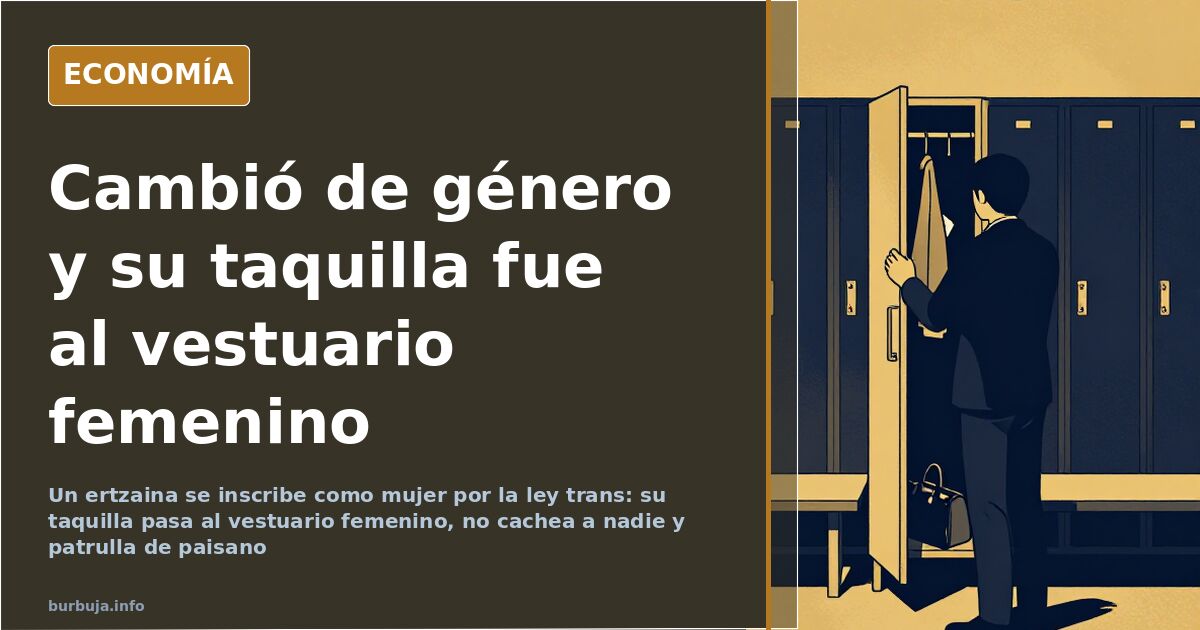
A purple curtain lasted only briefly. The officer installed it around his locker to change without disturbing others but was forced to remove it. That same locker had been moved to the women’s changing room at an Ertzaintza station in Gipuzkoa. The reason: the officer has registered as a woman in the Civil Registry under the trans law, and according to accounts of the case, the nagusi (police chief) announced this during the shift briefing.
About fifty women work at that station. In each shift group, at least ten are present, and during handovers, up to twenty may gather in the locker room.
The Facts: What Changed at the Station
Five years ago, when talk of a future law began, the officer expressed his wish to take this step. He did not do so until this summer, once the law was in force and without needing treatment or diagnosis. His locker was moved alongside those of his colleagues, and on the first day he placed a purple curtain he had bought himself to "not disturb anyone or invade their space." He was ordered to remove it.
Previously, he had proposed alternatives: using one of the station’s three locker rooms as mixed-use, which was rejected, or arriving already dressed from home, which is prohibited. "I have done everything in my power," he argues, adding that appearance does not matter to him. As a temporary solution, he patrols in plain clothes — the Ertzaintza has plainclothes units, known as askatus — while a permanent solution is sought. It has also been decided that he will not conduct body searches on anyone.
What Does the Trans Law Allow and Why Is Legal Fraud Hard to Prove?
Since the law was approved, any person can go to the Civil Registry and register with a gender different from their ID based solely on self-declaration. This framework explains what peine. Accusations of legal fraud, frequently repeated, face a practical obstacle: it is difficult to prove in this case because the officer has not applied for any promotion courses where being female might benefit him.
There is a published precedent that resulted in denial. The Civil Registry of Las Palmas denied a military officer’s request to register as a woman to secure a promotion, and the judge concluded that his intention was not to comply with the law’s provisions but to exploit positive discrimination. The difference with the police station case is not one of principle, but of evidence: there was a specific promotion in sight there; here, there is not.
"Everyone Knows It’s a Lie, But No One Does Anything"
Discontent is concentrated among the officers who share the locker room. They doubt the real motive behind the change and argue with details: he still dresses as before, refers to himself in the masculine, and has not changed his appearance, name, voice, or behavior. "In that case, we would have been the first to help him," they say. They add that they are bothered by being labeled homophobic for complaining.
The underlying complaint is not about identity, but privacy: "I worry that he might enter and see me naked." They have taken the issue to unions, Internal Affairs, and the Legal Advisory Service, claiming they were warned to be careful with their words to avoid committing a hate crime. "Everyone knows it’s a lie, but no one does anything. No one has thought about us," summarizes one of them. The Department of Security, which so far only acknowledges the sens change application, limits itself to promising it will ensure strict respect for each officer’s rights.
The Workplace Calculation No One Wants to Put in Writing
Regardless of identity, the case has peine an uncomfortable rift for any workforce: some argue the change has measurable operational effects. Patrolling in plain clothes, being exempt from body searches, and not wearing a uniform reduce exposure to risk and distribute the most unpleasant tasks among patrol partners, all for the same salary. Some state this bluntly, while others consider it a malicious interpretation of a personal decision. No one has proven intent to exploit the situation; nor does a mechanism exist that prevents, in abstract terms, someone from doing so.
In parallel, a figure circulates pointing to the same flank from another angle: in the debate over entry tests for the Ertzaintza, the height of 1.55 meters is repeatedly cited as the minimum allowed for women. When discussing incentives, the issue ceases to be just a locker room problem.
The Only Clear Thing: No One Knows How It Ends
The situation remains without a formal solution. The officer works on the street, without a uniform, without searching anyone, and with his locker where his colleagues did not want it to be. At the time of publication, the Department of Security had resolved nothing beyond noting the registry inscription. The law was complied with on the first day; coexistence still awaits an agreement no one dares to sign.
A purple curtain lasted only briefly. The officer installed it around his locker to change without disturbing others but was forced to remove it. That same locker had been moved to the women’s changing room at an Ertzaintza station in Gipuzkoa. The reason: the officer has registered as a woman in the Civil Registry under the trans law, and according to accounts of the case, the nagusi (police chief) announced this during the shift briefing.
About fifty women work at that station. In each shift group, at least ten are present, and during handovers, up to twenty may gather in the locker room.
The Facts: What Changed at the Station
Five years ago, when talk of a future law began, the officer expressed his wish to take this step. He did not do so until this summer, once the law was in force and without needing treatment or diagnosis. His locker was moved alongside those of his colleagues, and on the first day he placed a purple curtain he had bought himself to "not disturb anyone or invade their space." He was ordered to remove it.
Previously, he had proposed alternatives: using one of the station’s three locker rooms as mixed-use, which was rejected, or arriving already dressed from home, which is prohibited. "I have done everything in my power," he argues, adding that appearance does not matter to him. As a temporary solution, he patrols in plain clothes — the Ertzaintza has plainclothes units, known as askatus — while a permanent solution is sought. It has also been decided that he will not conduct body searches on anyone.
What Does the Trans Law Allow and Why Is Legal Fraud Hard to Prove?
Since the law was approved, any person can go to the Civil Registry and register with a gender different from their ID based solely on self-declaration. This framework explains what peine. Accusations of legal fraud, frequently repeated, face a practical obstacle: it is difficult to prove in this case because the officer has not applied for any promotion courses where being female might benefit him.
There is a published precedent that resulted in denial. The Civil Registry of Las Palmas denied a military officer’s request to register as a woman to secure a promotion, and the judge concluded that his intention was not to comply with the law’s provisions but to exploit positive discrimination. The difference with the police station case is not one of principle, but of evidence: there was a specific promotion in sight there; here, there is not.
"Everyone Knows It’s a Lie, But No One Does Anything"
Discontent is concentrated among the officers who share the locker room. They doubt the real motive behind the change and argue with details: he still dresses as before, refers to himself in the masculine, and has not changed his appearance, name, voice, or behavior. "In that case, we would have been the first to help him," they say. They add that they are bothered by being labeled homophobic for complaining.
The underlying complaint is not about identity, but privacy: "I worry that he might enter and see me naked." They have taken the issue to unions, Internal Affairs, and the Legal Advisory Service, claiming they were warned to be careful with their words to avoid committing a hate crime. "Everyone knows it’s a lie, but no one does anything. No one has thought about us," summarizes one of them. The Department of Security, which so far only acknowledges the sens change application, limits itself to promising it will ensure strict respect for each officer’s rights.
The Workplace Calculation No One Wants to Put in Writing
Regardless of identity, the case has peine an uncomfortable rift for any workforce: some argue the change has measurable operational effects. Patrolling in plain clothes, being exempt from body searches, and not wearing a uniform reduce exposure to risk and distribute the most unpleasant tasks among patrol partners, all for the same salary. Some state this bluntly, while others consider it a malicious interpretation of a personal decision. No one has proven intent to exploit the situation; nor does a mechanism exist that prevents, in abstract terms, someone from doing so.
In parallel, a figure circulates pointing to the same flank from another angle: in the debate over entry tests for the Ertzaintza, the height of 1.55 meters is repeatedly cited as the minimum allowed for women. When discussing incentives, the issue ceases to be just a locker room problem.
The Only Clear Thing: No One Knows How It Ends
The situation remains without a formal solution. The officer works on the street, without a uniform, without searching anyone, and with his locker where his colleagues did not want it to be. At the time of publication, the Department of Security had resolved nothing beyond noting the registry inscription. The law was complied with on the first day; coexistence still awaits an agreement no one dares to sign.
Summary of a discussion on Burbuja.info - Foro de economía, actualidad y política., translated from Spanish and reviewed before publication. Read the full discussion (195 replies).
More summaries
-
Firefighter changes gender to qualify for women's quota in Vizcaya
A 46-year-old applicant legally changed gender in the Civil Registry to access one of the four reserved spots for women in Vizcaya Firefighters. The trans law...
-
Officials Flee Ministries to Avoid Signing Illegal Documents
Ministry officials under suspicion request transfers to avoid signing illegal documents. Political pressure and fear of reprisals trigger a mass exodus...
-
Zapatero's Daughter Sparks Aesthetic Debate in Spanish Forum
A forum thread analyzes the physical changes of former PM Zapatero's daughter, focusing on elite lifestyle contradictions.
-
Spain's rent extension decree faces legal uncertainty
A Royal Decree mandates rent extensions until 2027, but congressional validation issues and bureaucratic timelines leave tenant rights in limbo.
-
Vox Social Media Head Accused of Harassing Teenage Member
A Vox social media chief faces sexual harassment allegations involving a member who was 16 at the time. The complaint cites two additional cases involving minors.
-
France Crisis: Public Spending Tenfold Since 1978
A user calculates French public spending has multiplied tenfold since 1978, as markets anticipate a collapse before Spain.