
Basque descendants in Idaho: 60,000 people and a complex identity
A forum explores how 60,000 Basque descendants in Idaho maintain cultural traditions despite many not speaking Basque or Spanish.
English · Original discussion in Spanish · Published
Basque descendants in Idaho: 60,000 people and a complex identity
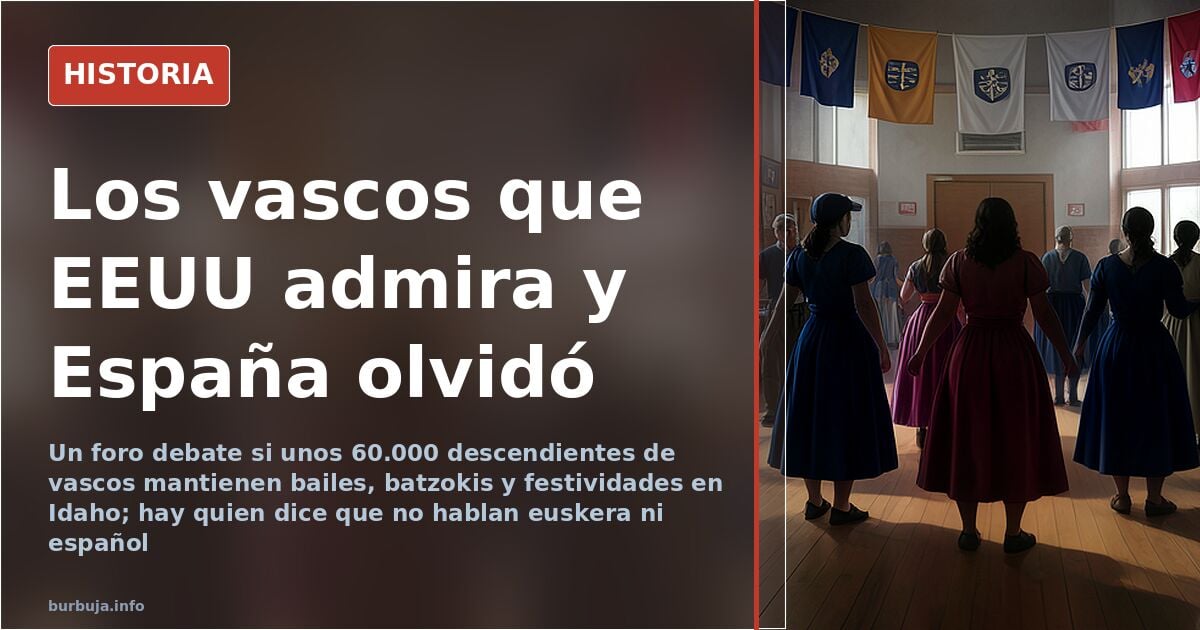
In Boise, the capital of Idaho, people dance the aurresku and hang ikurriñas (Basque flags) in social clubs that are older than many town halls in Bizkaia. The initial figures are striking: around 60,000 descendants of Basque immigrants who arrived a century ago maintain ethnocultural customs—regional dances, traditional clothing, festivities, and religion—and have their own batzokis (Basque community centers or clubs). The central thesis of the debate is that this group constitutes the only community of Spanish origin in the United States that preserves a recognizable cultural repertoire, and that promoting it as the essence of Iberian identity could challenge the Hispanic imagery associated with the country.
From Nevada shepherds to Brokeback Mountain
The documentary evidence of this migration is more than just dinner-table folklore. Robert Laxalt, a descendant of a Souletin shepherd who emigrated to Nevada, wrote "Sweet Promised Land," a chronicle of his father's life; his brother Paul became the Governor of Nevada and a Republican senator. On the Democratic side, California Congressman John Garamendi\s also has Basque roots. The literary footprint is more popular: in "Brokeback Mountain," the ranch foreman is named Joe Aguirre, and the Annie Proulx story that inspired the film is part of "Close Range: Wyoming Stories."
The settlement geography trinc a certain logic. Basque shepherds settled in the West Coast and the interior of California, as well as in the Cascadia region, according to the discussion material. It was not a spontaneous flow: it is argued that migrations were directed by the receiving country, which recruited shepherds and also brought many French Basques. In a plane crash that killed a famous boxer, two or three young French Basques were traveling toward Idaho.
The clash between myth and modern Basque politics
This is where the conversation divides. One school of thought holds that the nationalism articulated by Sabino Arana and the PNV (Basque Nationalist Party) constructed a new narrative about a pre-existing community: that the standardized language, hundreds of words, the flag, much of the folklore, and historical reinterpretations were modern inventions. The rebuttal is that the same criticism applies to any modern nation-state, and that the relevant question is not whether there was invention, but whether the result is honest or an ideological shuffle.
The contrast that most unsettles defenders of the official narrative is sociological. It is noted that a Basque person who preserves traditions in a rural area of the United States tends to vote for the right, while a Basque person who claims to think the same way in Andoain or Ordizia votes for left-wing, feminist, and multiculturalist parties. The paradox is left hanging without resolution.
Why are Basques said to be the first to arrive in America?
This attribution stems from a statement attributed to U.S. President Thomas Jefferson\s: "The first were the Basques." It is based on their status as excellent sailors, navigators, and whalers. It is a quote that circulates as symbolic reinforcement of the Basque role in the colonization of the continent, rather than as a demographic fact.
The paradox of the diaspora that does not return
The real portrait of the descendants is less epic and more prosaic. One testimony describes a Basque-American who was indistinguishable from any other American: they had never set foot in the Basque Country, spoke neither Basque nor Spanish, and their only peculiarity was being named Peio Iribar because an ancestor ended up there and the family maintained the tradition of using Basque names. Just as American as a Joe Smith.
Family ties, when they exist, are difficult to maintain. One participant recounts that two of his grandfather's uncles emigrated in the late 19th and early 20th centuries, and that during the Civil War, part of the family was able to escape thanks to those contacts, including being sheltered. They were humble shepherds established in California. Today, he maintains contact with a second cousin in Texas whose children try not to forget the legacy. The conclusion drawn is bitter: those who remained in Spain ended up emigrating too, and none of those original people remain in their ancestral lands.
The discussion concludes with the material itself. Of the 60,000 descendants who maintain batzokis, dances, and festivities in Idaho, some argue that most do not speak Basque or Spanish, have never visited the Basque Country, and vote just like any other resident of Boise. The tradition survives; the political subject one wishes to attribute to it, does not.
In Boise, the capital of Idaho, people dance the aurresku and hang ikurriñas (Basque flags) in social clubs that are older than many town halls in Bizkaia. The initial figures are striking: around 60,000 descendants of Basque immigrants who arrived a century ago maintain ethnocultural customs—regional dances, traditional clothing, festivities, and religion—and have their own batzokis (Basque community centers or clubs). The central thesis of the debate is that this group constitutes the only community of Spanish origin in the United States that preserves a recognizable cultural repertoire, and that promoting it as the essence of Iberian identity could challenge the Hispanic imagery associated with the country.
From Nevada shepherds to Brokeback Mountain
The documentary evidence of this migration is more than just dinner-table folklore. Robert Laxalt, a descendant of a Souletin shepherd who emigrated to Nevada, wrote "Sweet Promised Land," a chronicle of his father's life; his brother Paul became the Governor of Nevada and a Republican senator. On the Democratic side, California Congressman John Garamendi\s also has Basque roots. The literary footprint is more popular: in "Brokeback Mountain," the ranch foreman is named Joe Aguirre, and the Annie Proulx story that inspired the film is part of "Close Range: Wyoming Stories."
The settlement geography trinc a certain logic. Basque shepherds settled in the West Coast and the interior of California, as well as in the Cascadia region, according to the discussion material. It was not a spontaneous flow: it is argued that migrations were directed by the receiving country, which recruited shepherds and also brought many French Basques. In a plane crash that killed a famous boxer, two or three young French Basques were traveling toward Idaho.
The clash between myth and modern Basque politics
This is where the conversation divides. One school of thought holds that the nationalism articulated by Sabino Arana and the PNV (Basque Nationalist Party) constructed a new narrative about a pre-existing community: that the standardized language, hundreds of words, the flag, much of the folklore, and historical reinterpretations were modern inventions. The rebuttal is that the same criticism applies to any modern nation-state, and that the relevant question is not whether there was invention, but whether the result is honest or an ideological shuffle.
The contrast that most unsettles defenders of the official narrative is sociological. It is noted that a Basque person who preserves traditions in a rural area of the United States tends to vote for the right, while a Basque person who claims to think the same way in Andoain or Ordizia votes for left-wing, feminist, and multiculturalist parties. The paradox is left hanging without resolution.
Why are Basques said to be the first to arrive in America?
This attribution stems from a statement attributed to U.S. President Thomas Jefferson\s: "The first were the Basques." It is based on their status as excellent sailors, navigators, and whalers. It is a quote that circulates as symbolic reinforcement of the Basque role in the colonization of the continent, rather than as a demographic fact.
The paradox of the diaspora that does not return
The real portrait of the descendants is less epic and more prosaic. One testimony describes a Basque-American who was indistinguishable from any other American: they had never set foot in the Basque Country, spoke neither Basque nor Spanish, and their only peculiarity was being named Peio Iribar because an ancestor ended up there and the family maintained the tradition of using Basque names. Just as American as a Joe Smith.
Family ties, when they exist, are difficult to maintain. One participant recounts that two of his grandfather's uncles emigrated in the late 19th and early 20th centuries, and that during the Civil War, part of the family was able to escape thanks to those contacts, including being sheltered. They were humble shepherds established in California. Today, he maintains contact with a second cousin in Texas whose children try not to forget the legacy. The conclusion drawn is bitter: those who remained in Spain ended up emigrating too, and none of those original people remain in their ancestral lands.
The discussion concludes with the material itself. Of the 60,000 descendants who maintain batzokis, dances, and festivities in Idaho, some argue that most do not speak Basque or Spanish, have never visited the Basque Country, and vote just like any other resident of Boise. The tradition survives; the political subject one wishes to attribute to it, does not.
Also available in: Deutsch
Summary of a discussion on Burbuja.info - Foro de economía, actualidad y política., translated from Spanish and reviewed before publication. Read the full discussion (101 replies).
More summaries
-
Graphic wrongly claims Basque nationalism predates Rome
A chart places Basque nationalism before Rome, but historians note it emerged in the 19th century with Sabino Arana.
-
ETA and GAL: two arms of the same Gladio network in Spain
Investigation linking ETA and GAL as arms of the same NATO Gladio network, with drug trafficking funding and CIA control.
-
The history topics that bore people to tears: from the Banu Qasi to the 23F
Banu Qasi, the Cathars, World War II and Spain's 23F coup attempt top the list of historical topics that produce maximum boredom, according to a debate on how the past is taught.
-
Why Mexico should apologize: the debate that divides
Alexander von Humboldt warned that New Spain's wealth was only for the oligarchy. The debate over apologies to Spain reopens old wounds and old data.
-
Etruscans: the origins that Rome allegedly sought to erase
Archaeologists remain divided over the origins of the Etruscans, as ancient theories and modern genetic studies continue to spark debate.
-
Operation Epsom: the tank battle Normandy forgot
Two British armored divisions against three SS Panzer divisions in the Normandy bocage. Operation Epsom reveals the reality of combat without air superiority.