
Barcelona joins pact to cap weekly meat at 300 grams
Barcelona and thirteen cities pledge to limit personal meat consumption to 300 grams per week, sparking debate on health and climate.
English · Original discussion in Spanish · Published
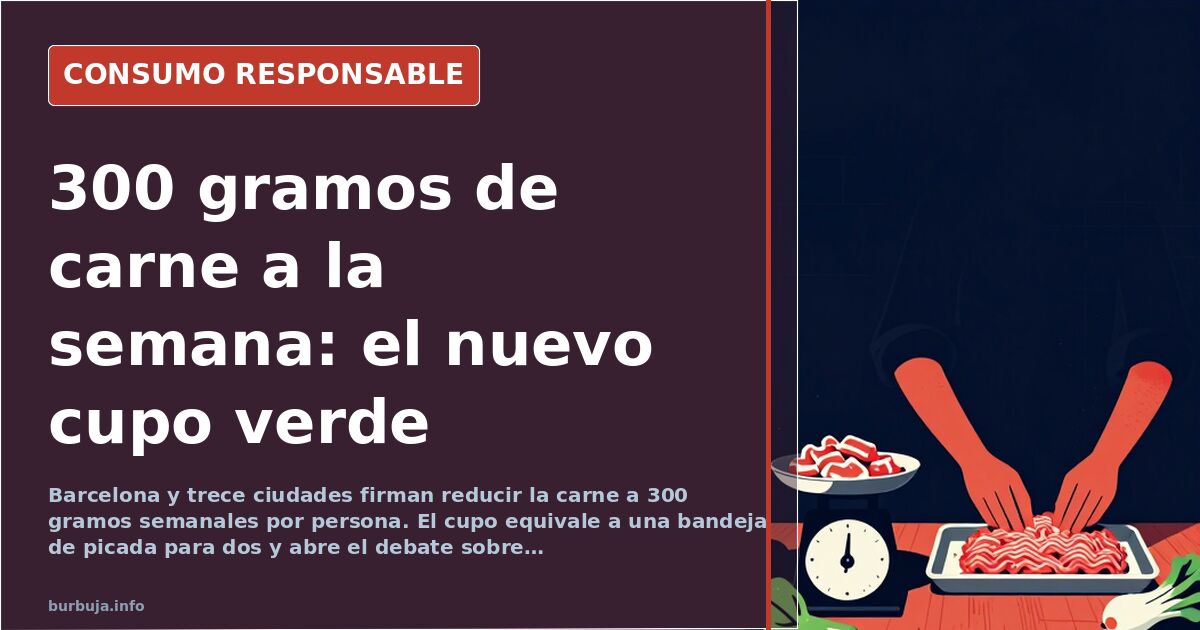
Barcelona commits to 300 grams of meat per person per week
Can a healthy diet be maintained with only 300 grams of meat a week? This question looms over the commitment signed by Barcelona alongside thirteen other cities at the Copenhagen mayors' summit (Denmark), where the "Well Fed Cities" declaration was adopted to reduce meat consumption in the fight against the climate emergency. To put it in context, this figure is half of what many households consume in a single meal: a standard tray of ground beef for a Bolognese sauce for two already uses up half the weekly quota. The issue isn't the number itself, but its implications for shopping baskets, family menus, and individual freedom to choose what goes into one's mouth.
What exactly does the Barcelona and thirteen-cities commitment say?
The "Well Fed Cities" declaration was signed at a mayors' summit held in Copenhagen and sets an indicative target of 300 grams of meat per person per week. It is not a binding regulation or a tax, but a political commitment to reduce consumption. However, the fine print remains vague: there is no control mechanism, no sanction, and no effective date. This hasn't stopped the announcement from raising alarms about how it would be implemented in practice.
The most repeated calculation in public discourse compares the figure to actual intake. A standard 300-gram tray of ground beef, used for a two-serving Bolognese, exhausts half the weekly quota. Four trays cover fourteen meals if distributed wisely, three if sandwiches are involved. And 300 grams of serrano ham can disappear into two sandwiches or a casual snack without anyone noticing.
Is a diet with only 300 grams of meat a week healthy?
There is no consensus here. One school of thought argues that animal protein is not essential and that a diet based on legumes, eggs, fish, and dairy covers needs adequately. Another counters that real substitution isn't fresh seasonal vegetables, but cheap carbohydrates: pasta, rice, bread, and pastries. The underlying argument is that those profiting from mass feeding aren't farmers, but industries converting cheap grains into cheap calories.
Skepticism extends to the environmental logic of the quota. Some ask whether 300 grams of chicken raised locally emits less than the same caloric load of papaya flown in from Indonesia. The answer isn't in the signed commitment, which doesn't address such details. Nor does it specify whether fish counts toward the 300 grams, a doubt left open in the text that completely changes the weekly menu for any coastal family.
How would it be applied: coupons, prices, or advertising?
The most frequent question concerns the mechanism. Will there be ration booklets? Coupons? Can you order pizza delivery when guests arrive? Data protection laws prevent asking about family size, so any per-person purchase control hits a legal wall before reaching the supermarket. This vacuum explains why the commitment remains a statement of intent.
The path currently being used, which requires no law, is economic. Making meat more expensive through breeding requirements, extra taxes, or complex traceability reduces consumption without banning it. The other route is advertising: medical and environmental studies, institutional campaigns on TV and in schools, promoting veganism via celebrities, and substituting products with vegan alternatives that maintain margins for large multinationals. The result is the same: less meat on the plate, more processed food on the shelf.
The post-war menu as a mirror
Historical comparison arises naturally. There was a time when the basis of diet was vegetables or legumes as a starter, meat or fish as a main course, and fruit for dessert, with offal more present than today's memory recalls. It wasn't a chosen diet; it was what existed. The difference is that then bread was better, and today animal protein has become a class marker: those who can afford it eat meat daily; those who cannot rely on carbs.
The commitment by Barcelona and the thirteen cities doesn't resolve this tension. It merely makes it visible. And it leaves an uncomfortable question: if the goal is reducing emissions, why focus on the citizen's steak rather than the transport of foods crossing the planet? For now, the answer isn't in the declaration.
Can a healthy diet be maintained with only 300 grams of meat a week? This question looms over the commitment signed by Barcelona alongside thirteen other cities at the Copenhagen mayors' summit (Denmark), where the "Well Fed Cities" declaration was adopted to reduce meat consumption in the fight against the climate emergency. To put it in context, this figure is half of what many households consume in a single meal: a standard tray of ground beef for a Bolognese sauce for two already uses up half the weekly quota. The issue isn't the number itself, but its implications for shopping baskets, family menus, and individual freedom to choose what goes into one's mouth.
What exactly does the Barcelona and thirteen-cities commitment say?
The "Well Fed Cities" declaration was signed at a mayors' summit held in Copenhagen and sets an indicative target of 300 grams of meat per person per week. It is not a binding regulation or a tax, but a political commitment to reduce consumption. However, the fine print remains vague: there is no control mechanism, no sanction, and no effective date. This hasn't stopped the announcement from raising alarms about how it would be implemented in practice.
The most repeated calculation in public discourse compares the figure to actual intake. A standard 300-gram tray of ground beef, used for a two-serving Bolognese, exhausts half the weekly quota. Four trays cover fourteen meals if distributed wisely, three if sandwiches are involved. And 300 grams of serrano ham can disappear into two sandwiches or a casual snack without anyone noticing.
Is a diet with only 300 grams of meat a week healthy?
There is no consensus here. One school of thought argues that animal protein is not essential and that a diet based on legumes, eggs, fish, and dairy covers needs adequately. Another counters that real substitution isn't fresh seasonal vegetables, but cheap carbohydrates: pasta, rice, bread, and pastries. The underlying argument is that those profiting from mass feeding aren't farmers, but industries converting cheap grains into cheap calories.
Skepticism extends to the environmental logic of the quota. Some ask whether 300 grams of chicken raised locally emits less than the same caloric load of papaya flown in from Indonesia. The answer isn't in the signed commitment, which doesn't address such details. Nor does it specify whether fish counts toward the 300 grams, a doubt left open in the text that completely changes the weekly menu for any coastal family.
How would it be applied: coupons, prices, or advertising?
The most frequent question concerns the mechanism. Will there be ration booklets? Coupons? Can you order pizza delivery when guests arrive? Data protection laws prevent asking about family size, so any per-person purchase control hits a legal wall before reaching the supermarket. This vacuum explains why the commitment remains a statement of intent.
The path currently being used, which requires no law, is economic. Making meat more expensive through breeding requirements, extra taxes, or complex traceability reduces consumption without banning it. The other route is advertising: medical and environmental studies, institutional campaigns on TV and in schools, promoting veganism via celebrities, and substituting products with vegan alternatives that maintain margins for large multinationals. The result is the same: less meat on the plate, more processed food on the shelf.
The post-war menu as a mirror
Historical comparison arises naturally. There was a time when the basis of diet was vegetables or legumes as a starter, meat or fish as a main course, and fruit for dessert, with offal more present than today's memory recalls. It wasn't a chosen diet; it was what existed. The difference is that then bread was better, and today animal protein has become a class marker: those who can afford it eat meat daily; those who cannot rely on carbs.
The commitment by Barcelona and the thirteen cities doesn't resolve this tension. It merely makes it visible. And it leaves an uncomfortable question: if the goal is reducing emissions, why focus on the citizen's steak rather than the transport of foods crossing the planet? For now, the answer isn't in the declaration.
Also available in: Deutsch
Summary of a discussion on Burbuja.info - Foro de economía, actualidad y política., translated from Spanish and reviewed before publication. Read the full discussion (131 replies).
More summaries
-
Best red wine for Spanish ham: from €8 Protos to Remelluri
Forum users recommend wines under €10, suggesting soft reds or Jerez finos instead of powerful reserves.
-
Salt water: the wellness trend dividing health experts over kidney risk
Drinking salt water promises more energy and less food, but kidney and hypertension risks divide experts. Data, testimonials and the science behind it…
-
Cádiz rentals: €600 budget, no car, an impossible task
Finding long-term rental in Cádiz coast with €600 and no car is nearly impossible. The debate highlights prices, areas, and exclusions.
-
Cruzcampo: Spoiled Kegs Fuel North-South Beer War
Unpasteurized Cruzcampo kegs sour in two days, causing taste differences between Seville and Madrid due to low rotation rates.
-
Danish homes for €79,000: The hidden conditions
Housing in Jutland costs €79,000. While the price is real, it requires effective residency, a CPR number, and living there year-round.
-
Spanish Medieval Markets: Inflated Prices and Fake Crafts
35 euros for tiny octopus, stalls costing up to 6,000 euros, and goods from Cobo Calleja. An economic look at Spain's medieval markets.