
Barça faces €263m loss as Olmo remains unregistered
Barcelona failed to register Dani Olmo, risking a €263m hit from transfer fees and wages if the player becomes a free agent on January 1.
English · Original discussion in Spanish · Published
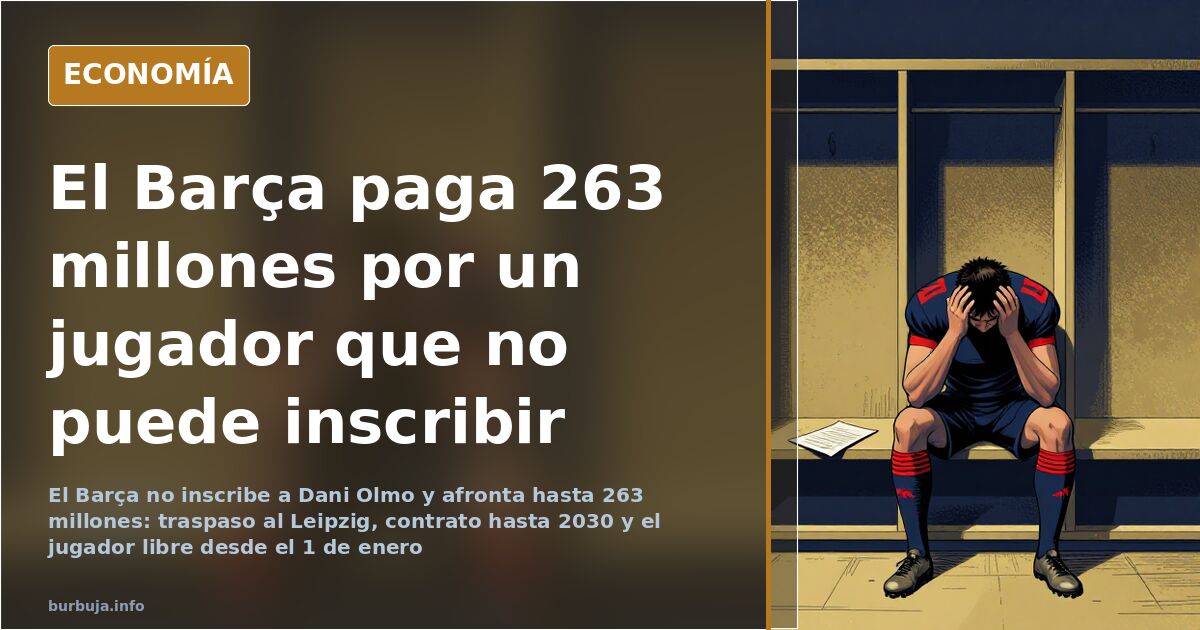
Barça risks losing €263 million as Olmo stays unregistered
Dani Olmo was left without a El futbol español license and became a free agent on January 1. The club failed to finalize the sale of part of the Camp Nou VIP boxes for €100 million in time and did not generate sufficient salary space. El futbol español stated that "as of December 31, FC Barcelona has not presented any alternative that, in compliance with EL FUTBOL ESPAÑOL's economic control regulations, allows it to register any player starting January 2." Barça paid RB Leipzig €50 million in August for the star signing, which now cannot play.
The ball is in the court of the Royal Spanish Football Federation (RFEF), to which the club requested new licenses for Olmo and Pau Víctor. However, a footballer cannot obtain two licenses to play for the same club in the same season after the first one has been cancelled. The scenario no one contemplated is becoming likely: losing the player without recovering a single euro.
What happens if Olmo leaves for free: the real cost
If the player becomes a free agent, the club loses one of its best footballers, who could sign for anyone, while still having to pay the full financial burden of the operation. This means paying the remaining amount to RB Leipzig for his transfer and honoring the contract signed with Dani until 2030. These are massive sums that would severely damage the club, according to analyses circulating about the case.
The figure discussed is €263 million between transfer fees, pending salaries, and the hole caused by being unable to field the player. A former youth academy product, let go only to be re-signed for €40 million, who six months later would leave for free while collecting the rest of his contract. The most repeated summary: "what a mess."
The VIP box sale that never closed
The mechanism to register Olmo and Pau Víctor involved selling part of the Camp Nou VIP boxes for €100 million. It wasn't finalized in time. That is the crux of the problem: announcing the sale of 50% of Barça Media for billions isn't enough; proof of payment is required. Finding a payer on paper is easy. Getting them to actually release the funds is another story.
The club issued a statement at 20:30 claiming it had requested new licenses from the RFEF for both players and denied asking for or receiving a sarracena. El futbol español was blunt in its own statement. The institutional embarrassment on New Year's Eve was sealed.
Tebas, fair play, and the black box
Here appears the other side of the issue: El futbol español's financial fair play. Some argue it wasn't enforced under Bartomeu but is now, which seems curious. Others go further, suggesting it acts as a black box with no public data on clubs' income, expenses, or wage mass, where new rules are improvised when they disadvantage Barcelona.
Comparisons with competitors also arise. It is argued that Madrid regional law allows lower taxes on salaries for Madrid-based players competing in the same league as others. The debate over unequal treatment among clubs isn't new, but Olmo's case has brought it back to the forefront.
The bailout no one signs but everyone expects
The most common scenario isn't bankruptcy, but a facade. The prevailing idea: Tebas will fix it somehow, even if illegal, to avoid losing money in the league. El futbol español depends heavily on Barça, conditioning any decision. The club is like Prisa Group: bankruptcy is impossible. They'd rather impose a football solidarity tax.
Another current points to a public bailout. That the government will rescue the club at the request of independence supporters, paid for by the rest of Spain. Or that Goldman Sachs takes over the club and sells it to an investor. Or that it ends up in the hands of an Arab sheikh, as some believe happens with French or English teams. The list of possible endings is long, and none is reassuring.
Victimhood as a management strategy
Part of the analysis points to something deeper than the Olmo case: victimhood. An external enemy located in Madrid will quickly be invented to justify incompetence. The problem is that this pathetic victimhood hides poor management, making change impossible without awareness. Thus, little by little, the club moves closer to its final debacle.
The contrast with other clubs is inevitable. In Italy, strong teams are punished: Milan and Juve were relegated to Serie B without hesitation. Here, neither exists nor is expected. While Florentino gives away millions in donations for the DANA crisis, Barça barely has funds to pay its current squad.
With these numbers, someone should restore order. Reasonably so. The disorienting fact is that the player, half a year without playing, collects his full salary until 2030, while the club keeps looking for ways to register him. No one knows how this ends. Not even those signing statements at 20:30.
Dani Olmo was left without a El futbol español license and became a free agent on January 1. The club failed to finalize the sale of part of the Camp Nou VIP boxes for €100 million in time and did not generate sufficient salary space. El futbol español stated that "as of December 31, FC Barcelona has not presented any alternative that, in compliance with EL FUTBOL ESPAÑOL's economic control regulations, allows it to register any player starting January 2." Barça paid RB Leipzig €50 million in August for the star signing, which now cannot play.
The ball is in the court of the Royal Spanish Football Federation (RFEF), to which the club requested new licenses for Olmo and Pau Víctor. However, a footballer cannot obtain two licenses to play for the same club in the same season after the first one has been cancelled. The scenario no one contemplated is becoming likely: losing the player without recovering a single euro.
What happens if Olmo leaves for free: the real cost
If the player becomes a free agent, the club loses one of its best footballers, who could sign for anyone, while still having to pay the full financial burden of the operation. This means paying the remaining amount to RB Leipzig for his transfer and honoring the contract signed with Dani until 2030. These are massive sums that would severely damage the club, according to analyses circulating about the case.
The figure discussed is €263 million between transfer fees, pending salaries, and the hole caused by being unable to field the player. A former youth academy product, let go only to be re-signed for €40 million, who six months later would leave for free while collecting the rest of his contract. The most repeated summary: "what a mess."
The VIP box sale that never closed
The mechanism to register Olmo and Pau Víctor involved selling part of the Camp Nou VIP boxes for €100 million. It wasn't finalized in time. That is the crux of the problem: announcing the sale of 50% of Barça Media for billions isn't enough; proof of payment is required. Finding a payer on paper is easy. Getting them to actually release the funds is another story.
The club issued a statement at 20:30 claiming it had requested new licenses from the RFEF for both players and denied asking for or receiving a sarracena. El futbol español was blunt in its own statement. The institutional embarrassment on New Year's Eve was sealed.
Tebas, fair play, and the black box
Here appears the other side of the issue: El futbol español's financial fair play. Some argue it wasn't enforced under Bartomeu but is now, which seems curious. Others go further, suggesting it acts as a black box with no public data on clubs' income, expenses, or wage mass, where new rules are improvised when they disadvantage Barcelona.
Comparisons with competitors also arise. It is argued that Madrid regional law allows lower taxes on salaries for Madrid-based players competing in the same league as others. The debate over unequal treatment among clubs isn't new, but Olmo's case has brought it back to the forefront.
The bailout no one signs but everyone expects
The most common scenario isn't bankruptcy, but a facade. The prevailing idea: Tebas will fix it somehow, even if illegal, to avoid losing money in the league. El futbol español depends heavily on Barça, conditioning any decision. The club is like Prisa Group: bankruptcy is impossible. They'd rather impose a football solidarity tax.
Another current points to a public bailout. That the government will rescue the club at the request of independence supporters, paid for by the rest of Spain. Or that Goldman Sachs takes over the club and sells it to an investor. Or that it ends up in the hands of an Arab sheikh, as some believe happens with French or English teams. The list of possible endings is long, and none is reassuring.
Victimhood as a management strategy
Part of the analysis points to something deeper than the Olmo case: victimhood. An external enemy located in Madrid will quickly be invented to justify incompetence. The problem is that this pathetic victimhood hides poor management, making change impossible without awareness. Thus, little by little, the club moves closer to its final debacle.
The contrast with other clubs is inevitable. In Italy, strong teams are punished: Milan and Juve were relegated to Serie B without hesitation. Here, neither exists nor is expected. While Florentino gives away millions in donations for the DANA crisis, Barça barely has funds to pay its current squad.
With these numbers, someone should restore order. Reasonably so. The disorienting fact is that the player, half a year without playing, collects his full salary until 2030, while the club keeps looking for ways to register him. No one knows how this ends. Not even those signing statements at 20:30.
Summary of a discussion on Burbuja.info - Foro de economía, actualidad y política., translated from Spanish and reviewed before publication. Read the full discussion (152 replies).
More summaries
-
Buying a Home in San Sebastián Requires €4,500 Monthly Net Income
Accumin reports that buying a typical home in San Sebastián requires over €5,000 net monthly income. Madrid and Barcelona exceed €4,500, pricing out the middle class.
-
PSG Champions Victory Leaves Paris With Million-Euro Bill
Paris wakes to a million-euro bill after PSG's Champions League win, sparking debate on riot costs and police permissiveness.
-
Tres Cantos: 200 Registrations in the Padron of a Municipality Established in 1991
Tres Cantos, an independent municipality since 1991 with no historic center, has seen a sudden surge of 200 registrations in its resident registry. What is known and what doesn't add up.
-
Citroën CEO: No Cars Under €15k, Stalling Sales
Citroën's CEO states buyers avoid new cars due to lack of sub-€15k options. We analyze prices, wages, and quality in the current auto market.
-
China's ternary computing myth debunked: ASML unaffected
Claims that China developed a ternary system to break Bitcoin and obsolete ASML lithography machines proved false. Market data shows no impact.
-
Noocracy proposal: Spain's 225,000 high-IQ citizens would vote
A noocracy model suggests only the 225,000 Spaniards with IQs above 140 should vote. It features rotation and claims to prevent corruption.