
Barbershop Prices: 7 to 13 Euros, But Do They Cut What You Ask?
Haircuts range from 7 to 13 euros, but the real issue isn't the price—it's whether they actually cut what you asked for.
English · Original discussion in Spanish · Published
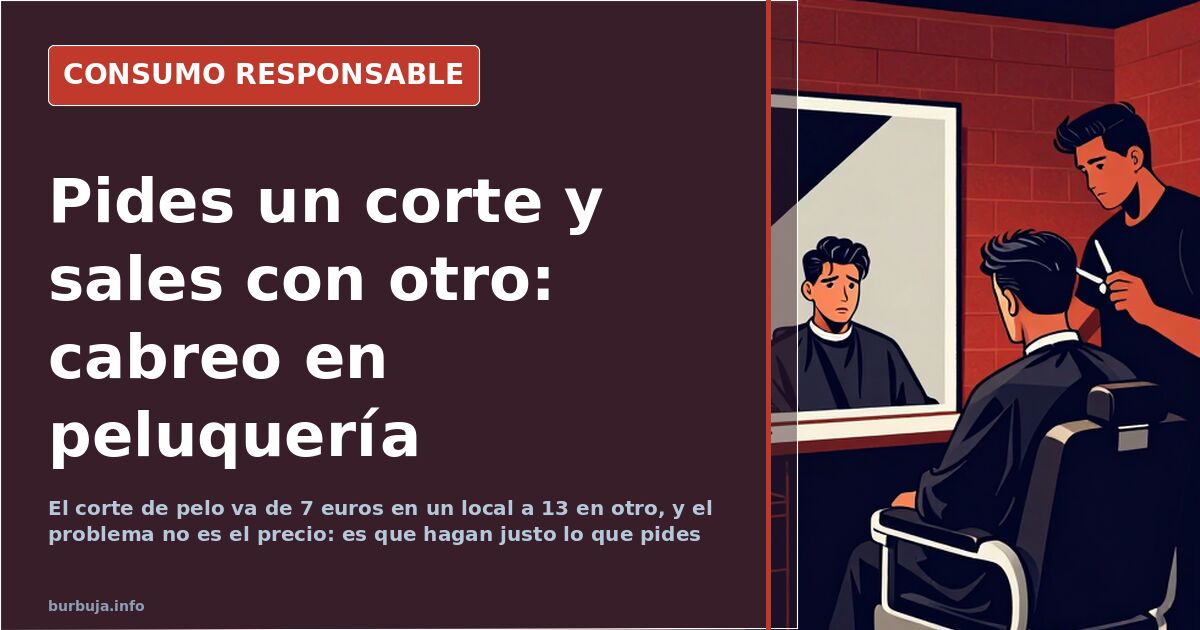
The cut is non-negotiable: 7 to 13 euros depending on the salon
Why do you leave the salon with the hair you didn't ask for, a lighter wallet, and the feeling that you argued for nothing? The complaint is old and universal: you request a specific cut, the professional suggests another, insists, and the result looks little like what you entered asking for. The anger comes not so much from the snip as from realizing your opinion on your own hair weighs less than the stylist's whim.
The trigger is almost always the same. Someone enters half-asleep, asks for the usual, and leaves with a fade "so you can style it later," meaning a solution designed for the professional's taste, not the client's. The sequence repeats: the unsolicited advice, the argument, the half-cut, and an extra expense at another shop to fix it. The cost of the second attempt is 12 euros.
You ask for one thing and they do what they feel like
The pattern described is not an isolated error; it is a way of working. You enter with a clear instruction and leave with the cutter's interpretation, adorned with unsolicited advice on creams and fixatives. The dominant reaction is to demand the order be fulfilled: the payer decides, and styling is their problem. It's not a preference, it's the order.
The complaint extends to forced conversation. Several accounts agree on the profile of the professional who doesn't shut up, who fills the visit with empty chatter and teaches nothing. For some, this weighs as much as the cut, adding a time cost that doesn't appear on the bill. The practical conclusion repeated: better a simple, unadorned salon, because the overloaded shop already warns of what awaits inside.
How much does a haircut cost: 7 to 13 euros
The price appears as the great equalizer. The range used by those comparing shops goes from the lowest fee to the best-paid cut:
The difference between extremes is around six euros per session. Translated to someone who goes twice a year, the savings hardly matter; for someone who goes every few weeks, it stops being pocket change. Cheap sometimes doesn't obey and expensive doesn't always hit, so the price variable takes a back seat to getting what was requested.
The exit: fixed hairdresser or own scissors
Faced with disappointment, two paths. The first, finding someone trustworthy and sticking with them: you endure the suggestion on the first visit, stand firm on your own, and by the third they stop asking. The second, more radical, dispensing with the service. Some have gone 20 years without stepping into a salon, cutting in layers and dry, convinced the result is indistinguishable from a professional's. A portion of those who practice it summarizes it thus: "I've gone about 20 years without stepping into a salon, I cut it myself in layers and dry, I assure you even hairdressers can't tell the difference."
Loyalty works when the shop doesn't change hands. One cited case spans 40 years in the same barbershop, until the owner's retirement and a final, almost clandestine cut. When the owner retires or the successor strikes with the comb, the bond breaks and the pilgrimage resumes. The looming question is evident: if your hairdresser retires when you still have hair, what do you do for the next twenty years?
From hair to vaccines: the drift of conversation
What started as an outlet about cuts ended drifting into unrelated territory. Part of the conversation jumped to breastfeeding, with claims about bottles and development that lack health backing. Another drifted toward vaccines, where unsupported theses were held about alleged vaccine effects against those defending vaccination citing data from the World Health Organization. None of those claims are backed by evidence.
It is best to separate this from the central issue. The discomfort with the salon is a reasonable consumer complaint; the digressions on health reproduce rumors that shouldn't be mixed. The useful part is the unfulfilled order, not the improvised clinic.
How to avoid the second cut and the extra cost
The operational summary is simple and repeated with few variations. Choose an unpretentious shop, explain the cut once firmly, and don't yield to the first suggestion. If the professional persists, switch. If the problem is the treatment and not the snip, consider cutting your own hair: clipper at two or three on the sides, scissors on top, and on to other things.
The neighborhood barbershop of old—the radio on, dry treatment, contained price—continues to be cited as the lost ideal. Finding one is increasingly difficult, and more so when the one who ran it has already retired.
With the clipper in hand and the price list in mind, maybe it turns out that the best hairdresser in the neighborhood is the bathroom mirror.
Why do you leave the salon with the hair you didn't ask for, a lighter wallet, and the feeling that you argued for nothing? The complaint is old and universal: you request a specific cut, the professional suggests another, insists, and the result looks little like what you entered asking for. The anger comes not so much from the snip as from realizing your opinion on your own hair weighs less than the stylist's whim.
The trigger is almost always the same. Someone enters half-asleep, asks for the usual, and leaves with a fade "so you can style it later," meaning a solution designed for the professional's taste, not the client's. The sequence repeats: the unsolicited advice, the argument, the half-cut, and an extra expense at another shop to fix it. The cost of the second attempt is 12 euros.
You ask for one thing and they do what they feel like
The pattern described is not an isolated error; it is a way of working. You enter with a clear instruction and leave with the cutter's interpretation, adorned with unsolicited advice on creams and fixatives. The dominant reaction is to demand the order be fulfilled: the payer decides, and styling is their problem. It's not a preference, it's the order.
The complaint extends to forced conversation. Several accounts agree on the profile of the professional who doesn't shut up, who fills the visit with empty chatter and teaches nothing. For some, this weighs as much as the cut, adding a time cost that doesn't appear on the bill. The practical conclusion repeated: better a simple, unadorned salon, because the overloaded shop already warns of what awaits inside.
How much does a haircut cost: 7 to 13 euros
The price appears as the great equalizer. The range used by those comparing shops goes from the lowest fee to the best-paid cut:
- Salon run by people of Chinese origin: 7 euros
- Spanish hairdresser: 11 euros
- Hairdresser of Colombian origin: 12 euros
- Maghrebi hairdresser: 9 euros, plus a 1 euro tip
- Romanian hairdresser: 13 euros for hair and 12 for beard
The difference between extremes is around six euros per session. Translated to someone who goes twice a year, the savings hardly matter; for someone who goes every few weeks, it stops being pocket change. Cheap sometimes doesn't obey and expensive doesn't always hit, so the price variable takes a back seat to getting what was requested.
The exit: fixed hairdresser or own scissors
Faced with disappointment, two paths. The first, finding someone trustworthy and sticking with them: you endure the suggestion on the first visit, stand firm on your own, and by the third they stop asking. The second, more radical, dispensing with the service. Some have gone 20 years without stepping into a salon, cutting in layers and dry, convinced the result is indistinguishable from a professional's. A portion of those who practice it summarizes it thus: "I've gone about 20 years without stepping into a salon, I cut it myself in layers and dry, I assure you even hairdressers can't tell the difference."
Loyalty works when the shop doesn't change hands. One cited case spans 40 years in the same barbershop, until the owner's retirement and a final, almost clandestine cut. When the owner retires or the successor strikes with the comb, the bond breaks and the pilgrimage resumes. The looming question is evident: if your hairdresser retires when you still have hair, what do you do for the next twenty years?
From hair to vaccines: the drift of conversation
What started as an outlet about cuts ended drifting into unrelated territory. Part of the conversation jumped to breastfeeding, with claims about bottles and development that lack health backing. Another drifted toward vaccines, where unsupported theses were held about alleged vaccine effects against those defending vaccination citing data from the World Health Organization. None of those claims are backed by evidence.
It is best to separate this from the central issue. The discomfort with the salon is a reasonable consumer complaint; the digressions on health reproduce rumors that shouldn't be mixed. The useful part is the unfulfilled order, not the improvised clinic.
How to avoid the second cut and the extra cost
The operational summary is simple and repeated with few variations. Choose an unpretentious shop, explain the cut once firmly, and don't yield to the first suggestion. If the professional persists, switch. If the problem is the treatment and not the snip, consider cutting your own hair: clipper at two or three on the sides, scissors on top, and on to other things.
The neighborhood barbershop of old—the radio on, dry treatment, contained price—continues to be cited as the lost ideal. Finding one is increasingly difficult, and more so when the one who ran it has already retired.
With the clipper in hand and the price list in mind, maybe it turns out that the best hairdresser in the neighborhood is the bathroom mirror.
Also available in: Deutsch
Summary of a discussion on Burbuja.info - Foro de economía, actualidad y política., translated from Spanish and reviewed before publication. Read the full discussion (226 replies).
More summaries
-
DIY Haircuts: Real Savings or Aesthetic Risk?
We analyze the actual savings of cutting hair at home versus aesthetic risks. Is the effort worth it?
-
Cheap Child-Rearing: The Myth and Reality of the Low-Cost Lifestyle
Raising children can save €1,500 in the first year through breastfeeding and co-sleeping, but it requires sacrificing one salary. The debate between responsible consumption and career trade-offs.
-
Turn off the TV and read: how to live without losing your health or your mind
Turn off the TV, read books and tend a vegetable garden: the domestic recipe gaining fans for stress-free living in an increasingly toxic environment.
-
Lidl's frozen sardines at €3.90/kg vs. fresh ones
A kilo of frozen sardines costs €3.90 compared to €9-€10 for fresh ones in Madrid. The question is whether the flavor holds up after freezing.
-
Bluetooth Headphones: The Comfort Scam Exposed
Are Bluetooth headphones worth it? We analyze price, sound quality, battery life, and health risks. Data suggests wired options still win.
-
Andreu Bacardit Promises Free Energy, Raising Fraud Concerns
The Onion Project claims infinite clean energy, but its promoter has a history of failed products. We analyze the red flags and potential scam patterns.