
Baños and Gisbert: from 'unlikely war' to a nuclear joke
A livestream with Colonel Baños ends in jokes about a tactical nuclear strike, while his criticism of Russian propaganda backfires
English · Original discussion in Spanish · Published
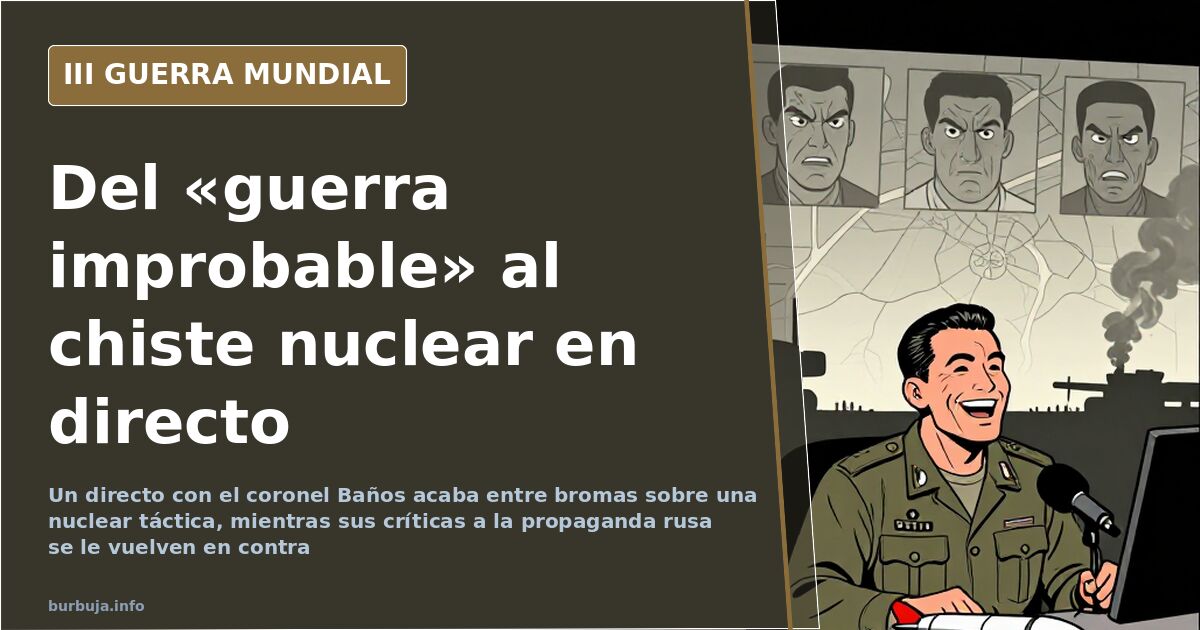
From 'unlikely war' to a live nuclear joke
Live on air, on the channel of a well-known commentator, someone sitting at the table voices the wish that Russia launch a tactical nuclear weapon 'so that everyone understands this war must end.' No one cuts the broadcast. They laugh. At that same table sits Colonel Pedro Baños, former military officer and regular pundit on geopolitical analysis shows, who days before the conflict began assured that a Russian invasion of Ukraine was highly unlikely. The scene, as related by those who watched the broadcast, sums up quite well the state of a genre: studio experts who have not collected on a single prediction since February 2022.
What is really being debated when Colonel Baños is debated
The figure provokes two incompatible reactions. For some, he is the one who best reads the available public information and who warned of the conflict's consequences before it broke out; for others, he is a peddler of narrative who has built his brand on the war. The figure most circulated against him is that of his paid courses and subscriptions, priced at 500 euros, and his intensive use of controversy as a draw. His military rank, far from settling the debate, fuels it: an ordinary analyst is not the same as a colonel speaking with presumed institutional authority.
The prediction that aged badly
Days before the invasion, he called the scenario highly unlikely and mocked those who took it as certain. According to his critics' reconstruction, he called those who maintained Russia would attack 'fools' and reassured his audience on the eve of the offensive. His defenders qualify this: he never ruled out war, warned of its consequences for months, and the earlier barrage of official warnings about an 'imminent invasion' had turned the forecast into a joke. The nuance matters, and a lot: getting a scenario wrong does not disqualify anyone; invoking rank as proof of authority does.
The autumn that never became a catastrophe
On the debit side, predictions pile up about a European winter of scarcity and severe energy shortages that never materialized. That contrast, between the apocalyptic tone and a much milder reality, is the argument that most wears down commentators who made permanent alarm their format. When the announced catastrophe does not arrive, the one left exposed is the one who announced it. And on a subject where everyone looks at the same public data, the margin for costly error is narrow.
A channel that sells and an audience that applauds
The show's host is placed in the most militant pro-Russian spectrum, and the tone of the livestream itself — jokes about nuclear escalation, complicity with the Kremlin's narrative — reinforces that label. What stands out is the asymmetry of the response: videos with the most controversial theses accumulate favorable comments, there is barely any pushback, and the whole thing works as a perfect business. Some explain it by aggressive moderation; others attribute it to a community that buys the narrative, the course, and the subscription without asking for a refund.
Rank, reserve status and public pay
A good part of the conversation drifted toward a detail of military career. Moving to the reserve does not eliminate the rank: the title of colonel is still used. And that status carries with it a public salary, according to those familiar with military careers, so a retired former military officer would not, in theory, need the income from the show. 2012 is even mentioned as the year he was left out of a promotion and moved away from the post he wanted. From there to claiming his media crusade is a personal vendetta is a long way.
From geostrategy guru to nuclear wish
The climax comes at the end of the program. A fellow panelist voices aloud the wish for a tactical nuclear launch, to the laughter of those present. The man who had built his prestige on the idea that Moscow was playing with an advantage and the West was sold out ends the evening laughing at the only escalation no one can control. There is no correction, no nuance, no expert. Just three people having a good time while the audience paying 500 euros watches from outside.
Where does that leave the analysis
The underlying discussion is uncomfortable for everyone. If a commentator with rank gets it wrong and keeps billing, the problem is not his: it is that of an ecosystem where the audience rewards certainty and punishes doubt. Those who get it right by chance do not come off much better. As long as the livestream remains online and the course remains on sale, the controversy has a future, and the disconcerting fact is not the nuclear joke: it is that four years later the table is still filling up.
Live on air, on the channel of a well-known commentator, someone sitting at the table voices the wish that Russia launch a tactical nuclear weapon 'so that everyone understands this war must end.' No one cuts the broadcast. They laugh. At that same table sits Colonel Pedro Baños, former military officer and regular pundit on geopolitical analysis shows, who days before the conflict began assured that a Russian invasion of Ukraine was highly unlikely. The scene, as related by those who watched the broadcast, sums up quite well the state of a genre: studio experts who have not collected on a single prediction since February 2022.
What is really being debated when Colonel Baños is debated
The figure provokes two incompatible reactions. For some, he is the one who best reads the available public information and who warned of the conflict's consequences before it broke out; for others, he is a peddler of narrative who has built his brand on the war. The figure most circulated against him is that of his paid courses and subscriptions, priced at 500 euros, and his intensive use of controversy as a draw. His military rank, far from settling the debate, fuels it: an ordinary analyst is not the same as a colonel speaking with presumed institutional authority.
The prediction that aged badly
Days before the invasion, he called the scenario highly unlikely and mocked those who took it as certain. According to his critics' reconstruction, he called those who maintained Russia would attack 'fools' and reassured his audience on the eve of the offensive. His defenders qualify this: he never ruled out war, warned of its consequences for months, and the earlier barrage of official warnings about an 'imminent invasion' had turned the forecast into a joke. The nuance matters, and a lot: getting a scenario wrong does not disqualify anyone; invoking rank as proof of authority does.
The autumn that never became a catastrophe
On the debit side, predictions pile up about a European winter of scarcity and severe energy shortages that never materialized. That contrast, between the apocalyptic tone and a much milder reality, is the argument that most wears down commentators who made permanent alarm their format. When the announced catastrophe does not arrive, the one left exposed is the one who announced it. And on a subject where everyone looks at the same public data, the margin for costly error is narrow.
A channel that sells and an audience that applauds
The show's host is placed in the most militant pro-Russian spectrum, and the tone of the livestream itself — jokes about nuclear escalation, complicity with the Kremlin's narrative — reinforces that label. What stands out is the asymmetry of the response: videos with the most controversial theses accumulate favorable comments, there is barely any pushback, and the whole thing works as a perfect business. Some explain it by aggressive moderation; others attribute it to a community that buys the narrative, the course, and the subscription without asking for a refund.
Rank, reserve status and public pay
A good part of the conversation drifted toward a detail of military career. Moving to the reserve does not eliminate the rank: the title of colonel is still used. And that status carries with it a public salary, according to those familiar with military careers, so a retired former military officer would not, in theory, need the income from the show. 2012 is even mentioned as the year he was left out of a promotion and moved away from the post he wanted. From there to claiming his media crusade is a personal vendetta is a long way.
From geostrategy guru to nuclear wish
The climax comes at the end of the program. A fellow panelist voices aloud the wish for a tactical nuclear launch, to the laughter of those present. The man who had built his prestige on the idea that Moscow was playing with an advantage and the West was sold out ends the evening laughing at the only escalation no one can control. There is no correction, no nuance, no expert. Just three people having a good time while the audience paying 500 euros watches from outside.
Where does that leave the analysis
The underlying discussion is uncomfortable for everyone. If a commentator with rank gets it wrong and keeps billing, the problem is not his: it is that of an ecosystem where the audience rewards certainty and punishes doubt. Those who get it right by chance do not come off much better. As long as the livestream remains online and the course remains on sale, the controversy has a future, and the disconcerting fact is not the nuclear joke: it is that four years later the table is still filling up.
Summary of a discussion on Burbuja.info - Foro de economía, actualidad y política., translated from Spanish and reviewed before publication. Read the full discussion (114 replies).
More summaries
-
The 73-year-old Valencian pensioner held by Russia in Ukraine
Mario García, a 73-year-old Valencian pensioner, is the first Spaniard captured by Russian troops in Ukraine. Relatives confirmed it in Kherson.
-
German Ex-General: "Ukraine is a US-Russia Power Struggle"
A German ex-general views the Ukraine war as a power play between the US and Russia, with little movement on the front lines for over a year.
-
Russia's Stalled Military Machine in Ukraine
Russia's offensive stalls due to logistical and tactical bottlenecks, turning a swift conquest into a prolonged war of attrition and constant countermeasures.
-
Ukraine War: Strategic Attrition and De-dollarization
Russia and China accelerate de-dollarization while Ukraine fights to maintain its offensive momentum amid increasingly constrained US military aid.
-
Ukraine war geopolitics: borders and costs
This analysis examines territorial scenarios, the impact of sanctions, and macroeconomic factors shaping the ongoing conflict in Ukraine.
-
Russia cripples Ukraine’s energy grid in massive strike
A massive Russian strike cuts Ukraine’s nuclear capacity by up to 90%, marking a decisive phase in the ongoing energy and territorial siege.