
Bank safe deposit boxes and inheritance: what Spain's tax office can actually see
Safe deposit boxes must be declared in an inheritance, and gold without an invoice cannot be sold without leaving a trail. Tax savings exist, but not where people think.
English · Original discussion in Spanish · Published
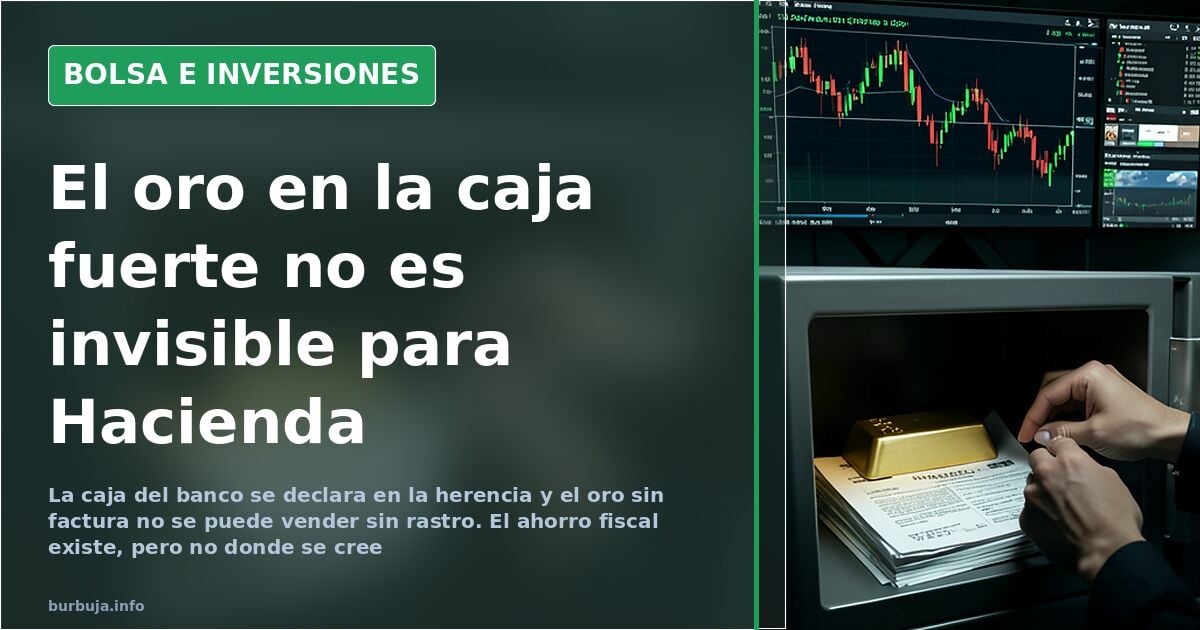
Gold in a bank safe deposit box doesn't erase the invoice or the tax
The promise sounds perfect: leave gold and silver bars in a bank safe deposit box and the heir escapes Inheritance Tax. The problem is that a safe deposit box is not a fiscal black hole. The box must be declared as part of the estate and, although in practice its contents are not routinely inspected, the metal still has an owner, an invoice and a paper trail. The trap is not at the bank: it lies in what happens afterwards, when the heir tries to turn that gold into cash.
What happens when the heir wants to sell the gold
The first wall appears at the shop. A gold buyer records the transaction with the seller's tax ID, and, as argued in the debate, no serious shop buys metal without an invoice: a single stolen piece can ruin the business and bring the police to the counter. Without an invoice, the heir is at the mercy of informal middlemen. With an invoice, the trail leads straight to the tax office.
The second wall is cash. Selling through the opaque circuit means getting paid in banknotes, and banknotes have a practical ceiling: you cannot buy anything over 1,000 euros without leaving a record. For large amounts, the problem is not getting paid, it's spending the money.
The invoice the dealer kept twenty years ago
Another myth falls here: that the paper invoice disappears and with it the trail. Invoices are entered in the company's digital ledger, mandatory for more than two decades now. Even if the customer throws away their copy, the transaction remains on record. And with precious metals, according to one participant, the cross-checking goes further: it is recorded as an import and export within the EU, so the final destination country is identified. Buying in a European shop doesn't remove the trail; buying in Andorra or Dubai does make it harder, at the cost of paying VAT at customs if it's silver.
The company route: legal, with fine print
The alternative that does circulate with some basis is the company. The metal is bought through a company and transferred by selling the shares, not the metal: this avoids Inheritance Tax and also Property Transfer Tax on real estate. There are conditions. The metal should not exceed 50% of the company's total assets or the setup looks shaky, and taxes arrive all the same when the metal is sold. It's planning, not magic.
Household goods, jewellery and the Catalan precedent
Against the bullion, the comparison with jewellery and household goods comes up: in Catalonia, an inheritance of this kind was settled with a payment of 2,500 euros for the household goods, according to those who lived it. Hence the idea that it might be better to buy jewellery than bullion. The difference is in tax treatment, not in hiding.
Wealth tax and the tax office's AI
The scenario that emerges for declared metal is uncomfortable: if the bar was bought in a shop, the tax office knows it exists, and it falls under Wealth Tax. Not declaring it amounts to saying it doesn't exist or that it's stolen. And declaring what was never declared comes with surcharges that can range from 30% to half. Add to that the antiestéticar of a sales ban, a specific tax on the metal, or tougher data cross-checking with automated tools. None of that is confirmed; it's the risk being weighed up.
The pattern repeats: gold protects against monetary whims, not against the taxman. The safe keeps the metal. It doesn't keep quiet.
What good is an heir with access to the safe if every gram they sell requires explaining where it came from?
Also available in: Deutsch
Summary of a discussion on Burbuja.info - Foro de economía, actualidad y política., translated from Spanish and reviewed before publication. Read the full discussion (79 replies).
More summaries
-
Inheritance tax in Andalusia, Spain: how to pay less when you inherit
A €500,000 estate, three children and a sister who died years earlier: the calculation that brings inheritance tax down to zero and the steps you cannot skip.
-
Inheritance tax in Spain: how to pay less when you inherit
Spain's inheritance tax is paid twice per family. Madrid grants a 99% rebate, Galicia exempts up to 125,000 euros, and Asturias offers no relief. Here are the options.
-
Spain's tax agency 'never investigates' those who don't pay taxes
A tweet claims a company linked to the partner of a PSOE (Spanish Socialist Party) official has gone five years without paying taxes and has amassed 13.3 million euros in rental income.
-
€140 million: fixed-term deposits, dividends or Switzerland
€140 million in fixed-term deposits at 4.25% would generate €400,000 net a month, according to one simulation. Another calculation gives €112,000. The difference matters.
-
140,000 euros with no mortgage or property: where to put them
140,000 euros from a property sale: Treasury bills at 3%, deposits at 3.35%, short-term fixed income funds at 4.2% or dividends. The map of returns without…
-
Spain's FNMT launches 1-kilo silver coin at €1,500, triple the metal value
Spain's FNMT has issued its first 1-kilo pure silver coin at €1,500, three times its metal value. Only 1,000 units minted, and the design has drawn criticism.