
Bank of Spain: 24M Migrants Needed to Sustain Pensions
Bank of Spain estimates 24 million working migrants are needed to maintain the current 26% dependency ratio, as contributions and retirement delays alone cannot cover the deficit.
English · Original discussion in Spanish · Published
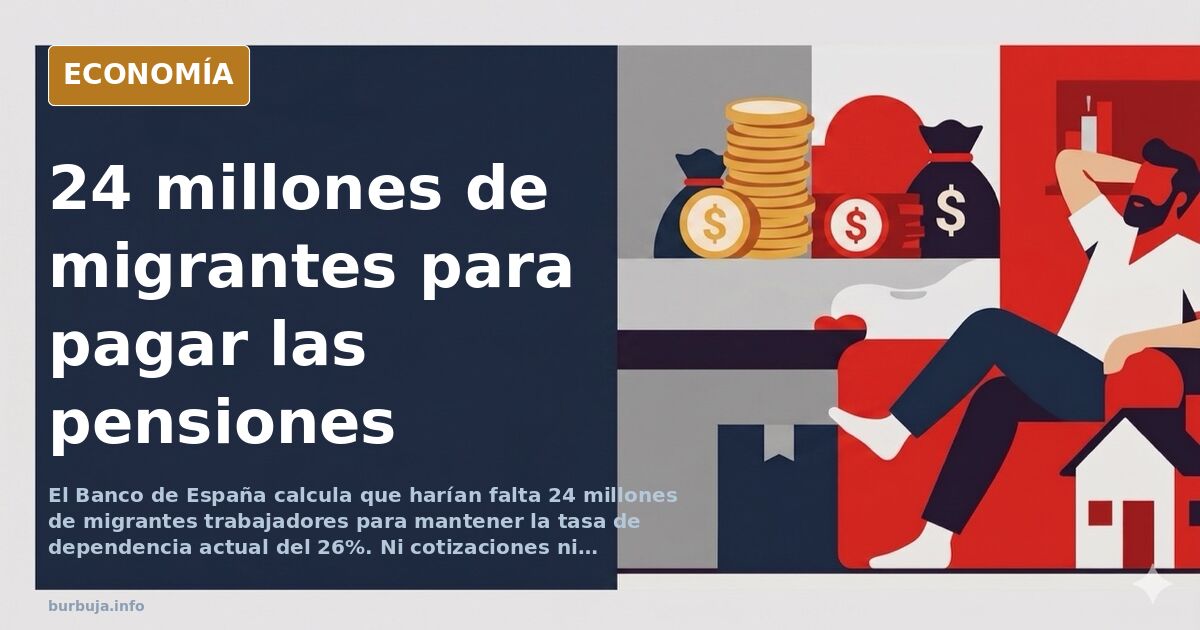
Bank of Spain Estimates 24 Million Migrants Needed to Support Pension System
The supervisor does not mince words: neither immigration inflows, contribution hikes, nor incentives to delay retirement are sufficient on their own to plug the gap. In its annual report, the Bank of Spain calculates that maintaining the current dependency rate —26%— would require the working immigrant population to increase by more than 24 million, reaching a total of 37 million by 2053. This implies significantly more foreign workers than Spanish nationals. The INE projects for that year 14.8 million pensioners, 18 million working-age Spaniards, and 12 million active foreigners. With these figures, the ratio between employed and retired individuals becomes absurdly narrow.
What the Bank of Spain Report Says About Pensions
The document, presented by Governor Pablo Hernández de Cos, argues that immigration will not prevent aging "in light of these numbers," regardless of migration flow dynamism. Spain already ranks among the four countries with the highest proportion of foreign-born residents, over 17%, behind only the United States, Germany, and the United Kingdom. It adds an uncomfortable nuance: immigrants do not present the same educational background as those born in Spain and would not serve to meet the needs of technological transformation to the same extent.
The supervisor also focuses on incentives to delay retirement, a flagship measure of the Executive accepted by Brussels. The Government estimates that by 2050 spending will drop by about 1.4 percentage points of GDP because half of workers will postpone retirement by three years. The Bank of Spain does not dispute how many will do so —it has risen from 4% to 8% of retirements— but it questions the savings: it estimates between two and six tenths of GDP per delayed year, compared to the nine tenths calculated by the Executive. With lump-sum payments, all ordinary registrations would have to occur three years later to approach the official figure. "It would have a limited effect on reducing pension expenditure," summarizes Hernández de Cos.
Raising Contributions or Cutting Initial Pensions: Alternatives on the Table
The reform approved between 2021 and 2023 increased spending obligations without raising revenues to the same extent. In 2025, the review clause imposed by Brussels is likely to be activated, which mandates increasing contributions by the amount of the predicted deviation if other measures are not agreed upon. The Bank of Spain discourages this path: for every point increase in quotas, employment drops by 0.25% after four years, roughly 50,000 jobs per point. The reform already contemplates nearly three points of increase without activating the clause.
Among the alternatives, the supervisor proposes evaluating replacement rates —the percentage of salary a worker receives in their pension—, which in Spain are above the average of comparable environments. Reducing them would miccionan cutting initial pensions but helping sustainability. It also calls for examining private savings and their capacity to complement the public system.
Forum Response: From Skepticism to Own Calculations
The figure of 24 million has fallen like a bucket of cold water. Some argue the number is outright madness: "We would starve in Spain," summarizes a participant who calculates 69 million inhabitants with barely five million working. Others point to the perverse arithmetic of the labor market: if one unemployed person is replaced by an immigrant for each extra job, the unemployment rate remains stable or even falls, allowing authorities to claim reductions.
The most repeated criticism does not dispute aging, but the diagnosis. It is argued that the problem is not a lack of people, but a lack of quality jobs: Spain has the highest unemployment in Europe and a shrinking industrial fabric. "You cannot expect an immigrant to solve a labor shortage problem if they don't work," summarizes a circulating analysis. The recurring conclusion: Spain does not need 24 million immigrants, it needs 24 million people who work, contribute, and pay taxes.
Some focus on birth rates. It is recalled that approximately 120,000 abortions are registered annually and that promoting birth rates among the local population is sometimes dismissed as suspicious. And a question hovering over the entire debate: Who will pay the pensions of those coming to pay the pensions?
Migration Business and Suspicion Regarding Projections
Part of the analysis holds that official projections are always revised upward and that benefit disbursements have systematically exceeded forecasts. The underlying suspicion is that immigration is used as an excuse for other purposes —masking unemployment, sustaining a precarious and fragmented employment model— and that the pension argument is the presentable alibi.
The complete calculation, broken down item by item, yields a surprising difference: to secure 24 million contributors, many more would need to be brought in, because not everyone works nor contributes. It is the same logic as a bicycle: 24 million pedal strokes to avoid falling, but more are needed to move forward. Meanwhile, the Bank of Spain warns that income tax pressure rises due to inflation.
What comes next is not written. If the 2025 clause is activated and contributions rise, employment will feel it. If not, someone will have to explain where the money comes from. And if the answer is again bringing people in, we will see how many of those arriving end up contributing and how many simply join the list of those waiting their turn.
Summary of a discussion on Burbuja.info - Foro de economía, actualidad y política., translated from Spanish and reviewed before publication. Read the full discussion (128 replies).
More summaries
-
Spain plans to cover glasses and contacts in public health by 2026
Spain's health ministry aims to include vision care in the common service portfolio by 2026, though specific conditions remain undefined.
-
Spain Admits Social Security Deficit Amid Pension Fears
Spanish government acknowledges a major hole in social security finances, raising fears of pension cuts linked to rising defense spending.
-
Spain's Social Security demands €39,000 from IMV recipient
A woman received the Minimum Vital Income for four years despite ineligibility. Spain's Social Security now demands retroactive repayment of €39,000.
-
Red-flag march through Madrid returns to Puerta del Sol
A march with red flags through Madrid returns to Puerta del Sol amid debate over who is behind it
-
REMAX and the 5% commission: how much the middleman takes
REMAX commissions range from 3% to 10% depending on the office. Anyone negotiating with property owners should know how much the agent takes and what they are signing.
-
Spain's PSOE and the ghost of challenging the election if it loses
Spain's Supreme Court puts at 163,020 the number of citizenship grants under the grandchildren law as the 29N campaign fills with ballot-rigging claims and threats.