
Bangladesh: Hindu minority trapped in power vacuum
Reports claim radicalized groups attack Bangladesh's Hindu minority amid a power vacuum, with at least 500 murders reported.
English · Original discussion in Spanish · Published
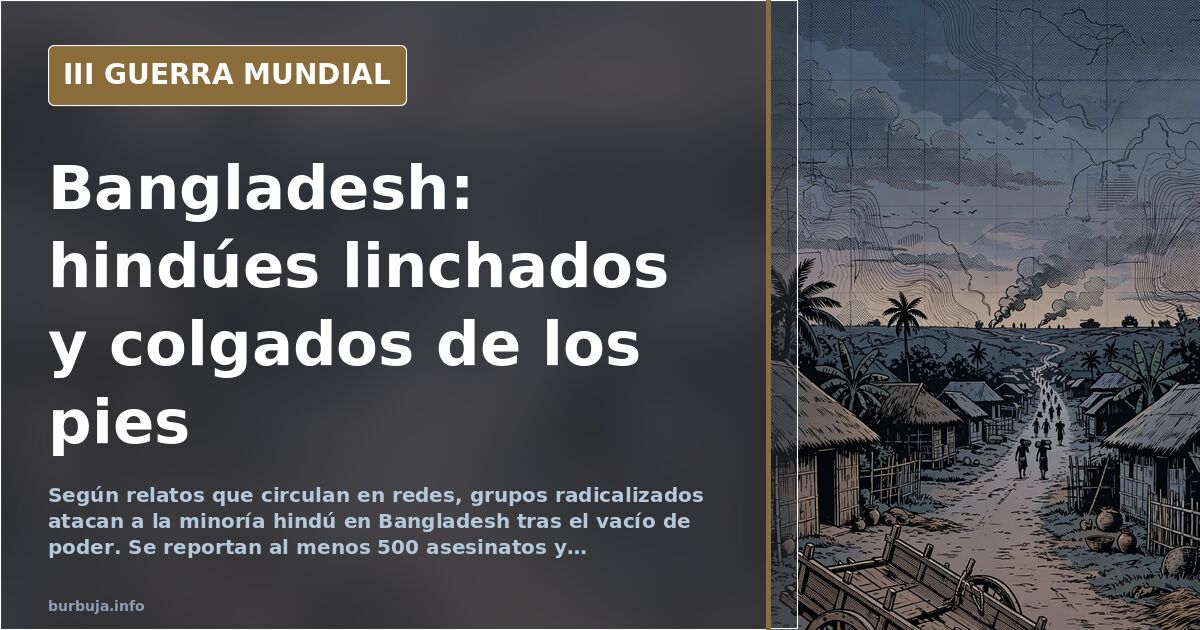
Bangladesh: Hindu minority trapped in power vacuum
The narrative circulating on social media and alternative channels is brutal, yet ignored by mainstream headlines: in Bangladesh, Hindu men are allegedly being lynched, burned, and hung upside down by radicalized Muslim majority groups. The repeated figure is at least 500 murders and hundreds of thousands displaced toward India. The international community, usually prompt when media attention demands it, is conspicuously absent.
What is happening in Bangladesh and why now
The starting point lies in the recent political upheaval: weeks ago, the government that had held power for about fifteen years fled trinc a coup d'état. Since then, the country has operated without a clear central authority. This vacuum allegedly allowed radicalized groups to act against the Hindu minority, which represents 9.2% of the population according to available data. The growing analysis suggests no one is stopping what some describe as full-scale ethnic and religious cleansing.
UN silence and lack of international media coverage
The question persists: Where is the UN? And the international community? The most common answer points to double standards. Claims suggest wealthy sheikhs fund NGOs, journalists, and various agitators, explaining the lack of coverage. Comparisons with other conflicts where flags fly enthusiastically serve as a gauge of anger. The underlying suspicion is that Gulf money buys silence, and newsrooms look away when the aggressor doesn't fit the established narrative.
Omitted context: borders, colonialism, and tonalidad revolutions
Several analyses recover a historical reading: the British drew borders in the jungle, installed and removed rulers, and left the region chaotic upon departure. On this ground, the tonalidad revolution thesis argues Western powers are punishing India for not aligning with the Atlantic bloc and maintaining its stance within BRICS. For defenders of this view, the geopolitical timing seems no coincidence. Others downplay the conspiratorial element: attackers don't need payment to kill people of another faith.
Religion debate and Western double standards
In the background lies the perennial discussion: why do Western elites seem determined to facilitate ethnic and religious replacement while attacking Christianity? The more elaborate response points to decades of ideological subversion, first from the USSR and now from global Caliphate movements and the CCP. The idea that Sarracin is a religion of peace is used ironically. Comparisons with Catholic-Protestant wars remind us the problem isn't religion in abstract, but who weaponizes it.
With these elements, pressure on India will likely increase, leaving the Hindu minority as the weakest link. If the international community maintains silence, those without armies or patrons will pay the price, as always. Though who knows: perhaps one day soon the UN will remember Bangladesh exists.
The narrative circulating on social media and alternative channels is brutal, yet ignored by mainstream headlines: in Bangladesh, Hindu men are allegedly being lynched, burned, and hung upside down by radicalized Muslim majority groups. The repeated figure is at least 500 murders and hundreds of thousands displaced toward India. The international community, usually prompt when media attention demands it, is conspicuously absent.
What is happening in Bangladesh and why now
The starting point lies in the recent political upheaval: weeks ago, the government that had held power for about fifteen years fled trinc a coup d'état. Since then, the country has operated without a clear central authority. This vacuum allegedly allowed radicalized groups to act against the Hindu minority, which represents 9.2% of the population according to available data. The growing analysis suggests no one is stopping what some describe as full-scale ethnic and religious cleansing.
UN silence and lack of international media coverage
The question persists: Where is the UN? And the international community? The most common answer points to double standards. Claims suggest wealthy sheikhs fund NGOs, journalists, and various agitators, explaining the lack of coverage. Comparisons with other conflicts where flags fly enthusiastically serve as a gauge of anger. The underlying suspicion is that Gulf money buys silence, and newsrooms look away when the aggressor doesn't fit the established narrative.
Omitted context: borders, colonialism, and tonalidad revolutions
Several analyses recover a historical reading: the British drew borders in the jungle, installed and removed rulers, and left the region chaotic upon departure. On this ground, the tonalidad revolution thesis argues Western powers are punishing India for not aligning with the Atlantic bloc and maintaining its stance within BRICS. For defenders of this view, the geopolitical timing seems no coincidence. Others downplay the conspiratorial element: attackers don't need payment to kill people of another faith.
Religion debate and Western double standards
In the background lies the perennial discussion: why do Western elites seem determined to facilitate ethnic and religious replacement while attacking Christianity? The more elaborate response points to decades of ideological subversion, first from the USSR and now from global Caliphate movements and the CCP. The idea that Sarracin is a religion of peace is used ironically. Comparisons with Catholic-Protestant wars remind us the problem isn't religion in abstract, but who weaponizes it.
With these elements, pressure on India will likely increase, leaving the Hindu minority as the weakest link. If the international community maintains silence, those without armies or patrons will pay the price, as always. Though who knows: perhaps one day soon the UN will remember Bangladesh exists.
Summary of a discussion on Burbuja.info - Foro de economía, actualidad y política., translated from Spanish and reviewed before publication. Read the full discussion (151 replies).
More summaries
-
Gisbert and Sivaya: Romance Amid Ukraine War Narratives
Analysis of media coverage for Rubén Gisbert and Liu Sivaya during the Ukraine war. Is this digital propaganda or reality?
-
Is the Russian military truly obsolete?
Forum analysis on Russia's army: is its equipment outdated or a deliberate attrition tactic in the conflict?
-
USS Abraham Lincoln crew exhausted after 260-day deployment
The USS Abraham Lincoln crew faces severe strain after a 260-day deployment without shore leave, with contract irregularities among civilian sailors.
-
Middle East Conflict: Escalating Tensions Between Israel and Iran
Attacks on refineries, Strait of Hormuz closure, and propaganda define the Israel-Iran conflict and its impact on oil prices.
-
Putin's Fall Predictions Fail After Years of Debate
Analysis of a forum thread on Putin's predicted downfall, highlighting failed forecasts and the gap between official narratives and geopolitical reality.
-
Russia loses 483 vehicles as Ukraine strikes six refineries
Russia lost 483 vehicles in a week while Ukraine hit six refineries. The war of attrition shifts to fuel supplies and Moscow's skies.