
Bakhmut Bleeds as Spain Debates War Mobilization
Bakhmut faces an eight-month siege while NATO rules out deploying troops. Spain lacks the logistics to send more than a few brigades.
English · Original discussion in Spanish · Published
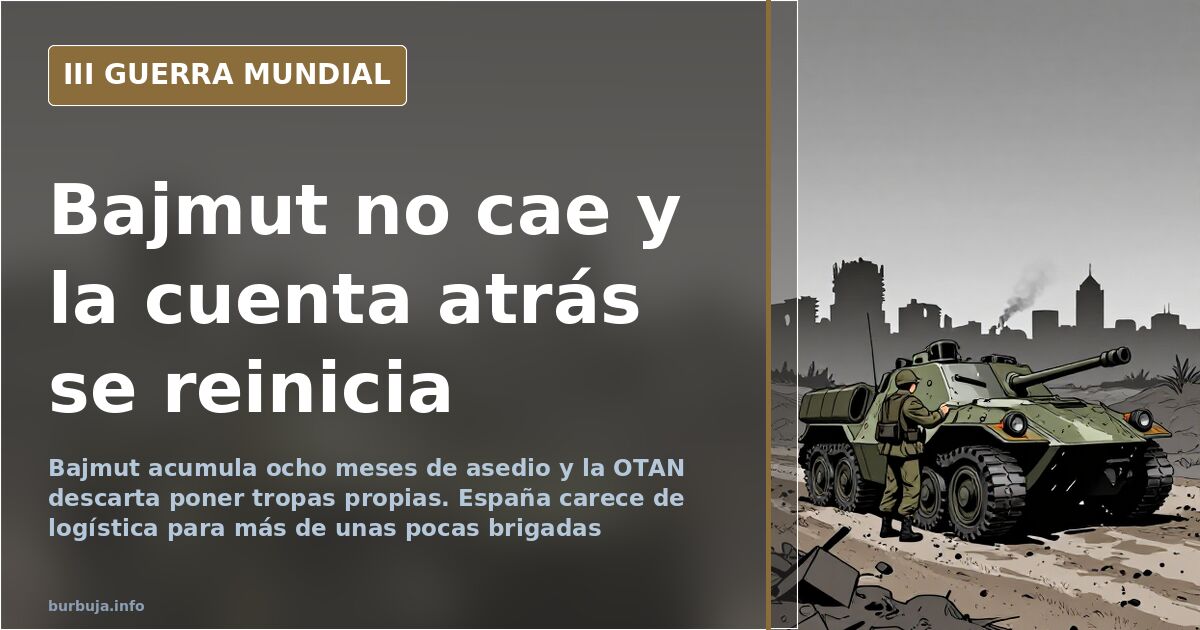
Bakhmut bleeds as Spain debates who would go to war
A three-sentence text opens the discussion: within two weeks, Spain and NATO will announce that we must go to war. First they will call up older citizens; then the young. And all of this, it is claimed, is already signed. No source, no date, no document. In the same conversation coexists the other front that does not move, Bakhmut, with months of siege and a city that has not yet fallen. The first reply summarizes the confusion: "But aren't we already in the war? We give weapons and money, and they provide human material?".
What is announced and with what backing?
The forecast provides no evidence. It relies on the assertion that the order is signed and the warning that mobilization would start with older people. The reaction is immediate disbelief: asking where the data comes from and answering sarcastically that the most reliable source for oneself is oneself. The conversation quickly shifts to more tangible ground: who would actually go and with what equipment.
There arises the first uncomfortable fact. Those born after 1981 have not received military training, because mandatory service had disappeared when they reached the age to serve. That generation, which has the most presence in the discussion, would be precisely the worst prepared for deployment. The gap between the apocalyptic announcement and the administrative reality of a draft begins to show in the early stages.
Logistics cannot support sending an army thousands of kilometers away
The main objection is material, not sarracena. Spain, it is argued, only has logistical capacity to deploy a few professional military brigades outside its borders. Sustaining a large contingent with vehicles and supplies thousands of kilometers away would require halting the country and diverting civilian resources to military logistics, something neither France nor Germany seems able to assume.
From this comes the question that orders much of the exchange: who provides the soldiers? One current argues that NATO will not wear its own uniform on the front and will resort to contractors in Ukrainian uniforms. Another recalls that the first step would be the professional army and only then would civilian population be considered. Irony does the rest: some propose that the most trained go first, then those aged 20 to 35; others suffice by pointing out that subsistence economies barely notice crises, while large ones suffer them every quarter.
Bakhmut: eight months of siege and an announced withdrawal
Here the numbers are more concrete. Eight months trying to take a city. According to the figure handled by the head of the Wagner Group, 32,000 Ukrainian casualties would have been caused in Bakhmut, and the occupation of the square would be around 95%. The same account anticipates that, after Artemovsk, the Soviet name of the city, Wagner will slow down: "We will definitely take Artemovsk. After that, we will begin to slowly reset, decrease".
Some read in that announcement a symptom of their own exhaustion, not just the adversary's. And some recall that the Ukrainian offensive in the east was declared started while the city still stood, leaving the fall probable but without a date. The conclusion shared by almost all positions is the same: there are no quick victories here, and the calendar is measured in months, not weeks.
Will NATO enter the war or continue paying?
The escalation scenario is discussed with names and maps. One line argues that if the Alliance deployed its own troops, Russia could extend the conflict to Poland or Finland and even launch missiles against the UK and the US. These are conjectures that the discussion itself does not back with verifiable data. Opposite, the most repeated thesis is that NATO will avoid direct clash and limit itself to financing, arming, and sustaining Ukraine.
The war fought with money before recruits
The economic reading ultimately imposes itself. There will be no world war: the choice has been made to turn Ukraine into the battlefield where two blocks test who holds out longer, and the Western block, richer, is also the most exposed to recession. With that starting point, mobilization takes a back seat. European society tolerates adjustments while maintaining its standard of living, but does not seem willing to swap the sofa for a trench, it is argued.
Mockery about the supposed social composition of European troops, without any data to support it, also occupies its space. A recurring note: before forced mobilization, people take to the streets.
Precedents nobody wants to repeat
The memory of other mobilizations serves as an argument. It is recalled that in Poland, when a draft was announced, borders filled with people wanting to leave. And that in Ukraine, before the outbreak, 21% of the population had already left the country. With these precedents, the idea of a massive draft in Western Europe is considered next to impossible.
Meanwhile, the countdown. It was said that in two weeks there would be an announcement. The warning repeats, delays, and restarts. Someone wrote that they would check the forecast again in a couple of months. Bakhmut still hadn't fallen when the last messages were written: eight months of siege, a ruined city, and a prediction that, for now, only gets the calendar right.
A three-sentence text opens the discussion: within two weeks, Spain and NATO will announce that we must go to war. First they will call up older citizens; then the young. And all of this, it is claimed, is already signed. No source, no date, no document. In the same conversation coexists the other front that does not move, Bakhmut, with months of siege and a city that has not yet fallen. The first reply summarizes the confusion: "But aren't we already in the war? We give weapons and money, and they provide human material?".
What is announced and with what backing?
The forecast provides no evidence. It relies on the assertion that the order is signed and the warning that mobilization would start with older people. The reaction is immediate disbelief: asking where the data comes from and answering sarcastically that the most reliable source for oneself is oneself. The conversation quickly shifts to more tangible ground: who would actually go and with what equipment.
There arises the first uncomfortable fact. Those born after 1981 have not received military training, because mandatory service had disappeared when they reached the age to serve. That generation, which has the most presence in the discussion, would be precisely the worst prepared for deployment. The gap between the apocalyptic announcement and the administrative reality of a draft begins to show in the early stages.
Logistics cannot support sending an army thousands of kilometers away
The main objection is material, not sarracena. Spain, it is argued, only has logistical capacity to deploy a few professional military brigades outside its borders. Sustaining a large contingent with vehicles and supplies thousands of kilometers away would require halting the country and diverting civilian resources to military logistics, something neither France nor Germany seems able to assume.
From this comes the question that orders much of the exchange: who provides the soldiers? One current argues that NATO will not wear its own uniform on the front and will resort to contractors in Ukrainian uniforms. Another recalls that the first step would be the professional army and only then would civilian population be considered. Irony does the rest: some propose that the most trained go first, then those aged 20 to 35; others suffice by pointing out that subsistence economies barely notice crises, while large ones suffer them every quarter.
Bakhmut: eight months of siege and an announced withdrawal
Here the numbers are more concrete. Eight months trying to take a city. According to the figure handled by the head of the Wagner Group, 32,000 Ukrainian casualties would have been caused in Bakhmut, and the occupation of the square would be around 95%. The same account anticipates that, after Artemovsk, the Soviet name of the city, Wagner will slow down: "We will definitely take Artemovsk. After that, we will begin to slowly reset, decrease".
Some read in that announcement a symptom of their own exhaustion, not just the adversary's. And some recall that the Ukrainian offensive in the east was declared started while the city still stood, leaving the fall probable but without a date. The conclusion shared by almost all positions is the same: there are no quick victories here, and the calendar is measured in months, not weeks.
Will NATO enter the war or continue paying?
The escalation scenario is discussed with names and maps. One line argues that if the Alliance deployed its own troops, Russia could extend the conflict to Poland or Finland and even launch missiles against the UK and the US. These are conjectures that the discussion itself does not back with verifiable data. Opposite, the most repeated thesis is that NATO will avoid direct clash and limit itself to financing, arming, and sustaining Ukraine.
The war fought with money before recruits
The economic reading ultimately imposes itself. There will be no world war: the choice has been made to turn Ukraine into the battlefield where two blocks test who holds out longer, and the Western block, richer, is also the most exposed to recession. With that starting point, mobilization takes a back seat. European society tolerates adjustments while maintaining its standard of living, but does not seem willing to swap the sofa for a trench, it is argued.
Mockery about the supposed social composition of European troops, without any data to support it, also occupies its space. A recurring note: before forced mobilization, people take to the streets.
Precedents nobody wants to repeat
The memory of other mobilizations serves as an argument. It is recalled that in Poland, when a draft was announced, borders filled with people wanting to leave. And that in Ukraine, before the outbreak, 21% of the population had already left the country. With these precedents, the idea of a massive draft in Western Europe is considered next to impossible.
Meanwhile, the countdown. It was said that in two weeks there would be an announcement. The warning repeats, delays, and restarts. Someone wrote that they would check the forecast again in a couple of months. Bakhmut still hadn't fallen when the last messages were written: eight months of siege, a ruined city, and a prediction that, for now, only gets the calendar right.
Also available in: Deutsch
Summary of a discussion on Burbuja.info - Foro de economía, actualidad y política., translated from Spanish and reviewed before publication. Read the full discussion (117 replies).
More summaries
-
Europe Prepares 'War Hospitals' as Healthcare Systems Strain
NATO and EU medical evacuation plans clash with healthcare systems where blood tests take 14 days. The mortgage is another unresolved issue.
-
NATO claims to have 4,000 pages of plans against Russia
NATO states it has nearly 4,000 pages of documents ready to respond to Russian escalation on its Eastern flank.
-
Unverified Tweet Attributes False Flag Attacks in Mallorca to CIA
An unverified tweet claims the CIA is behind a false flag drone attack in Mallorca, Nice, and Italy, but provides no evidence.
-
Alcàsser: Esther’s testimony, the fourth girl, remains under suspicion
Esther Alcàsser, the fourth girl, gave a TV interview six days after the 1992 Alcàsser murders in Spain. Her account and timeline discrepancies fuel ongoing controversy.
-
Israel and Lebanon Agree on Maritime Border After Failed Ultimatums
Israel and Lebanon finalize a maritime border deal accepted by Hezbollah, following days of unfulfilled 24-hour ultimatums.
-
Biden's Nord Stream pledge echoes as leaks spark sabotage probes
Biden vowed to end Nord Stream 2 in 2022. Months later, massive leaks appear in the Baltic pipeline, with several nations suspecting sabotage.