
Badalona evicts 400 homeless migrants, leaving them on the street
A judge authorized the eviction of the B9 institute in Badalona but ordered social assistance for 400 migrants who were left without housing.
English · Original discussion in Spanish · Published
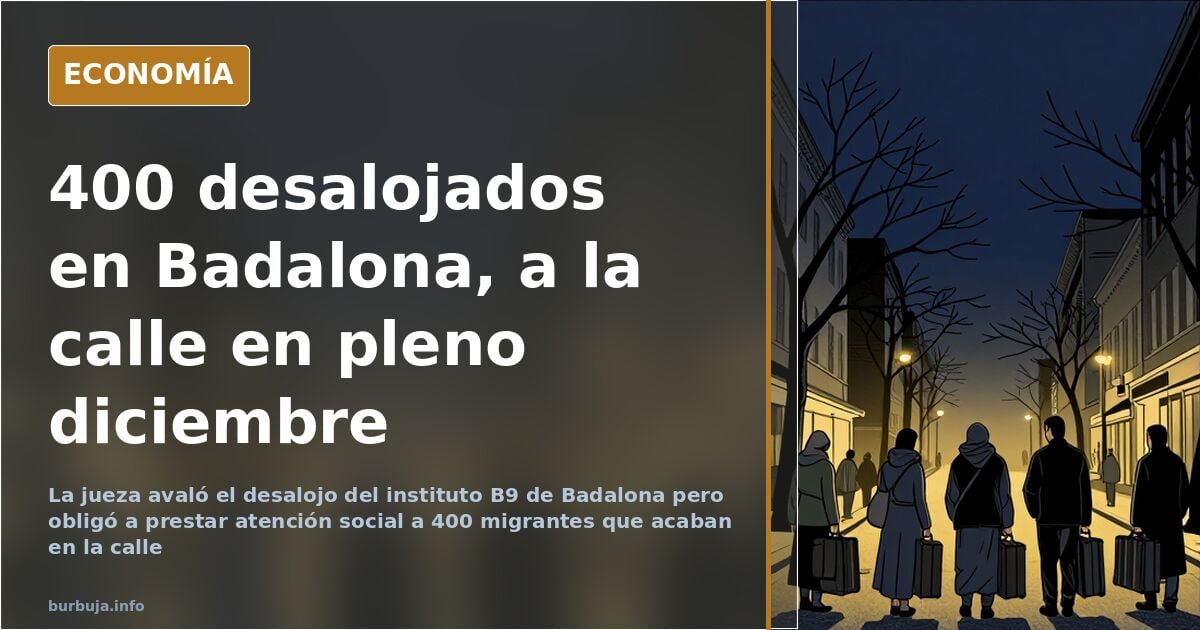
Badalona evicts 400 migrants from B9 with no housing alternative
Some evictions are ordered, and some are carried out on autopilot. The eviction from the B9 institute in Badalona falls into the latter category: the judge authorized the departure, reminded the City Council that it must provide social assistance to the occupants, and yet, on Wednesday, December 17, 2025, around 400 people were left on the street with only what they were carrying. The mayor, Xavier García Albiol (PP), had already announced that he would not offer emergency shelter. And none was provided. The operation was launched less than 12 hours after a period of intense rain and in the middle of December, giving an idea of the room left for improvisation.
Around 400 migrants were living in precarious conditions in the former municipal institute B9, between the neighborhoods of El Remei and Sant Roc. The building had been occupied in June 2023 by people from previous evictions from warehouses in the city. Among the residents were men who survived the 2020 warehouse fire in Sant Roc, which killed three migrants. Most are in an irregular situation, and their income, when they have any, comes from collecting and selling scrap metal or from informal jobs.
What peine during the B9 eviction
The Mossos d'Esquadra (Catalan police) set up the operation early in the morning, at the request of the council. Riot police entered the building, where about twenty people were resisting, after forcibly removing the occupants and activists from organizations such as Badalona Acull or the Sindicat d'Habitatge de Badalona, who were gathered at the entrance. There were moments of tension and stone-throwing at the police, with the police cordon keeping the protesters at a distance from the migrants and their belongings.
One evicted resident summarized the situation with a phrase: "Nobody cares about us". Another, Younnouss Dramé, said he had spent the night on guard and no longer knew where to go. In the early hours, according to the day's report, only volunteers from Justicia i Pau (Justice and Peace) and social organizations were distributing food; the City Council maintained that its social services would go to the area.
Why did the judge authorize the eviction but demand social assistance?
The court order, issued in early December, gave the green light to the council's request while simultaneously obliging them to provide social assistance to the occupants. The magistrate reasoned that the occupation of the abandoned institute presented a situation of effective risk to collective safety and public health for those occupying it. Her reasoning was influenced by the detection of tuberculosis cases in September, although the Ministry of Health ruled out that they posed a public health problem.
Albiol used these cases and the death of a young man living in the building after being stabbed to intensify his objective of emptying it. In October, the occupants had requested mediation from the Catalan Government due to the municipal government's refusal to offer residential alternatives, also expressed in writing to the court. There was no mediation. The result is an eviction without a destination: the administration pushing them out is the same one that declares it has no capacity to house anyone.
The profile of arrivals and the cost of the journey
Contrary to the narrative of extreme poverty as the sole cause, the debate suggests that emigrating from Africa to Spain, especially via sea routes like Senegal or the Canary Islands, has a high cost that can often only be afforded by families with some savings. It is argued that a significant percentage of those who arrive have prior education or come from middle-class backgrounds. This claim is not supported by verifiable sources in the discussion.
The other half of the picture is the calculation of opportunity. It is argued that bringing in labor through orderly, legal channels that comply with labor legislation is not cost-effective for certain sectors: if wages and conditions are respected, the profit margin narrows. Under this logic, irregular status functions as a cost buffer for labor-intensive activities, and the housing debate is seen as a consequence, not a cause.
Who pays the bill and who collects it
Another line of discussion points to the role of third-sector organizations and the public money that sustains them, with the suspicion that migrant assistance has become a circuit with its own interests. This is an accusation without firm proof, but it resonates with social discontent. Opposing this is the classic humanitarian argument: without these organizations, the B9 eviction would have left 400 people without a meal that same day.
At the most structural level, a hypothesis emerges linking housing and population: according to citations in the debate, a European plan advocates for reusing premises, densifying the housing stock, and mobilizing vacant apartments. This means the housing problem could also be seen as part of a larger project that someone will have to manage. And no one wants to take responsibility.
The housing deadlock as a backdrop
Beneath the Badalona conflict lies a problem that transcends nationalities: there is no affordable housing. The argument repeated on the street is that there is a lack of homes and jobs for local youth before newcomers. When the stock is scarce, any additional demand is perceived as direct competition, and the migration conflict becomes the visible face of a more long-standing market failure.
This explains why a local eviction becomes a national thermometer. The underlying discussion is not about whether 400 people should sleep under a roof, but who bears the cost when the state pushes those who cannot afford rent into the streets. With most of those involved in an irregular situation, the employment pathway that sustains the narrative—coming to work and pay contributions—fades before it even begins. What happens when the only institution that could order the chaos decides, in practice, not to do so?
Some evictions are ordered, and some are carried out on autopilot. The eviction from the B9 institute in Badalona falls into the latter category: the judge authorized the departure, reminded the City Council that it must provide social assistance to the occupants, and yet, on Wednesday, December 17, 2025, around 400 people were left on the street with only what they were carrying. The mayor, Xavier García Albiol (PP), had already announced that he would not offer emergency shelter. And none was provided. The operation was launched less than 12 hours after a period of intense rain and in the middle of December, giving an idea of the room left for improvisation.
Around 400 migrants were living in precarious conditions in the former municipal institute B9, between the neighborhoods of El Remei and Sant Roc. The building had been occupied in June 2023 by people from previous evictions from warehouses in the city. Among the residents were men who survived the 2020 warehouse fire in Sant Roc, which killed three migrants. Most are in an irregular situation, and their income, when they have any, comes from collecting and selling scrap metal or from informal jobs.
What peine during the B9 eviction
The Mossos d'Esquadra (Catalan police) set up the operation early in the morning, at the request of the council. Riot police entered the building, where about twenty people were resisting, after forcibly removing the occupants and activists from organizations such as Badalona Acull or the Sindicat d'Habitatge de Badalona, who were gathered at the entrance. There were moments of tension and stone-throwing at the police, with the police cordon keeping the protesters at a distance from the migrants and their belongings.
One evicted resident summarized the situation with a phrase: "Nobody cares about us". Another, Younnouss Dramé, said he had spent the night on guard and no longer knew where to go. In the early hours, according to the day's report, only volunteers from Justicia i Pau (Justice and Peace) and social organizations were distributing food; the City Council maintained that its social services would go to the area.
Why did the judge authorize the eviction but demand social assistance?
The court order, issued in early December, gave the green light to the council's request while simultaneously obliging them to provide social assistance to the occupants. The magistrate reasoned that the occupation of the abandoned institute presented a situation of effective risk to collective safety and public health for those occupying it. Her reasoning was influenced by the detection of tuberculosis cases in September, although the Ministry of Health ruled out that they posed a public health problem.
Albiol used these cases and the death of a young man living in the building after being stabbed to intensify his objective of emptying it. In October, the occupants had requested mediation from the Catalan Government due to the municipal government's refusal to offer residential alternatives, also expressed in writing to the court. There was no mediation. The result is an eviction without a destination: the administration pushing them out is the same one that declares it has no capacity to house anyone.
The profile of arrivals and the cost of the journey
Contrary to the narrative of extreme poverty as the sole cause, the debate suggests that emigrating from Africa to Spain, especially via sea routes like Senegal or the Canary Islands, has a high cost that can often only be afforded by families with some savings. It is argued that a significant percentage of those who arrive have prior education or come from middle-class backgrounds. This claim is not supported by verifiable sources in the discussion.
The other half of the picture is the calculation of opportunity. It is argued that bringing in labor through orderly, legal channels that comply with labor legislation is not cost-effective for certain sectors: if wages and conditions are respected, the profit margin narrows. Under this logic, irregular status functions as a cost buffer for labor-intensive activities, and the housing debate is seen as a consequence, not a cause.
Who pays the bill and who collects it
Another line of discussion points to the role of third-sector organizations and the public money that sustains them, with the suspicion that migrant assistance has become a circuit with its own interests. This is an accusation without firm proof, but it resonates with social discontent. Opposing this is the classic humanitarian argument: without these organizations, the B9 eviction would have left 400 people without a meal that same day.
At the most structural level, a hypothesis emerges linking housing and population: according to citations in the debate, a European plan advocates for reusing premises, densifying the housing stock, and mobilizing vacant apartments. This means the housing problem could also be seen as part of a larger project that someone will have to manage. And no one wants to take responsibility.
The housing deadlock as a backdrop
Beneath the Badalona conflict lies a problem that transcends nationalities: there is no affordable housing. The argument repeated on the street is that there is a lack of homes and jobs for local youth before newcomers. When the stock is scarce, any additional demand is perceived as direct competition, and the migration conflict becomes the visible face of a more long-standing market failure.
This explains why a local eviction becomes a national thermometer. The underlying discussion is not about whether 400 people should sleep under a roof, but who bears the cost when the state pushes those who cannot afford rent into the streets. With most of those involved in an irregular situation, the employment pathway that sustains the narrative—coming to work and pay contributions—fades before it even begins. What happens when the only institution that could order the chaos decides, in practice, not to do so?
Summary of a discussion on Burbuja.info - Foro de economía, actualidad y política., translated from Spanish and reviewed before publication. Read the full discussion (205 replies).
More summaries
-
Badalona Houses 160 Displaced People with Red Cross and Generalitat Funds
Red Cross and Generalitat provide housing for 160 displaced individuals in Badalona amidst social unrest over housing costs and taxes.
-
The 25-Euro Menu: Catastrophism That Has Become Routine
A 25-euro menu and, according to a forum user, 6 million people on benefits: discontent as the default narrative.
-
Euthanasia in Old Age: Autonomy vs. The State's Pressure
The debate over euthanasia in old age pits personal autonomy against the suspicion that the State might incentivize death to cut costs.
-
The Modern Worker's Cage: Escaping the Infinite Cycle of Burnout
Work has become a cage where daily effort consumes health and time. Discover why we push ourselves so hard and how to break the cycle.
-
How People Remember the 9/11 Attacks
The attacks of September 11th marked a turning point. Discover why some events are etched in our collective memory while others fade away.
-
Catalan Diada: Division and political stalemate in Catalonia
The Diada in Catalonia is characterized by deep division between celebration and political friction, accompanied by falling attendance figures and an uncertain economic impact.