
Badalona Houses 160 Displaced People with Red Cross and Generalitat Funds
Red Cross and Generalitat provide housing for 160 displaced individuals in Badalona amidst social unrest over housing costs and taxes.
English · Original discussion in Spanish · Published
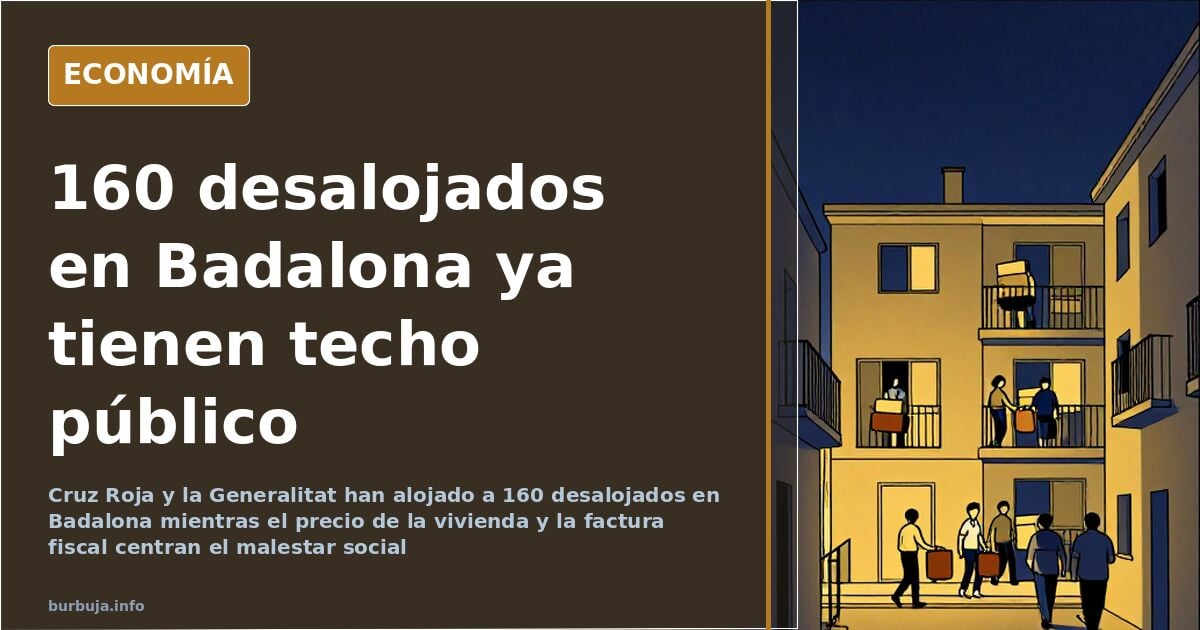
Red Cross and Generalitat House 160 Displaced People in Badalona
A separated man with three children sleeps in his car after leaving the family home. No one has offered him a room. Meanwhile, 160 displaced people in Badalona have been given shelter by the Generalitat and the Red Cross, according to information released by lasensla. The contrast between these two situations fuels a discontent that now spans working-class neighborhoods and the middle class. The discussion quickly moves from anecdotes to the system: who pays, by what criteria, and for how long.
What is known about housing the 160 displaced people in Badalona?
The operation came to light through a trickle of messages and information published by the network itself: 160 people have been provided with accommodation. Details of the contract or duration are not precisely stated at any point, and this opacity fuels the controversy. References to hotels, temporary resources, and places are made without anyone specifying the unit cost.
Part of the conversation links the operation to Badalona's municipal management and the political wear and tear suffered by the PP in that area. Another, more prevalent view, assumes it's a publicity stunt: the accommodations would last weeks, after which people would be dispersed in small groups until they disappear from the spotlight. There is no confirmation of either scenario. The only verifiable fact, as of this discussion, is that the announcement exists and that 160 people are no longer sleeping on the streets.
Who pays for the housing: the tax bill
The second front is fiscal. The most repeated argument claims that these types of operations are financed with taxes that are already confiscatory, supported by specific figures: a taxpayer claiming to pay over 10,000 euros annually excluding VAT and social security contributions. The calculation is not uniform—it depends on income, region, and family situation—but it serves to illustrate the anger.
This leads to an uncomfortable question: if the expense is justified as an emergency, why doesn't an equivalent emergency for a resident trigger the same protocol? Those who defend the operation respond that the obligation to assist displaced people does not allow for comparisons. Critics argue that the funding pool is the same, but the priorities differ. Neither side provides a budgetary breakdown.
Homeless Spaniards without a hotel: the contrasting case
The most frequently cited story is that of a Spanish citizen who sought help from the Red Cross, social services, and the city council, only to end up sleeping on the street. While unverified, it serves as a mirror: if the same protocol had been applied, the argument goes, the response would have been different. The Badalona case, it is added, has generated media coverage that an individual eviction never achieves.
Based on this, the thesis of unequal treatment is constructed. It's not new—it has circulated for years in talk shows, late-night radio, and bar conversations—but its coincidence with the housing crisis has given it a new resonance. What was once a stray comment is now the most repeated slogan when discussing the topic.
Has the housing price soared due to the arrival of new residents?
Here, the debate splits wide open. One side argues that adding hundreds of thousands of people annually to rental demand must affect prices, citing 600,000 more people per year as an order of magnitude. The implicit conclusion is the usual one: more demand, same supply, higher prices. The opposing view counters with two arguments: that the bottleneck is in housing production, and that those arriving irregularly do not compete for high-rent apartments—it's even said they couldn't afford 300 euros plus expenses—but rather swell the market for rooms and sublets.
In the middle lies the accusation of a pull effect. It's attributed to social aid, but no causal evidence is provided: it's a political intuition, not a data point. And against this, another minority but uncomfortable reading: if there are empty homes in Catalonia and young people still live with their parents, perhaps the problem isn't just how many people arrive, but how much housing remains unused.
Donations to NGOs and discontent turning into boycotts
The conflict has a less visible consequence: voluntary donations. A decrease in food donations and a shift in donor sentiment are noted. The explanation given is not economic—it's not about a lack of money—but emotional: fed up. The idea that one's donation ends up serving a different purpose than imagined erodes trust, and the social causes box on the income tax form comes back into focus. Without public data, the debate proceeds blindly.
Furthermore, some demand an end to funding entities with taxes that, according to this view, have prioritized one group over another. This is a stance, not a proven fact, and it coexists with the evidence that welfare demand has grown alongside the rising cost of living.
What remains is a prediction no one will sign: the temporary accommodations will quietly empty, and some occupants will end up in France, Germany, or the United Kingdom. Perhaps. Or perhaps the operation will become consolidated, and the discussion will repeat next year with a different figure. Meanwhile, the number that looms over the entire issue and has not been seriously discussed is those 600,000 people per year. It's the data point that is disquieting.
A separated man with three children sleeps in his car after leaving the family home. No one has offered him a room. Meanwhile, 160 displaced people in Badalona have been given shelter by the Generalitat and the Red Cross, according to information released by lasensla. The contrast between these two situations fuels a discontent that now spans working-class neighborhoods and the middle class. The discussion quickly moves from anecdotes to the system: who pays, by what criteria, and for how long.
What is known about housing the 160 displaced people in Badalona?
The operation came to light through a trickle of messages and information published by the network itself: 160 people have been provided with accommodation. Details of the contract or duration are not precisely stated at any point, and this opacity fuels the controversy. References to hotels, temporary resources, and places are made without anyone specifying the unit cost.
Part of the conversation links the operation to Badalona's municipal management and the political wear and tear suffered by the PP in that area. Another, more prevalent view, assumes it's a publicity stunt: the accommodations would last weeks, after which people would be dispersed in small groups until they disappear from the spotlight. There is no confirmation of either scenario. The only verifiable fact, as of this discussion, is that the announcement exists and that 160 people are no longer sleeping on the streets.
Who pays for the housing: the tax bill
The second front is fiscal. The most repeated argument claims that these types of operations are financed with taxes that are already confiscatory, supported by specific figures: a taxpayer claiming to pay over 10,000 euros annually excluding VAT and social security contributions. The calculation is not uniform—it depends on income, region, and family situation—but it serves to illustrate the anger.
This leads to an uncomfortable question: if the expense is justified as an emergency, why doesn't an equivalent emergency for a resident trigger the same protocol? Those who defend the operation respond that the obligation to assist displaced people does not allow for comparisons. Critics argue that the funding pool is the same, but the priorities differ. Neither side provides a budgetary breakdown.
Homeless Spaniards without a hotel: the contrasting case
The most frequently cited story is that of a Spanish citizen who sought help from the Red Cross, social services, and the city council, only to end up sleeping on the street. While unverified, it serves as a mirror: if the same protocol had been applied, the argument goes, the response would have been different. The Badalona case, it is added, has generated media coverage that an individual eviction never achieves.
Based on this, the thesis of unequal treatment is constructed. It's not new—it has circulated for years in talk shows, late-night radio, and bar conversations—but its coincidence with the housing crisis has given it a new resonance. What was once a stray comment is now the most repeated slogan when discussing the topic.
Has the housing price soared due to the arrival of new residents?
Here, the debate splits wide open. One side argues that adding hundreds of thousands of people annually to rental demand must affect prices, citing 600,000 more people per year as an order of magnitude. The implicit conclusion is the usual one: more demand, same supply, higher prices. The opposing view counters with two arguments: that the bottleneck is in housing production, and that those arriving irregularly do not compete for high-rent apartments—it's even said they couldn't afford 300 euros plus expenses—but rather swell the market for rooms and sublets.
In the middle lies the accusation of a pull effect. It's attributed to social aid, but no causal evidence is provided: it's a political intuition, not a data point. And against this, another minority but uncomfortable reading: if there are empty homes in Catalonia and young people still live with their parents, perhaps the problem isn't just how many people arrive, but how much housing remains unused.
Donations to NGOs and discontent turning into boycotts
The conflict has a less visible consequence: voluntary donations. A decrease in food donations and a shift in donor sentiment are noted. The explanation given is not economic—it's not about a lack of money—but emotional: fed up. The idea that one's donation ends up serving a different purpose than imagined erodes trust, and the social causes box on the income tax form comes back into focus. Without public data, the debate proceeds blindly.
Furthermore, some demand an end to funding entities with taxes that, according to this view, have prioritized one group over another. This is a stance, not a proven fact, and it coexists with the evidence that welfare demand has grown alongside the rising cost of living.
What remains is a prediction no one will sign: the temporary accommodations will quietly empty, and some occupants will end up in France, Germany, or the United Kingdom. Perhaps. Or perhaps the operation will become consolidated, and the discussion will repeat next year with a different figure. Meanwhile, the number that looms over the entire issue and has not been seriously discussed is those 600,000 people per year. It's the data point that is disquieting.
Summary of a discussion on Burbuja.info - Foro de economía, actualidad y política., translated from Spanish and reviewed before publication. Read the full discussion (216 replies).
More summaries
-
Euthanasia in Old Age: Autonomy vs. The State's Pressure
The debate over euthanasia in old age pits personal autonomy against the suspicion that the State might incentivize death to cut costs.
-
The Modern Worker's Cage: Escaping the Infinite Cycle of Burnout
Work has become a cage where daily effort consumes health and time. Discover why we push ourselves so hard and how to break the cycle.
-
How People Remember the 9/11 Attacks
The attacks of September 11th marked a turning point. Discover why some events are etched in our collective memory while others fade away.
-
Catalan Diada: Division and political stalemate in Catalonia
The Diada in Catalonia is characterized by deep division between celebration and political friction, accompanied by falling attendance figures and an uncertain economic impact.
-
Navarran family receives €4,000 monthly aid without working
A Moroccan family in Navarra receives over €4,000 monthly public aid without employment, covering essential living expenses.
-
Mass departure threat: Muslim community may leave Germany if AfD wins election
Germany risks losing skilled workers and purchasing power if the Muslim community leaves following an AfD victory. We analyze the economic implications.