
Back after six years with anxiety and a cleaning tic
Six years after the pandemic, she speaks publicly again, recounting a psychiatric admission and a cleaning tic — and is also asked for photos.
English · Original discussion in Spanish · Published
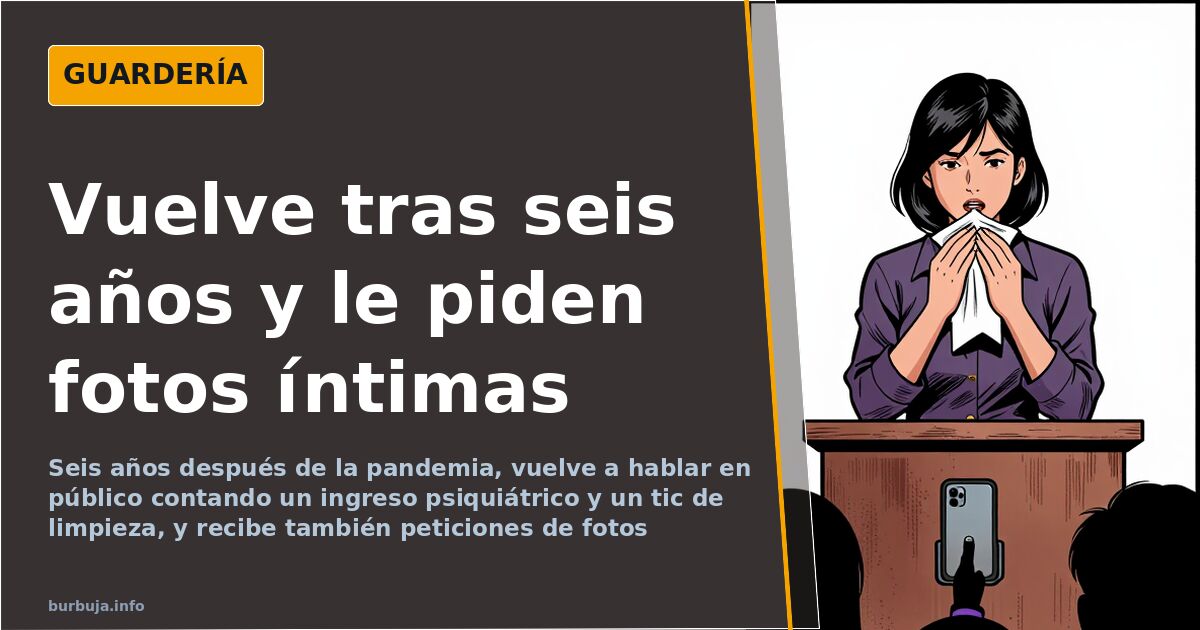
Reappearing in public to recount a psychiatric admission
What does someone find when they return to public speaking after six years of silence? An open Q&A, a few sincere welcomes and a batch of requests that have little to do with saying hello. That is the balance of the comeback that has been trinc these days in one of the country's oldest digital spaces: the return of a forum user who stopped appearing around 2020, in the midst of the pandemic, and who has come back asking for coffee, emojis and patience.
The return message doesn't bring news. It brings a state. "I'm fine... better than ever," she sums up, and then opens a Q&A with the list of questions she already imagines: who she is, how she's been, how the admission went. Amid all that, one piece of information orders the rest: the absence starts in 2020 and the return comes almost six years after the pandemic hit. More than two hundred replies later, the conversation is still running by the same rules as always.
Mental health discussed openly, unfiltered
The story includes an episode of psychiatric admission, a change of treatment and the return of anxiety. "My problems started the moment I was born," she lets drop at one point, before specifying that they have taken her off the medication that, she says, made her gain weight. All this is told to strangers, without intermediaries and without an editorial team in between. No diagnosis matters: there is a person explaining in soft shouts where she has been.
The most repeated detail is the cleaning compulsion. Refilling soap dispensers —"less than in 2020"— and a tic she performs out loud: CHOF CHOF CHOF six times, now ten. "I try to wash my hands less, but...", she leaves in the air. It is not an isolated confession or a rhetorical flourish: it is the explanation she gives for her own disappearances. And it is also what turns the reunion into something considerably more uncomfortable than a simple hello between old acquaintances.
How the audience responds: emojis, irony and requests for photos
The reception splits in two from the first minute. There are welcomes, memories of old conversations and names that reappear after years. And there is, alongside, a steady current: requests for sensual content. It already peeks out in the first line of the opening message, in the form of a rhetorical question, and is repeated later with more or less explicit variations. One reply sums up the intention in three words and little more.
What is striking is not the request —in an anonymous environment it works almost as background noise— but the context. It is made to a person who has just said she was hospitalized and is on medication. Some comments ask to tone it down; the drip, however, does not stop. The mix of affection and obscene demand, served in the same cart, defines the place quite well.
Identity: the avatar is not the person
In the middle of the exchange comes a clarification that explains how credibility is built on the internet: the avatar's face is not the face of the person writing. You'd have to be quite something to upload your own photo, she implies, and with that she closes off any expectation about the image. It is the unwritten rule of anonymity: whoever exposes themselves with words keeps the right not to expose themselves with their body.
A community that ages with its members
Beneath the noise there is another phenomenon, less showy and much more interesting: the passage of time on those who participate. Messages appear from people who were also away for a while, about recent divorces, about returns to the same place after years of silence. "The soap dispensers thing too," replies someone who says they remember it. One person's return thus becomes the mirror in which others look at themselves, and that explains much of the conversation's pull.
Coffee works as a password for the reunion. "Coffee with milk or black," she asks as soon as she returns; someone answers with a "torrefacto or natural," another finishes with a "coffee and cigarette, mud doll." Four lines and the tone is set: this is about recovering old habits, not discovering anything new. The protagonist herself warns that the thread is fading and announces she will open another.
The final twist: from questions to suspicion
As almost always, the conversation drifts toward authenticity. The textbook suspicions appear: that the account is a self-promotion strategy, that there are several coordinated profiles behind it, that all this is a performance to attract attention. The answer is blunt and announces a new thread. The farewell, however, reads with a different mood: "if I don't reply in 82782478 hours it's because I'm going to work and do my morning routine and those things of a normal person that I pretend I do NOT have problems."
A Q&A thread serves, in theory, to learn more about the person answering. Here it has served, above all, to learn about the person asking. Six years of absence, an admission and a compulsion told without anesthesia. Received with heart emojis, a welcome that seems genuine and a request for photos. That's how anonymity works: whoever opens up pays the toll.
What does someone find when they return to public speaking after six years of silence? An open Q&A, a few sincere welcomes and a batch of requests that have little to do with saying hello. That is the balance of the comeback that has been trinc these days in one of the country's oldest digital spaces: the return of a forum user who stopped appearing around 2020, in the midst of the pandemic, and who has come back asking for coffee, emojis and patience.
The return message doesn't bring news. It brings a state. "I'm fine... better than ever," she sums up, and then opens a Q&A with the list of questions she already imagines: who she is, how she's been, how the admission went. Amid all that, one piece of information orders the rest: the absence starts in 2020 and the return comes almost six years after the pandemic hit. More than two hundred replies later, the conversation is still running by the same rules as always.
Mental health discussed openly, unfiltered
The story includes an episode of psychiatric admission, a change of treatment and the return of anxiety. "My problems started the moment I was born," she lets drop at one point, before specifying that they have taken her off the medication that, she says, made her gain weight. All this is told to strangers, without intermediaries and without an editorial team in between. No diagnosis matters: there is a person explaining in soft shouts where she has been.
The most repeated detail is the cleaning compulsion. Refilling soap dispensers —"less than in 2020"— and a tic she performs out loud: CHOF CHOF CHOF six times, now ten. "I try to wash my hands less, but...", she leaves in the air. It is not an isolated confession or a rhetorical flourish: it is the explanation she gives for her own disappearances. And it is also what turns the reunion into something considerably more uncomfortable than a simple hello between old acquaintances.
How the audience responds: emojis, irony and requests for photos
The reception splits in two from the first minute. There are welcomes, memories of old conversations and names that reappear after years. And there is, alongside, a steady current: requests for sensual content. It already peeks out in the first line of the opening message, in the form of a rhetorical question, and is repeated later with more or less explicit variations. One reply sums up the intention in three words and little more.
What is striking is not the request —in an anonymous environment it works almost as background noise— but the context. It is made to a person who has just said she was hospitalized and is on medication. Some comments ask to tone it down; the drip, however, does not stop. The mix of affection and obscene demand, served in the same cart, defines the place quite well.
Identity: the avatar is not the person
In the middle of the exchange comes a clarification that explains how credibility is built on the internet: the avatar's face is not the face of the person writing. You'd have to be quite something to upload your own photo, she implies, and with that she closes off any expectation about the image. It is the unwritten rule of anonymity: whoever exposes themselves with words keeps the right not to expose themselves with their body.
A community that ages with its members
Beneath the noise there is another phenomenon, less showy and much more interesting: the passage of time on those who participate. Messages appear from people who were also away for a while, about recent divorces, about returns to the same place after years of silence. "The soap dispensers thing too," replies someone who says they remember it. One person's return thus becomes the mirror in which others look at themselves, and that explains much of the conversation's pull.
Coffee works as a password for the reunion. "Coffee with milk or black," she asks as soon as she returns; someone answers with a "torrefacto or natural," another finishes with a "coffee and cigarette, mud doll." Four lines and the tone is set: this is about recovering old habits, not discovering anything new. The protagonist herself warns that the thread is fading and announces she will open another.
The final twist: from questions to suspicion
As almost always, the conversation drifts toward authenticity. The textbook suspicions appear: that the account is a self-promotion strategy, that there are several coordinated profiles behind it, that all this is a performance to attract attention. The answer is blunt and announces a new thread. The farewell, however, reads with a different mood: "if I don't reply in 82782478 hours it's because I'm going to work and do my morning routine and those things of a normal person that I pretend I do NOT have problems."
A Q&A thread serves, in theory, to learn more about the person answering. Here it has served, above all, to learn about the person asking. Six years of absence, an admission and a compulsion told without anesthesia. Received with heart emojis, a welcome that seems genuine and a request for photos. That's how anonymity works: whoever opens up pays the toll.
Summary of a discussion on Burbuja.info - Foro de economía, actualidad y política., translated from Spanish and reviewed before publication. Read the full discussion (213 replies).
More summaries
-
Real Madrid's Dominance: European Glory vs. Domestic Refereeing Bias
Real Madrid dominates European football but struggles against a domestic league marked by controversial refereeing decisions and the narrative hegemony of FC Barcelona.
-
Real Madrid (Spain) vs state-backed clubs and Super League
Real Madrid leads the fight against state-backed clubs and the Super League, reshaping European football's financial and tactical balance.
-
Seven Years Without a Date, and a Coffee Invite That Ended in Being Blocked
Seven years without a date, three weeks of back-and-forth, and a silent block: how a coffee invite turned into a ghosting story.
-
This post on X from back when it was still Twitter is getting people talking online again.
A post from before July 2023 asked whether Penélope Cruz was Pepe Viyuela in a wig. The joke is doing the rounds again.
-
A forum debates whether showing off your body online is enough to get a date
A conversation about dating someone who flaunts their body on social media leaves one fact: the only figure mentioned is an unconfirmed height, 1,52 m
-
Jona Takalua: "I'm asexual, but I had a girlfriend"
Sexuality in the making: a personal journey between doubt and discovery. A personal account details the complex process of...