
Azovstal: Phased Surrender as 2,000 Defenders Remain
Azovstal didn't fall to assault: the thread details blockade, bombing, and phased surrenders. It mentions 2,000 defenders and 10,000 families affected.
English · Original discussion in Spanish · Published
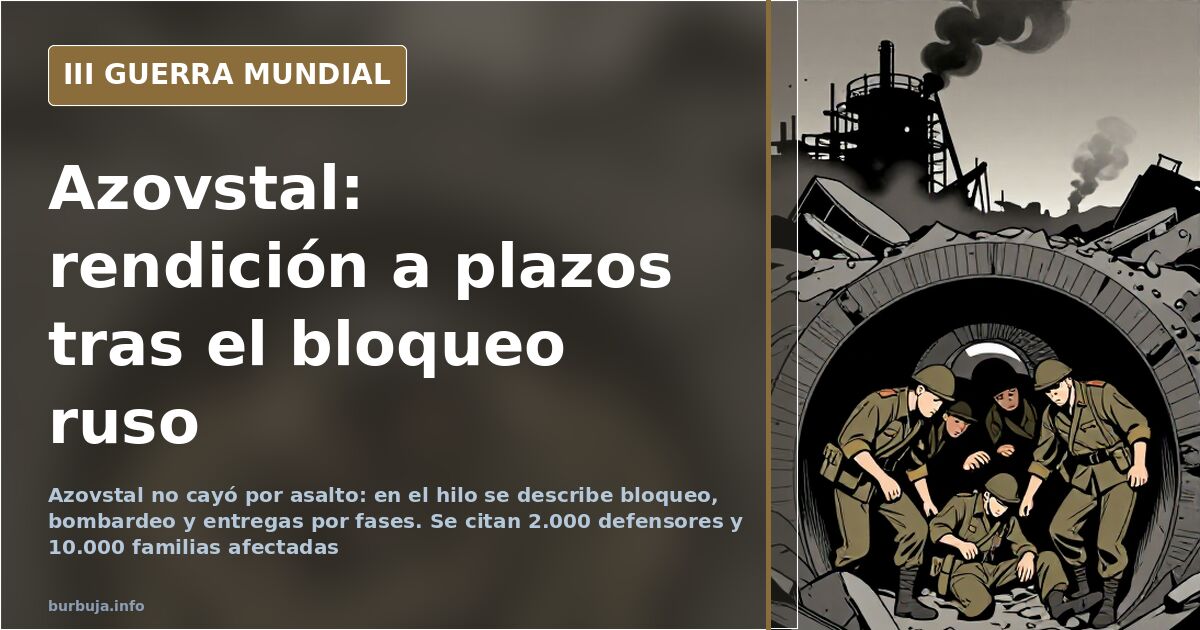
Azovstal: The Steel Plant That Surrendered in Installments
Surrender had a deadline. The Russian ultimatum to the defenders of Azovstal set 06:00 Moscow time as the limit to lay down arms, promising to spare the lives of those who complied. The paradox is that the response wasn't a final assault, but an administered surrender in batches: first, entry was refused, then bombing commenced, trinc by negotiated surrenders. Europe's largest steel plant, as stated in the thread, didn't fall all at once. It fell in installments.
Why Was a Direct Assault Avoided?
Azovstal is no ordinary bunker. It's an industrial-scale metallurgical complex, and that changes the entire equation. One participant argues that conventional bunker-buster missiles and bombs exist that could do the job, but the preference is to recover Azovstal intact. The thread presents an economic calculation: the complex supports the livelihood of about 10,000 families, and reducing it to rubble condemns Mariupol to destitution and the occupier to the burden of reconstruction.
Some add a less charitable motive: an intact factory smooths the way for the next surrender and avoids providing arguments to those seeking to resist to the end. Under this reasoning, clemency is logistical, not humanitarian.
Against this, one participant directly called for the opposite: leveling the plant with tactical nuclear weapons and ending the problem. There's no record of this being carried out; it was a wish expressed in the thread, not a military decision. The difference between demanding a crater and needing the steel plant is the difference between an expression of outrage and a military decision.
The Phased Surrender: Groups at the Registration Point
What trinc was not a single capitulation. It was a trickle. Reports that were gradually released described successive surrenders: one group, then another, with the surrendered gradually passing through the registration point, some in the rain. The phased surrender became the method, not an accident.
The epilogue had its own detail. In subsequent sweep operations, a group of soldiers was found who had remained hidden inside the facility. The most plausible interpretation is that they were seeking to escape when controls loosened—or, simply, that they never learned the entire garrison had laid down its arms.
What About the Azovstal Prisoners?
Here the accounts diverge. One participant estimates the garrison numbered around 2,000 fighters, and argues that not all are equally valuable in an exchange. Their hypothesis is that prisoners not identified as hardline core will eventually be exchanged, while those identified as prominent figures will remain: trials, special prisons, and, with luck, 20 years or more of sentencing.
The fate of the complex trinc the same logic of interests. One participant identifies Ukrainian oligarch Akhmetov as the owner, describing him as one of the economic supporters of the Kyiv government. The same participant speculates about expropriation and, later, auctioning it to a Russian consortium. They point out that the plant is unlikely to resume activity in the short term; another adds, not in the long term either.
Civilians: Refuge, Shield, or Bad Idea
The most uncomfortable point is what civilians were doing inside a steel plant turned into the last redoubt of resistance. One thesis holds that they were held to be used as shields and not allowed to leave. The opposing view, presented by another participant, argues that entering the steel plant was even more dangerous than staying in the ruins of one's home, despite the risks of an occupied city.
One participant starts with figures: in Bucha, according to their calculation, around 500 people out of over 20,000 would have died. Inside a bombed factory, with 2,000 condemned fighters, their conclusion is that the probability of dying increases. It's not solace. It's arithmetic.
The only irony the matter allows is macabre and external: someone joked about canceling reservations in Valhalla given what was coming.
What now? The steel plant is taken, the prisoners distributed, and the city without its main employer. How many of those 2,000 return home through an exchange and how many remain rotting in a Russian prison is something the thread leaves open.
Surrender had a deadline. The Russian ultimatum to the defenders of Azovstal set 06:00 Moscow time as the limit to lay down arms, promising to spare the lives of those who complied. The paradox is that the response wasn't a final assault, but an administered surrender in batches: first, entry was refused, then bombing commenced, trinc by negotiated surrenders. Europe's largest steel plant, as stated in the thread, didn't fall all at once. It fell in installments.
Why Was a Direct Assault Avoided?
Azovstal is no ordinary bunker. It's an industrial-scale metallurgical complex, and that changes the entire equation. One participant argues that conventional bunker-buster missiles and bombs exist that could do the job, but the preference is to recover Azovstal intact. The thread presents an economic calculation: the complex supports the livelihood of about 10,000 families, and reducing it to rubble condemns Mariupol to destitution and the occupier to the burden of reconstruction.
Some add a less charitable motive: an intact factory smooths the way for the next surrender and avoids providing arguments to those seeking to resist to the end. Under this reasoning, clemency is logistical, not humanitarian.
Against this, one participant directly called for the opposite: leveling the plant with tactical nuclear weapons and ending the problem. There's no record of this being carried out; it was a wish expressed in the thread, not a military decision. The difference between demanding a crater and needing the steel plant is the difference between an expression of outrage and a military decision.
The Phased Surrender: Groups at the Registration Point
What trinc was not a single capitulation. It was a trickle. Reports that were gradually released described successive surrenders: one group, then another, with the surrendered gradually passing through the registration point, some in the rain. The phased surrender became the method, not an accident.
The epilogue had its own detail. In subsequent sweep operations, a group of soldiers was found who had remained hidden inside the facility. The most plausible interpretation is that they were seeking to escape when controls loosened—or, simply, that they never learned the entire garrison had laid down its arms.
What About the Azovstal Prisoners?
Here the accounts diverge. One participant estimates the garrison numbered around 2,000 fighters, and argues that not all are equally valuable in an exchange. Their hypothesis is that prisoners not identified as hardline core will eventually be exchanged, while those identified as prominent figures will remain: trials, special prisons, and, with luck, 20 years or more of sentencing.
The fate of the complex trinc the same logic of interests. One participant identifies Ukrainian oligarch Akhmetov as the owner, describing him as one of the economic supporters of the Kyiv government. The same participant speculates about expropriation and, later, auctioning it to a Russian consortium. They point out that the plant is unlikely to resume activity in the short term; another adds, not in the long term either.
Civilians: Refuge, Shield, or Bad Idea
The most uncomfortable point is what civilians were doing inside a steel plant turned into the last redoubt of resistance. One thesis holds that they were held to be used as shields and not allowed to leave. The opposing view, presented by another participant, argues that entering the steel plant was even more dangerous than staying in the ruins of one's home, despite the risks of an occupied city.
One participant starts with figures: in Bucha, according to their calculation, around 500 people out of over 20,000 would have died. Inside a bombed factory, with 2,000 condemned fighters, their conclusion is that the probability of dying increases. It's not solace. It's arithmetic.
The only irony the matter allows is macabre and external: someone joked about canceling reservations in Valhalla given what was coming.
What now? The steel plant is taken, the prisoners distributed, and the city without its main employer. How many of those 2,000 return home through an exchange and how many remain rotting in a Russian prison is something the thread leaves open.
Summary of a discussion on Burbuja.info - Foro de economía, actualidad y política., translated from Spanish and reviewed before publication. Read the full discussion (218 replies).
More summaries
-
Russian POWs Speak Out: 'They Left Us Behind'
Volodymyr Zolkin films Russian prisoners detailing corruption, Wagner recruits paid in cash, and the Geneva Convention.
-
Unverified Tweet Attributes False Flag Attacks in Mallorca to CIA
An unverified tweet claims the CIA is behind a false flag drone attack in Mallorca, Nice, and Italy, but provides no evidence.
-
Kiev's Systematic Air Campaign Targets Factories, Warehouses, and Data Centers
Kiev faces systematic missile and drone attacks on factories, warehouses, and data centers, leading to blackouts and smoke.
-
Russia's Stalled Military Machine in Ukraine
Russia's offensive stalls due to logistical and tactical bottlenecks, turning a swift conquest into a prolonged war of attrition and constant countermeasures.
-
Ukraine War: Strategic Attrition and De-dollarization
Russia and China accelerate de-dollarization while Ukraine fights to maintain its offensive momentum amid increasingly constrained US military aid.
-
Ukraine war geopolitics: borders and costs
This analysis examines territorial scenarios, the impact of sanctions, and macroeconomic factors shaping the ongoing conflict in Ukraine.