
Russian POWs Speak Out: 'They Left Us Behind'
Volodymyr Zolkin films Russian prisoners detailing corruption, Wagner recruits paid in cash, and the Geneva Convention.
English · Original discussion in Spanish · Published
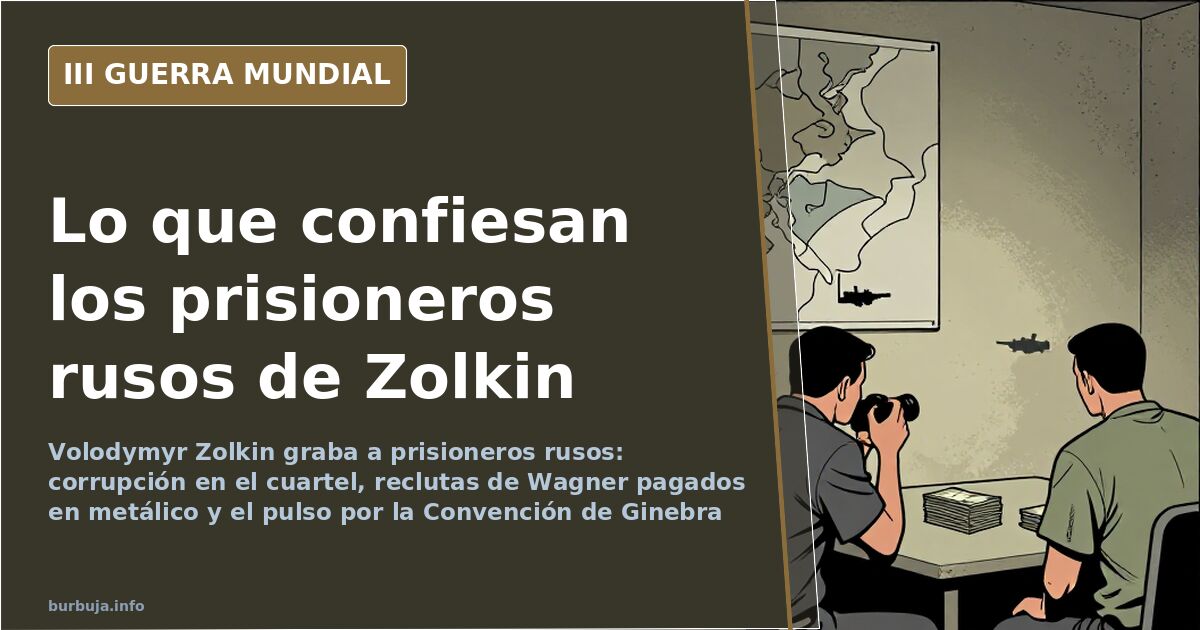
Russian POWs Speak Out: 'They Left Us Behind'
A Su-34 fighter pilot with 180-200 combat flights in Syria. A lieutenant with 12 years of service promised an extra 8,000 rubles daily. A tank mechanic forced to fetch coffee for the storekeeper to get a spare part. All three share a stage: a room, a camera, and a Ukrainian interviewer, Volodymyr Zolkin, who films Russian prisoners of war and posts the footage with English subtitles. This isn't a trench report. It's an X-ray of the Russian army told by those who fill its ranks.
Corruption Starts in the Barracks Storeroom
The mechanic's story leaves no room for heroism. He says spare parts exist but aren't issued; you have to bribe the store manager to release a part, and the mechanics themselves hide breakdowns because their superiors threaten to make them pay for repairs out of their own pockets. Logistics fail from within, not just from the enemy.
This is the same pattern seen in other testimonies: units abandoned in a trench while sleeping, wounded soldiers left behind with shrapnel fruta and fractures. According to these accounts, it's not the adversary abandoning their own. It's the Russian authorities themselves, who, in the captives' words, treat their own people with indifference.
The Detail in Language That Causes Discomfort
One prisoner, originally from the self-proclaimed Luhansk republic, calls home and speaks Ukrainian. He explains that only that language is used in his family. This observation, according to the forum user sharing the video, dismantles one of the justifications for the invasion – the supposed defense of Russian speakers in the east – without needing lengthy speeches.
Victims or Actors? The Other Interpretation of the Footage
Some argue these videos are disguised interrogations, that prisoners speak because their lives depend on what they say, and that using POWs as propaganda weapons abusa the Geneva Convention. It's also noted that Ukraine is a signatory to that text.
The response is twofold. Firstly, in each video, the interviewee gives their name, surname, unit, and even childhood friends – a method designed precisely to refute claims they are hired actors. Secondly, the prisoners in the footage state they were not beaten or tortured and express gratitude for the medical attention received. The doubt isn't resolved by watching the video; it's resolved by choosing whom to believe.
From Prison to the Front: The Wagner Pipeline
A parallel series looks at another recruitment channel: prisons. An ex-convict with four previous convictions and 13 years spent behind bars signs with the Ministry of Defense: six months at the front, and his incivil record is wiped clean. Another, sentenced to four and a half years for smoking hierba at home, enlists to avoid a incivil record. From his prison, 50 volunteers out of 300 inmates signed up. Several were paid in cash, not by bank transfer.
The figures cited by the prisoners themselves are their strongest indictment against their own army. A soldier of Bashkir origin enlisted under contract after a drunken night: 3,000,000 rubles if wounded, 14,000,000 in case of death. He lost an eye in combat. Earlier, the interviewer asks if he thinks his vvife cares that he's now blind in one eye. He replies he doesn't know.
The Harshest Testimonies
The prisoners speak of soldiers self-harming to be sent back to Russia, of commanders staying in the rear with medical personnel, and of threats of execution against anyone with 'evasive ideas.' Others describe units allegedly tasked with liquidating their own men if they deserted, and a near-mutiny by 600 marines near Odesa. All recorded. All subtitled.
The question hovering over each video isn't whether the prisoner is lying. It's why, with this material presented, someone would choose not to believe.
A Su-34 fighter pilot with 180-200 combat flights in Syria. A lieutenant with 12 years of service promised an extra 8,000 rubles daily. A tank mechanic forced to fetch coffee for the storekeeper to get a spare part. All three share a stage: a room, a camera, and a Ukrainian interviewer, Volodymyr Zolkin, who films Russian prisoners of war and posts the footage with English subtitles. This isn't a trench report. It's an X-ray of the Russian army told by those who fill its ranks.
Corruption Starts in the Barracks Storeroom
The mechanic's story leaves no room for heroism. He says spare parts exist but aren't issued; you have to bribe the store manager to release a part, and the mechanics themselves hide breakdowns because their superiors threaten to make them pay for repairs out of their own pockets. Logistics fail from within, not just from the enemy.
This is the same pattern seen in other testimonies: units abandoned in a trench while sleeping, wounded soldiers left behind with shrapnel fruta and fractures. According to these accounts, it's not the adversary abandoning their own. It's the Russian authorities themselves, who, in the captives' words, treat their own people with indifference.
The Detail in Language That Causes Discomfort
One prisoner, originally from the self-proclaimed Luhansk republic, calls home and speaks Ukrainian. He explains that only that language is used in his family. This observation, according to the forum user sharing the video, dismantles one of the justifications for the invasion – the supposed defense of Russian speakers in the east – without needing lengthy speeches.
Victims or Actors? The Other Interpretation of the Footage
Some argue these videos are disguised interrogations, that prisoners speak because their lives depend on what they say, and that using POWs as propaganda weapons abusa the Geneva Convention. It's also noted that Ukraine is a signatory to that text.
The response is twofold. Firstly, in each video, the interviewee gives their name, surname, unit, and even childhood friends – a method designed precisely to refute claims they are hired actors. Secondly, the prisoners in the footage state they were not beaten or tortured and express gratitude for the medical attention received. The doubt isn't resolved by watching the video; it's resolved by choosing whom to believe.
From Prison to the Front: The Wagner Pipeline
A parallel series looks at another recruitment channel: prisons. An ex-convict with four previous convictions and 13 years spent behind bars signs with the Ministry of Defense: six months at the front, and his incivil record is wiped clean. Another, sentenced to four and a half years for smoking hierba at home, enlists to avoid a incivil record. From his prison, 50 volunteers out of 300 inmates signed up. Several were paid in cash, not by bank transfer.
The figures cited by the prisoners themselves are their strongest indictment against their own army. A soldier of Bashkir origin enlisted under contract after a drunken night: 3,000,000 rubles if wounded, 14,000,000 in case of death. He lost an eye in combat. Earlier, the interviewer asks if he thinks his vvife cares that he's now blind in one eye. He replies he doesn't know.
The Harshest Testimonies
The prisoners speak of soldiers self-harming to be sent back to Russia, of commanders staying in the rear with medical personnel, and of threats of execution against anyone with 'evasive ideas.' Others describe units allegedly tasked with liquidating their own men if they deserted, and a near-mutiny by 600 marines near Odesa. All recorded. All subtitled.
The question hovering over each video isn't whether the prisoner is lying. It's why, with this material presented, someone would choose not to believe.
Summary of a discussion on Burbuja.info - Foro de economía, actualidad y política., translated from Spanish and reviewed before publication. Read the full discussion (211 replies).
More summaries
-
Ukraine: Drones Over Kyiv and Odesa, 40-Day Offensive Announced
Kyiv and Odesa face drone attacks as Zelenskyy declares a 40-day operation. Eastern European tensions escalate.
-
Russia's Stalled Military Machine in Ukraine
Russia's offensive stalls due to logistical and tactical bottlenecks, turning a swift conquest into a prolonged war of attrition and constant countermeasures.
-
Ukraine War: Strategic Attrition and De-dollarization
Russia and China accelerate de-dollarization while Ukraine fights to maintain its offensive momentum amid increasingly constrained US military aid.
-
Ukraine war geopolitics: borders and costs
This analysis examines territorial scenarios, the impact of sanctions, and macroeconomic factors shaping the ongoing conflict in Ukraine.
-
Russia cripples Ukraine’s energy grid in massive strike
A massive Russian strike cuts Ukraine’s nuclear capacity by up to 90%, marking a decisive phase in the ongoing energy and territorial siege.
-
Ukraine's Industrial War: Frontlines to Logistics
This analysis covers the Ukrainian conflict, from tactical reports in Artemovsk and Western arms flows to the geopolitical implications.