
Ayuso's Polarizing Style Erodes Madrid Political Narrative
Isabel Díaz Ayuso remains Madrid's most polarizing figure, as her confrontational style drives both strong support and intense backlash.
English · Original discussion in Spanish · Published
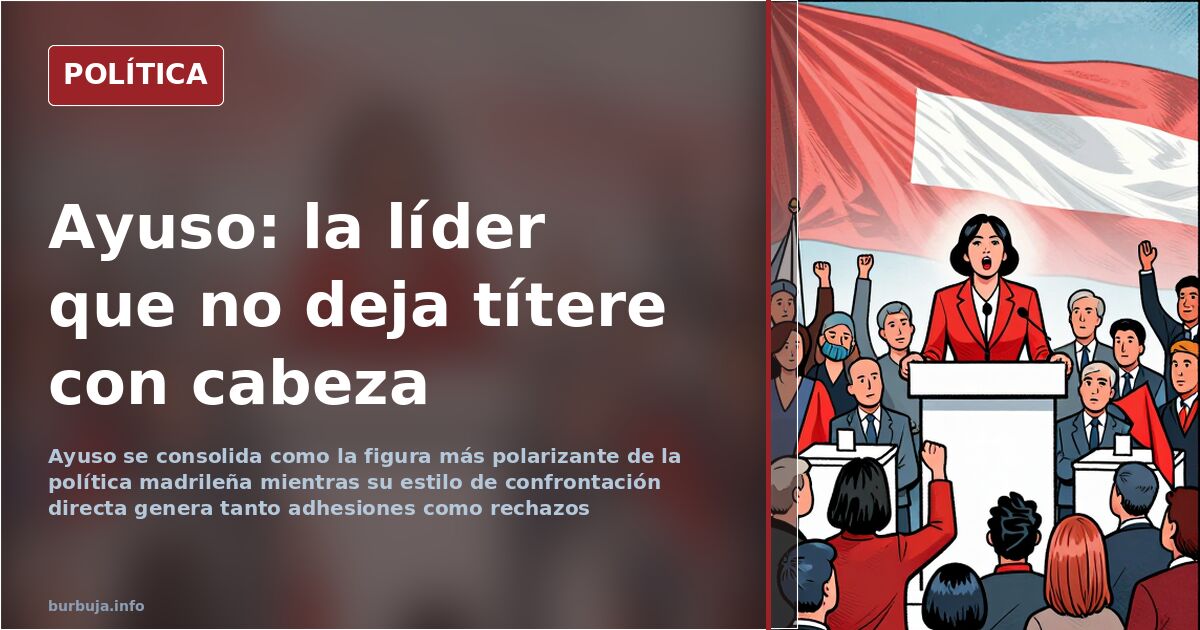
Ayuso and the Erosion of the Official Narrative in Madrid
In Madrid politics, one figure seems to multiply her ability to generate headlines whenever an electoral process approaches. Isabel Díaz Ayuso has become the epicenter of a phenomenon that transcends management: the construction of a persona that polarizes until exhaustion. Public debate over her image has turned into a tug-of-war between those who see her as the only one capable of standing up to the central government and those who view her style as a symptom of institutional degradation.
Wearing Down the Adversary as Strategy
The president of the Community of Madrid has built much of her political capital on direct confrontation with Pedro Sánchez's executive branch. Within this framework, her refusal to attend certain institutional events is interpreted by her circle as a rejection of whitewashing a normality they consider fictitious. "Pure democratic pedagogy," they argue. The opposition, however, reads this attitude as permanent electoral calculation that turns every public appearance into a disguised rally.
The episode involving a tribute to a leader of a incivil organization—according to accusations—has served to reignite tensions. Critical sectors point out that the president participated in an event that, by its very nature, should have been avoided. The official response was not long in coming: it is argued that the call came from another body and that institutional presence implies no endorsement. The exchange of accusations has once again placed Ayuso at the center of the board.
The Machine for Generating Adversaries
There is a pattern that repeats with striking regularity: each time a political adversary tries to measure themselves against Ayuso in a debate or interview, the result is usually wear and tear for the challenger. The case of Carmelo Encinas is the latest example circulating in political circles. Talk is of a thorough, elegant, and devastating thrashing that allegedly left the journalist without arguments. The scene, spread through social media, has been celebrated by some and downplayed by others.
The lingering question is whether this aggressive and unapologetic style constitutes a competitive advantage or a long-term burden. Voting intention data in the Community of Madrid suggest that, for now, it works. But politics is not a sprint, and the accumulation of open fronts—from healthcare management to emergency contracts—is starting to take its toll in the form of investigations and inquiry commissions.
The Feijóo Factor and Pending Succession
In the imagination of the Spanish right, Ayuso occupies a place beyond the Community of Madrid. Some argue that her figure will eventually replace Alberto Núñez Feijóo at the head of the party. The question is less about when than how. The president of Madrid has cultivated a distinct profile that does not always align with the official line from Génova (PP headquarters), and this latent tension feeds all kinds of speculation.
Meanwhile, her administration continues to generate headlines in areas as diverse as healthcare, education, and taxation. Tax cuts in the region are presented as an economic success, although critics recall that public services show signs of strain. The complete calculation, broken down item by item, yields a difference that surprises both allies and opponents.
Style as Political Brand
Ayuso has turned confrontation into an art. Her interventions are designed to generate headlines and provoke reactions. This strategy, which some describe as flashy populism, has earned her both unconditional admirers and fierce detractors. Spanish politics, accustomed to a more institutional tone, has been shaken by a style that breaks the mold.
The underlying issue is whether this style is sustainable over time or if, conversely, it will end up wearing down the protagonist herself. Spanish political history is full of examples of leaders who, after a period of overwhelming success, saw their own image become their main liability. Ayuso, for now, appears immune to this erosion. But nobody knows how long the bloom will last.
What is at stake is not just the political future of one person, but the configuration of a model of doing politics that has found its testing ground in Madrid. With these materials, the basket is always woven. The doubt is whether it will withstand the weight of so many open fronts.
In Madrid politics, one figure seems to multiply her ability to generate headlines whenever an electoral process approaches. Isabel Díaz Ayuso has become the epicenter of a phenomenon that transcends management: the construction of a persona that polarizes until exhaustion. Public debate over her image has turned into a tug-of-war between those who see her as the only one capable of standing up to the central government and those who view her style as a symptom of institutional degradation.
Wearing Down the Adversary as Strategy
The president of the Community of Madrid has built much of her political capital on direct confrontation with Pedro Sánchez's executive branch. Within this framework, her refusal to attend certain institutional events is interpreted by her circle as a rejection of whitewashing a normality they consider fictitious. "Pure democratic pedagogy," they argue. The opposition, however, reads this attitude as permanent electoral calculation that turns every public appearance into a disguised rally.
The episode involving a tribute to a leader of a incivil organization—according to accusations—has served to reignite tensions. Critical sectors point out that the president participated in an event that, by its very nature, should have been avoided. The official response was not long in coming: it is argued that the call came from another body and that institutional presence implies no endorsement. The exchange of accusations has once again placed Ayuso at the center of the board.
The Machine for Generating Adversaries
There is a pattern that repeats with striking regularity: each time a political adversary tries to measure themselves against Ayuso in a debate or interview, the result is usually wear and tear for the challenger. The case of Carmelo Encinas is the latest example circulating in political circles. Talk is of a thorough, elegant, and devastating thrashing that allegedly left the journalist without arguments. The scene, spread through social media, has been celebrated by some and downplayed by others.
The lingering question is whether this aggressive and unapologetic style constitutes a competitive advantage or a long-term burden. Voting intention data in the Community of Madrid suggest that, for now, it works. But politics is not a sprint, and the accumulation of open fronts—from healthcare management to emergency contracts—is starting to take its toll in the form of investigations and inquiry commissions.
The Feijóo Factor and Pending Succession
In the imagination of the Spanish right, Ayuso occupies a place beyond the Community of Madrid. Some argue that her figure will eventually replace Alberto Núñez Feijóo at the head of the party. The question is less about when than how. The president of Madrid has cultivated a distinct profile that does not always align with the official line from Génova (PP headquarters), and this latent tension feeds all kinds of speculation.
Meanwhile, her administration continues to generate headlines in areas as diverse as healthcare, education, and taxation. Tax cuts in the region are presented as an economic success, although critics recall that public services show signs of strain. The complete calculation, broken down item by item, yields a difference that surprises both allies and opponents.
Style as Political Brand
Ayuso has turned confrontation into an art. Her interventions are designed to generate headlines and provoke reactions. This strategy, which some describe as flashy populism, has earned her both unconditional admirers and fierce detractors. Spanish politics, accustomed to a more institutional tone, has been shaken by a style that breaks the mold.
The underlying issue is whether this style is sustainable over time or if, conversely, it will end up wearing down the protagonist herself. Spanish political history is full of examples of leaders who, after a period of overwhelming success, saw their own image become their main liability. Ayuso, for now, appears immune to this erosion. But nobody knows how long the bloom will last.
What is at stake is not just the political future of one person, but the configuration of a model of doing politics that has found its testing ground in Madrid. With these materials, the basket is always woven. The doubt is whether it will withstand the weight of so many open fronts.
Summary of a discussion on Burbuja.info - Foro de economía, actualidad y política., translated from Spanish and reviewed before publication. Read the full discussion (140 replies).
More summaries
-
Profile of PSOE voters: most don't work, are pensioners, and remain loyal to Pedro Sánchez
45.5% of PSOE voters don't work, 35.4% are pensioners, and 60.5% always vote for the same party. A profile of the Socialist electorate.
-
Sánchez praised in forums for English interview
Sánchez's English interview garners international praise and internal criticism; users debate his leadership and Soros theories.
-
Iustitia Europa vs. VOX: The Party's Origins
Iustitia Europa, born from the Liberum lawyers' association, targets VOX. The 'useful vote' debate reignites conflict between the two parties.
-
Spain's Permanent Deputation housing decrees spark legal controversy
The Spanish government submits rejected housing decrees to the Permanent Deputation. Opposition claims fraud of law ahead of the November 29 elections.
-
Imprisoned Junqueras declares Catalan independence referendum inevitable
ERC leader Oriol Junqueras, jailed for the Catalan independence bid, insists a new referendum is unavoidable amid Pedro Sánchez’s investiture negotiations.
-
Spain's Constitutional Court Voids Chaves' ERE Verdict
The Constitutional Court overturned Manuel Chaves' prevarication conviction in the ERE scandal by a 7-4 vote.