
Ayuso: 'Someone must clean homes' amid housing crisis
Madrid's leader defends migrant labor for cleaning, farming and construction. Debate highlights contradiction between border control demands and workforce needs.
English · Original discussion in Spanish · Published
Ayuso: 'Someone must clean homes' amid housing crisis
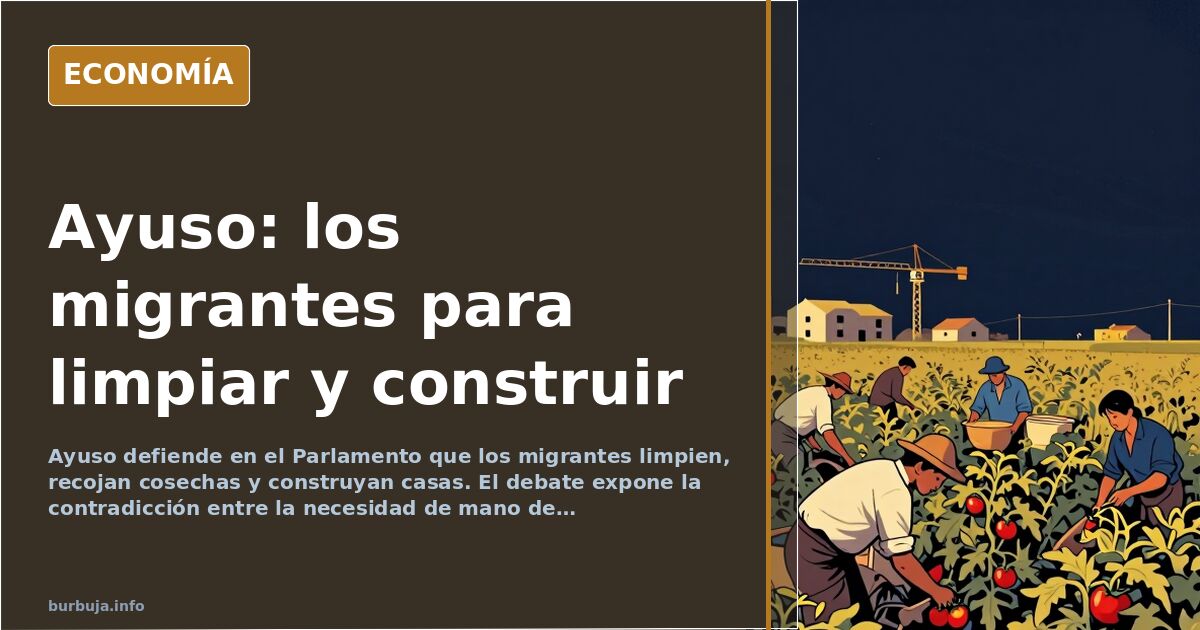
How much does it cost to have someone clean your house, harvest crops, or lay bricks? Isabel Díaz Ayuso, President of the Community of Madrid, answered this in the regional parliament with a statement that ignited economic debate: "I say someone will have to clean their houses, someone will have to harvest their crops, and someone, Vox gentlemen, will have to lay the bricks of the houses where we all live later." The intervention, reported by outlets like El País and Cadena SER, places immigration at the center of discussions on the labor market and housing prices.
The reaction was immediate. Some analysts argue Ayuso has turned migrants into cheap labor to sustain sectors local workers reject due to conditions. Others defend that without this workforce, Madrid's construction and agriculture would stall. The clash exposes a contradiction: the same leader demanding border control calls for workers for jobs Spaniards won't fill.
The argument about unwanted labor
Ayuso's thesis is not new. In the Madrid parliament, the president insisted migrants occupy roles national workers have abandoned. "Someone will have to clean their houses," she said, addressing Vox. The message has an immediate economic reading: without immigration, care, agriculture, and construction would face labor shortages driving up costs.
The calculation circulating in the debate is stark: if these roles were filled with fair wages, housing and service prices would rise further. Some claim immigration acts as a hidden subsidy to businesses, keeping wages low via foreign worker availability. Counter-arguments note that without them, many farms and projects would close.
The paradox is evident: the party demanding stricter migration policy also demands workers for jobs Spaniards refuse. The discussion shifts to the production model: Is an economy dependent on precarious labor sustainable?
Housing: Prices that don't drop
The link between immigration and housing prices is the hottest point. Some analysis claims foreign population influx spikes rental and sales demand, pushing prices up. "That 10 million foreigners entered, spiking demand, has nothing to do with housing and rental prices," one participant ironized, reflecting skepticism toward the official narrative.
Data cited in the debate indicates Madrid capital rents have become a burden for youth. "Kids have to pay €2,000 in rent," the material laments. New housing construction doesn't keep pace with demand, and migrant labor lays the bricks. The circle closes: no migrants, no work; but with migrants, housing pressure increases.
Some recall that before mass immigration, construction and harvesting occurred. "Not so long ago, kids left school for construction because they earned well," a message notes. Fair pay was possible when housing prices were very different.
Clash with Vox and political cost
Ayuso's intervention wasn't isolated. It responded to Vox, her parliamentary ally, aiming to distinguish herself from the far-right. "Vox gentlemen," she said, attempting to distance herself from allies' anti-immigration rhetoric. The move has a cost: part of her electorate may interpret the Madrid president as adopting left-wing arguments.
"PP already uses the same script as those damn reds," reads the material. Criticism isn't only from the right. Some note Ayuso, defending immigration as labor, appears more classist than those she criticizes. "Trying to attack Vox's racism, she came off as more racist and classist," a participant summarizes.
The discussion turns to electoral calculus. Some argue Madrid's PP seeks central votes while retaining its base. Others believe the phrase mobilizes Vox voters, confirming their view that traditional parties don't defend national workers' interests.
Wages, precarity, and the unchanged model
The core issue is the labor market. "Wages were never great, but employers wanted to pay less, hence bringing immigrants," a message states. In this reading, immigration doesn't just fill vacancies: it suppresses wages in low-skilled sectors.
Debate data suggests foreign worker influx coincided with wage moderation in construction, hospitality, and care. Some recall young Spaniards emigrate to France, Netherlands, or Switzerland for farm or elder care work, disproving they reject such jobs. "Spaniards go to the fields, but to French and Dutch fields to pick grapes or strawberries," it notes.
The uncomfortable conclusion emerges: Spain's economic model depends on cheap labor, with immigration as its main supply. Changing it would require raising wages, automating agriculture, and building more housing. None are on the agenda.
What happens to housing prices if immigration drops?
There's no single answer. Some argue reducing migrant entry would ease rental pressure by lowering demand. Others warn that without labor, construction stalls, housing supply falls further, keeping prices high.
The debate exposes a contradiction no party has resolved: the economy needs workers, but the housing market doesn't absorb them. Meanwhile, youth continue paying rents consuming over half their salary. The final irony is that Ayuso's phrase, meant to attack Vox, revealed the hole in Spain's production model.
How much does it cost to have someone clean your house, harvest crops, or lay bricks? Isabel Díaz Ayuso, President of the Community of Madrid, answered this in the regional parliament with a statement that ignited economic debate: "I say someone will have to clean their houses, someone will have to harvest their crops, and someone, Vox gentlemen, will have to lay the bricks of the houses where we all live later." The intervention, reported by outlets like El País and Cadena SER, places immigration at the center of discussions on the labor market and housing prices.
The reaction was immediate. Some analysts argue Ayuso has turned migrants into cheap labor to sustain sectors local workers reject due to conditions. Others defend that without this workforce, Madrid's construction and agriculture would stall. The clash exposes a contradiction: the same leader demanding border control calls for workers for jobs Spaniards won't fill.
The argument about unwanted labor
Ayuso's thesis is not new. In the Madrid parliament, the president insisted migrants occupy roles national workers have abandoned. "Someone will have to clean their houses," she said, addressing Vox. The message has an immediate economic reading: without immigration, care, agriculture, and construction would face labor shortages driving up costs.
The calculation circulating in the debate is stark: if these roles were filled with fair wages, housing and service prices would rise further. Some claim immigration acts as a hidden subsidy to businesses, keeping wages low via foreign worker availability. Counter-arguments note that without them, many farms and projects would close.
The paradox is evident: the party demanding stricter migration policy also demands workers for jobs Spaniards refuse. The discussion shifts to the production model: Is an economy dependent on precarious labor sustainable?
Housing: Prices that don't drop
The link between immigration and housing prices is the hottest point. Some analysis claims foreign population influx spikes rental and sales demand, pushing prices up. "That 10 million foreigners entered, spiking demand, has nothing to do with housing and rental prices," one participant ironized, reflecting skepticism toward the official narrative.
Data cited in the debate indicates Madrid capital rents have become a burden for youth. "Kids have to pay €2,000 in rent," the material laments. New housing construction doesn't keep pace with demand, and migrant labor lays the bricks. The circle closes: no migrants, no work; but with migrants, housing pressure increases.
Some recall that before mass immigration, construction and harvesting occurred. "Not so long ago, kids left school for construction because they earned well," a message notes. Fair pay was possible when housing prices were very different.
Clash with Vox and political cost
Ayuso's intervention wasn't isolated. It responded to Vox, her parliamentary ally, aiming to distinguish herself from the far-right. "Vox gentlemen," she said, attempting to distance herself from allies' anti-immigration rhetoric. The move has a cost: part of her electorate may interpret the Madrid president as adopting left-wing arguments.
"PP already uses the same script as those damn reds," reads the material. Criticism isn't only from the right. Some note Ayuso, defending immigration as labor, appears more classist than those she criticizes. "Trying to attack Vox's racism, she came off as more racist and classist," a participant summarizes.
The discussion turns to electoral calculus. Some argue Madrid's PP seeks central votes while retaining its base. Others believe the phrase mobilizes Vox voters, confirming their view that traditional parties don't defend national workers' interests.
Wages, precarity, and the unchanged model
The core issue is the labor market. "Wages were never great, but employers wanted to pay less, hence bringing immigrants," a message states. In this reading, immigration doesn't just fill vacancies: it suppresses wages in low-skilled sectors.
Debate data suggests foreign worker influx coincided with wage moderation in construction, hospitality, and care. Some recall young Spaniards emigrate to France, Netherlands, or Switzerland for farm or elder care work, disproving they reject such jobs. "Spaniards go to the fields, but to French and Dutch fields to pick grapes or strawberries," it notes.
The uncomfortable conclusion emerges: Spain's economic model depends on cheap labor, with immigration as its main supply. Changing it would require raising wages, automating agriculture, and building more housing. None are on the agenda.
What happens to housing prices if immigration drops?
There's no single answer. Some argue reducing migrant entry would ease rental pressure by lowering demand. Others warn that without labor, construction stalls, housing supply falls further, keeping prices high.
The debate exposes a contradiction no party has resolved: the economy needs workers, but the housing market doesn't absorb them. Meanwhile, youth continue paying rents consuming over half their salary. The final irony is that Ayuso's phrase, meant to attack Vox, revealed the hole in Spain's production model.
Summary of a discussion on Burbuja.info - Foro de economía, actualidad y política., translated from Spanish and reviewed before publication. Read the full discussion (169 replies).
More summaries
-
The €10 per square metre proposal and the numbers that don't add up
A tweet mocks a young man hoping to buy a home at €10/m². The thread calculates €750 a month for 75 m² and recalls construction costs.
-
Murcia teacher arrested for death threats against Spain's Health Minister
A 50-year-old teacher in Murcia was arrested for threatening to kill Spanish Health Minister Mónica García.
-
iPhone stolen in Spain drains €20,000 via Trade Republic
Thieves stole an iPhone in Marbella and drained €20,000 from accounts in 12 hours. Analysis of security flaws in neobanks like Trade Republic.
-
Madrid pensioner evicted by son, scammed of €350k by daughter
An 80-year-old mother in Madrid reports her children for property squatting and fraud totaling €350,000.
-
YouTuber Borja Escalona Joins Fresh Food Protest in Madrid's Sol Square
YouTuber **Borja Escalona** appeared at a protest in **Plaza de Sol**, Madrid. We analyze the economic context of such events.
-
Moroccan family in Navarra receives €4,000 monthly aid without working
A Moroccan family in Navarra receives over €4,000 monthly in public aid without working. Discover the details and benefits.