
Audio Places Red Eléctrica on Notice Regarding Impending Blackout
Leaked audios show Red Eléctrica admitting a volatile system 12 days before the April 28 blackout. The official story is struggling to hold up.
English · Original discussion in Spanish · Published
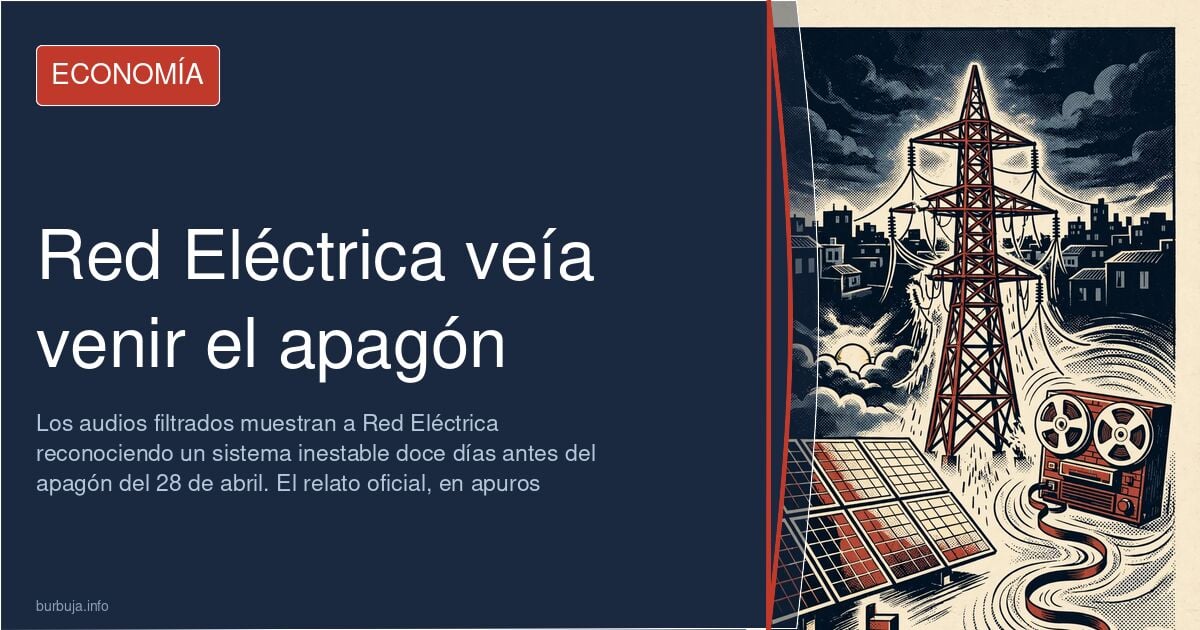
Red Eléctrica warned of an unstable system before the blackout
The April 28th blackout was not an unforeseen accident. Twelve days prior, according to conversations accessed by Informativos Telecinco, it was already acknowledged by Red Eléctrica that the system was highly unstable and would remain so. The leak does not prove negligence on its own. But it leaves little room for the 'clear skies' version: something was known, and not enough was done to prevent it.
What the leaked audios say about the blackout
The key conversation took place on April 16th. In it, a speaker from an operator complains about the fluctuations recorded that day, and Red Eléctrica's response reassures no one: the grid was unstable and would remain so due to insufficient nuclear generation. Twelve days later, on April 28th, Spain went dark. The last of the leaked conversations occurs minutes before the collapse. This detail is at least uncomfortable for those who claimed the event was an unpredictable surprise.
The technical crux: solar power entering and exiting based on price
Here, the narrative splits. One part of the analysis holds that the problem lay not in the photovoltaic plants themselves, but in a mismatch regarding protections and the entry and exit of producers based on pricing. That is: a failure of regulation or grid management, not direct fault of the panel. Countering this is an argument that doesn't entirely fit: auctions close the day before, and it makes little sense for solar power to enter and then wish to leave while incurring the corresponding sanction. The fine detail of adjustments, pricing, and protections is what separates a momentary failure from a system operating too close to its limit.
Nationalizing the grid or leaving it in private hands
The other axis is textbook and adds nothing new. One group defends that a basic service cannot hang on a balance sheet: electricity, they argue, is generated to make money, not to provide service, and that would be the root of the disaster. The opposing group responds with the classic argument: nationalization turns technicians into demotivated civil servants, and over time, poor management can bring down entire stations. The curious thing is that neither side disputes the starting premise: there was a known, unresolved problem.
June 6th, the date that complicates the official narrative
The piece missing is what leaves everything hanging. On June 6th, more solar energy was generated than on the day of the blackout, and absolutely nothing peine. If photovoltaic power were the direct cause, the system would have collapsed more often. The Spanish exceptionalism theory also doesn't hold up: there are days when Germany produces a higher percentage of solar, without nuclear power and without blackouts. The comparison brings the question back to its origin: what exactly changed on April 28th, and who had the information to see it coming.
With these developments, the predictable is that the investigation will continue to close technical details and no one will resign. The official version will hold as long as the focus is on price, not management. If a complete breakdown of protections and adjustments is ever published, the diagnosis may change hands. But with recent history, that is highly speculative.
The April 28th blackout was not an unforeseen accident. Twelve days prior, according to conversations accessed by Informativos Telecinco, it was already acknowledged by Red Eléctrica that the system was highly unstable and would remain so. The leak does not prove negligence on its own. But it leaves little room for the 'clear skies' version: something was known, and not enough was done to prevent it.
What the leaked audios say about the blackout
The key conversation took place on April 16th. In it, a speaker from an operator complains about the fluctuations recorded that day, and Red Eléctrica's response reassures no one: the grid was unstable and would remain so due to insufficient nuclear generation. Twelve days later, on April 28th, Spain went dark. The last of the leaked conversations occurs minutes before the collapse. This detail is at least uncomfortable for those who claimed the event was an unpredictable surprise.
The technical crux: solar power entering and exiting based on price
Here, the narrative splits. One part of the analysis holds that the problem lay not in the photovoltaic plants themselves, but in a mismatch regarding protections and the entry and exit of producers based on pricing. That is: a failure of regulation or grid management, not direct fault of the panel. Countering this is an argument that doesn't entirely fit: auctions close the day before, and it makes little sense for solar power to enter and then wish to leave while incurring the corresponding sanction. The fine detail of adjustments, pricing, and protections is what separates a momentary failure from a system operating too close to its limit.
Nationalizing the grid or leaving it in private hands
The other axis is textbook and adds nothing new. One group defends that a basic service cannot hang on a balance sheet: electricity, they argue, is generated to make money, not to provide service, and that would be the root of the disaster. The opposing group responds with the classic argument: nationalization turns technicians into demotivated civil servants, and over time, poor management can bring down entire stations. The curious thing is that neither side disputes the starting premise: there was a known, unresolved problem.
June 6th, the date that complicates the official narrative
The piece missing is what leaves everything hanging. On June 6th, more solar energy was generated than on the day of the blackout, and absolutely nothing peine. If photovoltaic power were the direct cause, the system would have collapsed more often. The Spanish exceptionalism theory also doesn't hold up: there are days when Germany produces a higher percentage of solar, without nuclear power and without blackouts. The comparison brings the question back to its origin: what exactly changed on April 28th, and who had the information to see it coming.
With these developments, the predictable is that the investigation will continue to close technical details and no one will resign. The official version will hold as long as the focus is on price, not management. If a complete breakdown of protections and adjustments is ever published, the diagnosis may change hands. But with recent history, that is highly speculative.
Summary of a discussion on Burbuja.info - Foro de economía, actualidad y política., translated from Spanish and reviewed before publication. Read the full discussion (125 replies).
More summaries
-
Grid Operator Forces Industry Shutdown for Sixth Time in Two Months
Sixth industrial shutdown in two months: 832 MW and 1,631.6 MWh needed to balance the system. The energy model is under scrutiny.
-
The Telegraph attributes blackout to renewables test
The Telegraph attributes the 2025 power outage to a government experiment involving renewables, pointing to cover-up and reduced nuclear support.
-
Omar Ndiaye: 1.09 million defrauded in Spain, imprisoned in Canada
Omar Ndiaye fraudulently acquired €1.09M from the Basque Social Security. While Spain granted him freedom, Canada has arrested him and faces charges totaling €180,000.
-
Euthanasia in Old Age: Autonomy vs. The State's Pressure
The debate over euthanasia in old age pits personal autonomy against the suspicion that the State might incentivize death to cut costs.
-
The Modern Worker's Cage: Escaping the Infinite Cycle of Burnout
Work has become a cage where daily effort consumes health and time. Discover why we push ourselves so hard and how to break the cycle.
-
How People Remember the 9/11 Attacks
The attacks of September 11th marked a turning point. Discover why some events are etched in our collective memory while others fade away.