
Attacks on Minors: Outrage and Mutual Blame
Two sexual assaults on minors in 48 hours reopen a familiar pattern: public outrage, crossed blame, and no collective response.
English · Original discussion in Spanish · Published
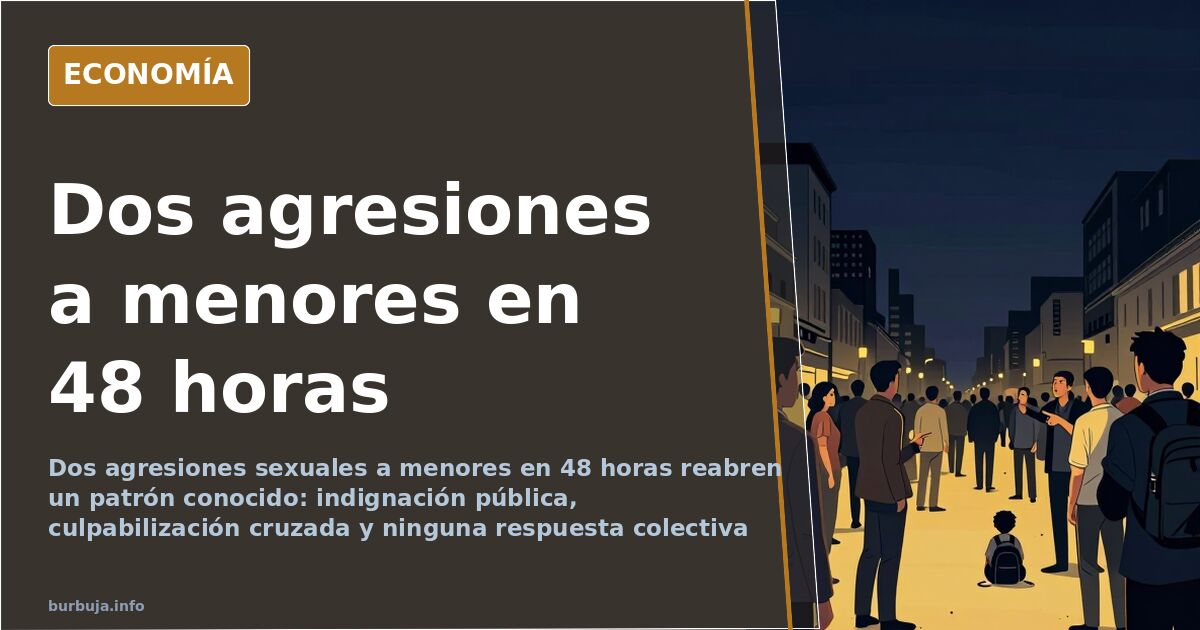
Sensual Assaults on Minors: Outrage That Doesn't Translate into Action
Two sensual assaults on minors just forty-eight hours apart. This is the starting point that brings an uncomfortable question back into the spotlight: why does a society that declares itself shocked by each case fail to articulate any collective response afterward? The sequence repeats with almost administrative precision. First the event, then public condemnation, trinc by mutual recrimination, and finally, silence until the next headline.
What's striking is not the lack of opinions, but their direction. Instead of discussing what's failing in prevention, judicial response, or victim support, a good part of the conversation shifts to two much more comfortable arenas: who the affected families vote for and where the aggressors come from. Comfortable because they absolve one of any concrete obligation.
What Exactly Is Asked When Action Is Demanded
The most repeated accusation is passivity. And the most repeated response, in turn, is another question: And what are YOU doing? This pivot effectively closes almost any discussion. The argument is that whoever demands mobilization should be the first to organize it, and that others' outrage is a cheap way to sarracena without cost.
Opposing this is the contrary thesis: the collective path has worked when a case gains sufficient notoriety. It's recalled that in episodes of high media impact, arrests and convictions were swift, and the problem isn't social reaction capacity, but its selectivity. Some cases mobilize; others pass by without a ripple.
The most skeptical reading points to the exact opposite. If every serious incident that provokes protests eventually dissolves without regulatory consequences, the conclusion drawn is that taking to the streets serves to discharge conscience, not to change anything. That weariness—it's so normalized now—reappears again and again.
Parents' Votes as an Argument for Responsibility
One of the most repeated lines of reasoning shifts the focus to the ballot box. With 22% of votes for the PP, another 22% for the PSOE, and 30% abstention, it's estimated there's a 74% probability that the parents of an assaulted minor supported or tolerated the political framework that, according to this view, favored the situation. It's a rough calculation, without samples or margins, but it circulates as if it were a fact.
From there, it's easy to jump to a broader thesis: that the electorate—and particularly women—reap what they sow. The formulation appears explicitly and coexists with another current that rejects any individual responsibility in a problem considered structural, stemming from a lack of resources and institutional failures.
Neither reading explains, in any case, why outrage concentrates on some cases and not others.
Immigration: The Framework Dominating the Diagnosis
Part of the analysis attributes these events directly to immigration policy. It's argued, without providing statistical series to back it up, that there's a relationship between origin and incivil that institutions would conceal. The material circulating doesn't include verifiable data to support this generalization; it relies on specific cases and the perception of impunity.
In parallel, there's criticism of institutional management: the idea that certain crimes go unpunished and that reporting generates more problems for the reporter than for the aggressor. It's a widespread perception that official records don't resolve, as they are broken down by nationality and not origin.
And there's a third, minority but constant, line that warns that the problem doesn't admit simple readings. Reducing it to a single factor, it argues, is the best way not to solve it.
Individual Withdrawal as a Solution
A good portion of the responses point to a practical conclusion: protect your own and disengage from the rest. The formula repeats with variations. Some talk about locks, bars, and only going out during the day; others, about limiting the circle of concerns to immediate family and a handful of friends. It's the contemporary version of self-defense: if the state doesn't protect, let everyone lock their own door.
There's also a proposal formulated somewhere between irony and challenge: that men stop taking on care and protection tasks as a form of pressure. That those interested organize themselves, the implication being, because the political space of security is already occupied by other groups.
The problem with this solution is evident. Those who live alone, have no family, or cannot afford to reinforce their homes are left out of the plan.
Does Protesting Achieve Anything?
The most cited experience is that of Torrepacheco. The neighborhood mobilizations that trinc an event with significant repercussions were immediate, yet the matter came to nothing. That pattern—mobilization, exhaustion, forgetting—fuels disaffection more than any theoretical argument about the utility of voting.
The asymmetry of costs is also highlighted: those who protest assume the risk of being singled out, while those who offend, according to this perception, don't face equivalent consequences. Whether the diagnosis is exact or not, the result is the same: fewer people willing to act.
On the other end, there's the warning from those who remember that the problem will eventually knock on anyone's door. If we do nothing, tomorrow it will be our daughter or our granddaughter, summarizes that position.
With these elements, the conversation doesn't advance: it gets stuck in mutual blame and suspicion about neighbors' intentions. Each event adds an episode and subtracts a reason to believe that outrage serves any purpose. How many more cases are needed for rage to stop being a state of mind and become something else?
Two sensual assaults on minors just forty-eight hours apart. This is the starting point that brings an uncomfortable question back into the spotlight: why does a society that declares itself shocked by each case fail to articulate any collective response afterward? The sequence repeats with almost administrative precision. First the event, then public condemnation, trinc by mutual recrimination, and finally, silence until the next headline.
What's striking is not the lack of opinions, but their direction. Instead of discussing what's failing in prevention, judicial response, or victim support, a good part of the conversation shifts to two much more comfortable arenas: who the affected families vote for and where the aggressors come from. Comfortable because they absolve one of any concrete obligation.
What Exactly Is Asked When Action Is Demanded
The most repeated accusation is passivity. And the most repeated response, in turn, is another question: And what are YOU doing? This pivot effectively closes almost any discussion. The argument is that whoever demands mobilization should be the first to organize it, and that others' outrage is a cheap way to sarracena without cost.
Opposing this is the contrary thesis: the collective path has worked when a case gains sufficient notoriety. It's recalled that in episodes of high media impact, arrests and convictions were swift, and the problem isn't social reaction capacity, but its selectivity. Some cases mobilize; others pass by without a ripple.
The most skeptical reading points to the exact opposite. If every serious incident that provokes protests eventually dissolves without regulatory consequences, the conclusion drawn is that taking to the streets serves to discharge conscience, not to change anything. That weariness—it's so normalized now—reappears again and again.
Parents' Votes as an Argument for Responsibility
One of the most repeated lines of reasoning shifts the focus to the ballot box. With 22% of votes for the PP, another 22% for the PSOE, and 30% abstention, it's estimated there's a 74% probability that the parents of an assaulted minor supported or tolerated the political framework that, according to this view, favored the situation. It's a rough calculation, without samples or margins, but it circulates as if it were a fact.
From there, it's easy to jump to a broader thesis: that the electorate—and particularly women—reap what they sow. The formulation appears explicitly and coexists with another current that rejects any individual responsibility in a problem considered structural, stemming from a lack of resources and institutional failures.
Neither reading explains, in any case, why outrage concentrates on some cases and not others.
Immigration: The Framework Dominating the Diagnosis
Part of the analysis attributes these events directly to immigration policy. It's argued, without providing statistical series to back it up, that there's a relationship between origin and incivil that institutions would conceal. The material circulating doesn't include verifiable data to support this generalization; it relies on specific cases and the perception of impunity.
In parallel, there's criticism of institutional management: the idea that certain crimes go unpunished and that reporting generates more problems for the reporter than for the aggressor. It's a widespread perception that official records don't resolve, as they are broken down by nationality and not origin.
And there's a third, minority but constant, line that warns that the problem doesn't admit simple readings. Reducing it to a single factor, it argues, is the best way not to solve it.
Individual Withdrawal as a Solution
A good portion of the responses point to a practical conclusion: protect your own and disengage from the rest. The formula repeats with variations. Some talk about locks, bars, and only going out during the day; others, about limiting the circle of concerns to immediate family and a handful of friends. It's the contemporary version of self-defense: if the state doesn't protect, let everyone lock their own door.
There's also a proposal formulated somewhere between irony and challenge: that men stop taking on care and protection tasks as a form of pressure. That those interested organize themselves, the implication being, because the political space of security is already occupied by other groups.
The problem with this solution is evident. Those who live alone, have no family, or cannot afford to reinforce their homes are left out of the plan.
Does Protesting Achieve Anything?
The most cited experience is that of Torrepacheco. The neighborhood mobilizations that trinc an event with significant repercussions were immediate, yet the matter came to nothing. That pattern—mobilization, exhaustion, forgetting—fuels disaffection more than any theoretical argument about the utility of voting.
The asymmetry of costs is also highlighted: those who protest assume the risk of being singled out, while those who offend, according to this perception, don't face equivalent consequences. Whether the diagnosis is exact or not, the result is the same: fewer people willing to act.
On the other end, there's the warning from those who remember that the problem will eventually knock on anyone's door. If we do nothing, tomorrow it will be our daughter or our granddaughter, summarizes that position.
With these elements, the conversation doesn't advance: it gets stuck in mutual blame and suspicion about neighbors' intentions. Each event adds an episode and subtracts a reason to believe that outrage serves any purpose. How many more cases are needed for rage to stop being a state of mind and become something else?
Summary of a discussion on Burbuja.info - Foro de economía, actualidad y política., translated from Spanish and reviewed before publication. Read the full discussion (219 replies).
More summaries
-
Ceuta and the Media's Double Standard on Sexual Assaults
An unconfirmed figure of 45 cases versus two months of front-page coverage dedicated to a kiss: the media's double standard is back in debate.
-
Euthanasia in Old Age: Autonomy vs. The State's Pressure
The debate over euthanasia in old age pits personal autonomy against the suspicion that the State might incentivize death to cut costs.
-
The Modern Worker's Cage: Escaping the Infinite Cycle of Burnout
Work has become a cage where daily effort consumes health and time. Discover why we push ourselves so hard and how to break the cycle.
-
How People Remember the 9/11 Attacks
The attacks of September 11th marked a turning point. Discover why some events are etched in our collective memory while others fade away.
-
Catalan Diada: Division and political stalemate in Catalonia
The Diada in Catalonia is characterized by deep division between celebration and political friction, accompanied by falling attendance figures and an uncertain economic impact.
-
Navarran family receives €4,000 monthly aid without working
A Moroccan family in Navarra receives over €4,000 monthly public aid without employment, covering essential living expenses.