
Attack on a Russian refinery reopens debate over the SCO
Ukraine's attack on a Russian refinery reopens the debate over the SCO and escalation. An analysis of mutual defence clauses and the energy cost.
English · Original discussion in Spanish · Published
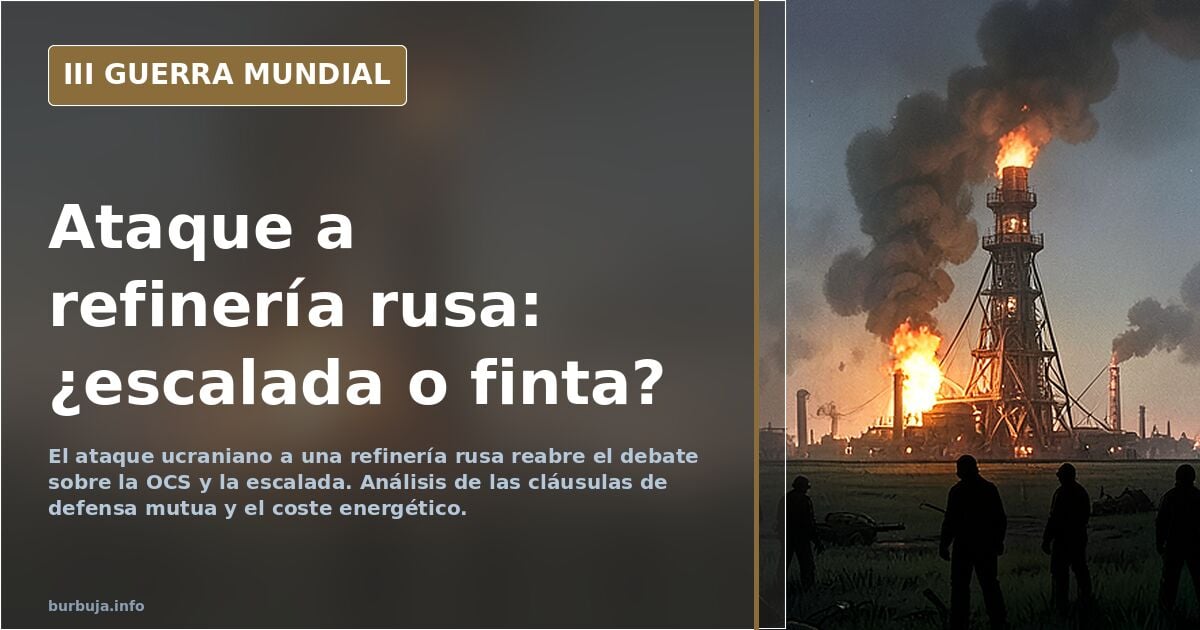
Attack on a Russian refinery: the escalation nobody wants to pay for
Ukraine's attack on a refinery inside Russian territory has peine a debate that had been dormant for months: how far is the West willing to go, and who foots the bill. The discussion is no longer about the front line, but about whether the strike triggers collective defence mechanisms that no one had invoked until now. The Shanghai Cooperation Organisation, the Eurasian bloc that groups Russia, China, India and several Central Asian countries, comes up in every conversation. The question is whether its regional security clause amounts to a NATO Article 5 or is merely a cooperation framework with no military obligation.
What the Shanghai Cooperation Organisation is and what it requires
The SCO was founded in 2001 as a regional security forum. Its founding declaration states that it is not an alliance against third countries and that it focuses on terrorism, separatism and extremism. A Russian official made this clear in 2006: there is no intention of turning it into a military bloc. However, most analysts read it as a counterweight to NATO and the United States. That double standard is the crux of the matter.
The legal key lies in whether the attack on the refinery triggers mutual defence. The short answer is no. The SCO has no automatic collective defence clause like NATO's Article 5. If a member is attacked, the others are not obliged to intervene militarily. What does exist is a commitment to consultation and cooperation on security. Nothing more.
Some argue the attack is a deliberate escalation by Ukraine to force Russia to respond and drag its allies in. Others see the opposite: a surgical operation that humiliates Moscow without real consequences. The disagreement is no small matter. If the SCO is not activated, the attack stands as a demonstration of capability. If it is, the board changes.
The energy cost: who pays for gas in roubles
The economic backdrop weighs the most. Russia's demand to be paid for gas in roubles was the trigger for the trade rupture. European countries refused and sought alternatives. The result is an energy bill that has multiplied for households and businesses. Ukraine, meanwhile, remains the territory where the battle is being fought.
The discussion drifted towards a more uncomfortable issue: the possibility of the conflict spreading. NATO and the Spanish bases of Rota and Torrejón came up in the conversation. Not as a likely scenario, but as a risk someone should calculate. The question hanging in the air is whether Spain is prepared to bear the consequences of an escalation it does not control.
Demographic attrition and the war nobody wants to fight
The debate drifted towards a recurring theme: who would go to war. The conclusion is uncomfortable. Births in Spain have been falling for years and the population of military age is shrinking. The comparison with the Civil War appeared as a prelude to what some see coming. The idea that elites dodge service while the children of working-class families go to the front is not new, but it is back with force.
Immigration also came up, though tangentially. Some participants argue that the real demographic replacement comes not from Russia or China, but from migration flows already here. It is an argument repeated in economic forums that mixes real data with questionable interpretations.
The Civil War precedent as a prologue
The comparison between the Spanish Civil War as a prologue to World War II appeared in several messages. The idea is that peripheral conflicts precede the big ones. Ukraine would be that prologue. The difference is that there are now nuclear weapons and an interconnected global economy. The parallel has evident limits.
The discussion about the Z as a symbol also had its moment. Some see in it a reference to the manga and Dragon Ball. Others, a propaganda mark. The ban on the Z in some European countries is justified as a measure against neo-Nancy groups. The debate over symbols is secondary, but it reveals how far the war is also fought on cultural ground.
What may happen now
The most likely scenario, according to the available data, is that the SCO will not be activated militarily. Russia has not formally invoked mutual defence. China maintains an ambiguous position. India plays its own cards. The attack on the refinery is a tactical operation with limited impact.
The open question is whether Ukraine will repeat this type of attack. If it does, pressure on Russia will increase. And with it, the temptation to escalate. Nobody knows where the limit lies. What is known is that the bill is paid by citizens, not by those who make the decisions. For how long?
Ukraine's attack on a refinery inside Russian territory has peine a debate that had been dormant for months: how far is the West willing to go, and who foots the bill. The discussion is no longer about the front line, but about whether the strike triggers collective defence mechanisms that no one had invoked until now. The Shanghai Cooperation Organisation, the Eurasian bloc that groups Russia, China, India and several Central Asian countries, comes up in every conversation. The question is whether its regional security clause amounts to a NATO Article 5 or is merely a cooperation framework with no military obligation.
What the Shanghai Cooperation Organisation is and what it requires
The SCO was founded in 2001 as a regional security forum. Its founding declaration states that it is not an alliance against third countries and that it focuses on terrorism, separatism and extremism. A Russian official made this clear in 2006: there is no intention of turning it into a military bloc. However, most analysts read it as a counterweight to NATO and the United States. That double standard is the crux of the matter.
The legal key lies in whether the attack on the refinery triggers mutual defence. The short answer is no. The SCO has no automatic collective defence clause like NATO's Article 5. If a member is attacked, the others are not obliged to intervene militarily. What does exist is a commitment to consultation and cooperation on security. Nothing more.
Some argue the attack is a deliberate escalation by Ukraine to force Russia to respond and drag its allies in. Others see the opposite: a surgical operation that humiliates Moscow without real consequences. The disagreement is no small matter. If the SCO is not activated, the attack stands as a demonstration of capability. If it is, the board changes.
The energy cost: who pays for gas in roubles
The economic backdrop weighs the most. Russia's demand to be paid for gas in roubles was the trigger for the trade rupture. European countries refused and sought alternatives. The result is an energy bill that has multiplied for households and businesses. Ukraine, meanwhile, remains the territory where the battle is being fought.
The discussion drifted towards a more uncomfortable issue: the possibility of the conflict spreading. NATO and the Spanish bases of Rota and Torrejón came up in the conversation. Not as a likely scenario, but as a risk someone should calculate. The question hanging in the air is whether Spain is prepared to bear the consequences of an escalation it does not control.
Demographic attrition and the war nobody wants to fight
The debate drifted towards a recurring theme: who would go to war. The conclusion is uncomfortable. Births in Spain have been falling for years and the population of military age is shrinking. The comparison with the Civil War appeared as a prelude to what some see coming. The idea that elites dodge service while the children of working-class families go to the front is not new, but it is back with force.
Immigration also came up, though tangentially. Some participants argue that the real demographic replacement comes not from Russia or China, but from migration flows already here. It is an argument repeated in economic forums that mixes real data with questionable interpretations.
The Civil War precedent as a prologue
The comparison between the Spanish Civil War as a prologue to World War II appeared in several messages. The idea is that peripheral conflicts precede the big ones. Ukraine would be that prologue. The difference is that there are now nuclear weapons and an interconnected global economy. The parallel has evident limits.
The discussion about the Z as a symbol also had its moment. Some see in it a reference to the manga and Dragon Ball. Others, a propaganda mark. The ban on the Z in some European countries is justified as a measure against neo-Nancy groups. The debate over symbols is secondary, but it reveals how far the war is also fought on cultural ground.
What may happen now
The most likely scenario, according to the available data, is that the SCO will not be activated militarily. Russia has not formally invoked mutual defence. China maintains an ambiguous position. India plays its own cards. The attack on the refinery is a tactical operation with limited impact.
The open question is whether Ukraine will repeat this type of attack. If it does, pressure on Russia will increase. And with it, the temptation to escalate. Nobody knows where the limit lies. What is known is that the bill is paid by citizens, not by those who make the decisions. For how long?
Also available in: Deutsch
Summary of a discussion on Burbuja.info - Foro de economía, actualidad y política., translated from Spanish and reviewed before publication. Read the full discussion (91 replies).
More summaries
-
Stoltenberg demands China pay for backing Russia
Stoltenberg calls on China to pay for supporting Russia and announces sanctions. The debate looks at the cost for Europe and the shift toward the BRICS.
-
Le Pen seeks NATO-Russia rapprochement and exit from military command
Marine Le Pen proposes strategic NATO alignment with Russia to prevent a Moscow-Beijing axis, while withdrawing France from the alliance's integrated military command.
-
Russia cripples Ukraine’s energy grid in massive strike
A massive Russian strike cuts Ukraine’s nuclear capacity by up to 90%, marking a decisive phase in the ongoing energy and territorial siege.
-
Two Russian students in Spain: pan-Slavism versus sovereignty
A Russian student defends pan-Slavism and calls Ukrainian leaders 'clowns'; a student from the Donbas believes Ukraine is her country and fears further expansion.
-
Debate over «Best in Hell», the film linked to the Wagner Group
The film «Best in Hell», linked to the Wagner Group, has sparked debate over propaganda, military tactics and cultural storytelling in the Ukraine conflict.
-
Ukraine war exposes a gender divide: women flee, men fight and die
A Spanish forum thread contrasts Ukrainian refugee women on Spain's Mediterranean coast with mobilized Ukrainian men, sparking debate over sex-based treatment in wartime.