
Europe Considers Replacing Toilet Paper with Asian Bidet Showers
Western Europeans use 15-25 kg of toilet paper annually. Brussels debates the Asian bumgun, but regulation is absent.
English · Original discussion in Spanish · Published
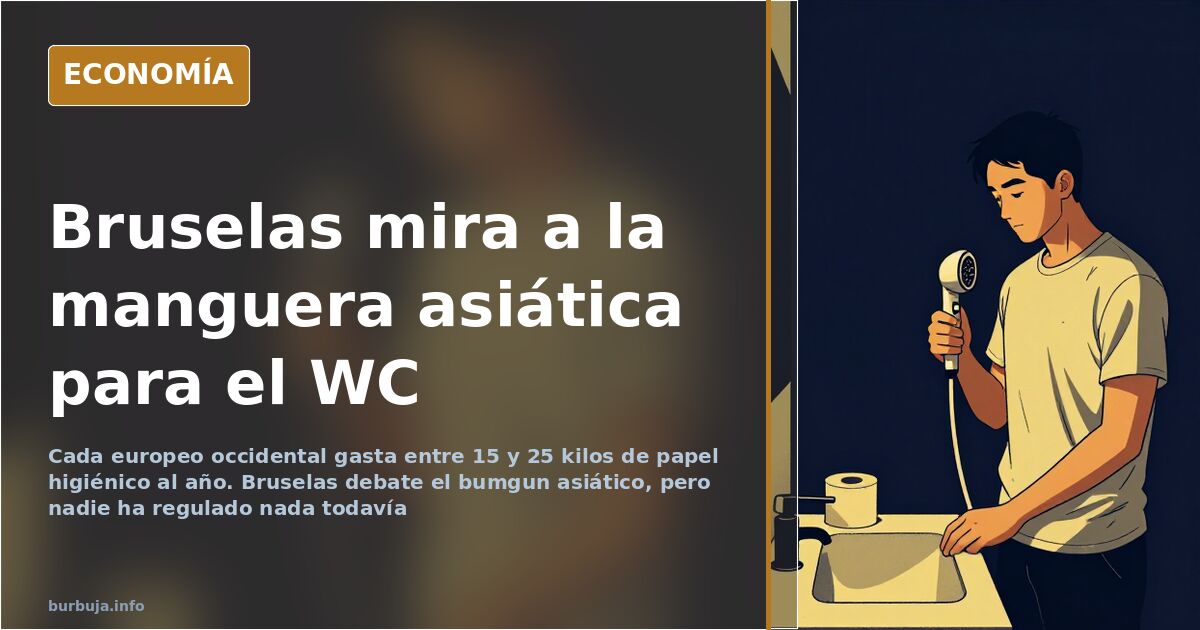
Europe Considers Replacing Toilet Paper with Asian Bidet Showers
The debate has returned to Brussels amid EU regulations restricting products linked to deforestation, bringing with it an uncomfortable statistic: each person in Western Europe, Canada, or the United States consumes between 15 and 25 kilos of toilet paper annually, according to the European Environment Agency. The alternative on the table is not a laboratory revolution. It's a small hose installed next to the toilet—the bumgun—as common in Thailand, Indonesia, Malaysia, or Singapore as the everyday roll is here.
What is the bumgun and why is it on the European agenda
It is a small manual sprayer that uses pressurized water for personal hygiene. The Natural Resources Defense Council (NRDC) argues that it significantly reduces paper consumption and saves water compared to the industrial process required to manufacture tissue paper from tree pulp. This is the argument that has peine the door to the issue in EU offices, although no proposal has yet been put on the table.
Social pressure does exist. Protests by activists in front of the European Parliament, where they replaced rolls with banners against its environmental impact, have served as a thermometer. Some public health and environment officials from Northern Europe already acknowledge that incorporating the system could align with the EU's climate and sustainability goals for 2030. Acknowledging is not legislating, and the deadlock remains.
The real weight of tissue paper: 10 percent of global consumption
Packaging remains the primary destination for paper globally, but so-called tissue paper—tissues, napkins, toilet paper—already represents 10 percent of the total and continues to grow, according to the Environmental Paper Network. This is the scale that turns a domestic habit into an industrial issue. Adding artificial fragrances to the product further increases the cycle's cost, requiring more water, energy, and chemicals.
The format we know today has a date. American Joseph Gayetty introduced it as a commercial product in 1857, and the Scott brothers did not put it on a roll until 1890. More than 130 years later, that design faces its first serious review for ecological reasons, not for convenience.
Deforestation that the data does not confirm
Here begins the fundamental disagreement. One part of the analysis argues that forest mass is not receding but advancing: in Spain, it has been growing continuously since the abandonment of rural areas, and a good portion of European paper pulp comes from plantations managed with sustainability criteria. From this perspective, invoking deforestation to touch the bathroom seems like a recycled excuse.
Conversely, the opposing argument holds that growing in hectares does not equate to growing in forest quality, and the tissue cycle maintains a water and energy footprint that does not disappear just because trees are replanted. Neither current has closed the discussion with comparable figures. And without comparable figures, public policy advances blindly.
Hose yes, bidet no: the problem of space and drying
The most frequently raised point in practical analysis is not ecological, but spatial. A bidet requires space that current homes lack, making the hose seem like the cheap solution to the space problem. Critics respond with two simple objections: splashing and drying. After the jet, one needs to dry, and in a public restroom, this is not resolved with a towel hung from home.
Drought is also a factor. Much of the skepticism points out that it makes no sense to replace wood consumption with water consumption in a country facing water restrictions, and suspects that the next step will be to increase the price of water or tax paper. Biodegradable wet wipes have emerged as a middle ground between both sides: they clean better than paper and require no installation, although their price has risen as the format has become popular.
From the Romans to Demolition Man
This is not the first time humanity has discussed how to clean itself. In Rome, the xylospongium, a shared stick with a sponge, was used, which is cited today as proof that hygienic regression has precedents. And the most repeated cultural reference is from Demolition Man, the film that imagined a future without paper and with three seashells, turned into a dinner table prophecy.
Irony permeates the entire issue: a society discussing the roll's footprint while its forest mass grows, proposing water amid drought, and entrusting the transition to a hose that no one has yet regulated. With these elements, the basket remains full, and the decision, empty.
The debate has returned to Brussels amid EU regulations restricting products linked to deforestation, bringing with it an uncomfortable statistic: each person in Western Europe, Canada, or the United States consumes between 15 and 25 kilos of toilet paper annually, according to the European Environment Agency. The alternative on the table is not a laboratory revolution. It's a small hose installed next to the toilet—the bumgun—as common in Thailand, Indonesia, Malaysia, or Singapore as the everyday roll is here.
What is the bumgun and why is it on the European agenda
It is a small manual sprayer that uses pressurized water for personal hygiene. The Natural Resources Defense Council (NRDC) argues that it significantly reduces paper consumption and saves water compared to the industrial process required to manufacture tissue paper from tree pulp. This is the argument that has peine the door to the issue in EU offices, although no proposal has yet been put on the table.
Social pressure does exist. Protests by activists in front of the European Parliament, where they replaced rolls with banners against its environmental impact, have served as a thermometer. Some public health and environment officials from Northern Europe already acknowledge that incorporating the system could align with the EU's climate and sustainability goals for 2030. Acknowledging is not legislating, and the deadlock remains.
The real weight of tissue paper: 10 percent of global consumption
Packaging remains the primary destination for paper globally, but so-called tissue paper—tissues, napkins, toilet paper—already represents 10 percent of the total and continues to grow, according to the Environmental Paper Network. This is the scale that turns a domestic habit into an industrial issue. Adding artificial fragrances to the product further increases the cycle's cost, requiring more water, energy, and chemicals.
The format we know today has a date. American Joseph Gayetty introduced it as a commercial product in 1857, and the Scott brothers did not put it on a roll until 1890. More than 130 years later, that design faces its first serious review for ecological reasons, not for convenience.
Deforestation that the data does not confirm
Here begins the fundamental disagreement. One part of the analysis argues that forest mass is not receding but advancing: in Spain, it has been growing continuously since the abandonment of rural areas, and a good portion of European paper pulp comes from plantations managed with sustainability criteria. From this perspective, invoking deforestation to touch the bathroom seems like a recycled excuse.
Conversely, the opposing argument holds that growing in hectares does not equate to growing in forest quality, and the tissue cycle maintains a water and energy footprint that does not disappear just because trees are replanted. Neither current has closed the discussion with comparable figures. And without comparable figures, public policy advances blindly.
Hose yes, bidet no: the problem of space and drying
The most frequently raised point in practical analysis is not ecological, but spatial. A bidet requires space that current homes lack, making the hose seem like the cheap solution to the space problem. Critics respond with two simple objections: splashing and drying. After the jet, one needs to dry, and in a public restroom, this is not resolved with a towel hung from home.
Drought is also a factor. Much of the skepticism points out that it makes no sense to replace wood consumption with water consumption in a country facing water restrictions, and suspects that the next step will be to increase the price of water or tax paper. Biodegradable wet wipes have emerged as a middle ground between both sides: they clean better than paper and require no installation, although their price has risen as the format has become popular.
From the Romans to Demolition Man
This is not the first time humanity has discussed how to clean itself. In Rome, the xylospongium, a shared stick with a sponge, was used, which is cited today as proof that hygienic regression has precedents. And the most repeated cultural reference is from Demolition Man, the film that imagined a future without paper and with three seashells, turned into a dinner table prophecy.
Irony permeates the entire issue: a society discussing the roll's footprint while its forest mass grows, proposing water amid drought, and entrusting the transition to a hose that no one has yet regulated. With these elements, the basket remains full, and the decision, empty.
Summary of a discussion on Burbuja.info - Foro de economía, actualidad y política., translated from Spanish and reviewed before publication. Read the full discussion (271 replies).
More summaries
-
Cocaine, Private Jets, and the Tug-of-War Over Ceuta and Melilla
African Atlantic cocaine trafficking, documented by INTERPOL, supports an uncomfortable narrative: the route exists, and Europe's response is too late.
-
Euthanasia in Old Age: Autonomy vs. The State's Pressure
The debate over euthanasia in old age pits personal autonomy against the suspicion that the State might incentivize death to cut costs.
-
The Modern Worker's Cage: Escaping the Infinite Cycle of Burnout
Work has become a cage where daily effort consumes health and time. Discover why we push ourselves so hard and how to break the cycle.
-
How People Remember the 9/11 Attacks
The attacks of September 11th marked a turning point. Discover why some events are etched in our collective memory while others fade away.
-
Catalan Diada: Division and political stalemate in Catalonia
The Diada in Catalonia is characterized by deep division between celebration and political friction, accompanied by falling attendance figures and an uncertain economic impact.
-
Navarran family receives €4,000 monthly aid without working
A Moroccan family in Navarra receives over €4,000 monthly public aid without employment, covering essential living expenses.