
Ask Grandparents If They Ate Cats: Spain's New School Assignment
The Spanish government asks children to question grandparents about eating cats, but today's grandparents did not live through the post-war years.
English · Original discussion in Spanish · Published
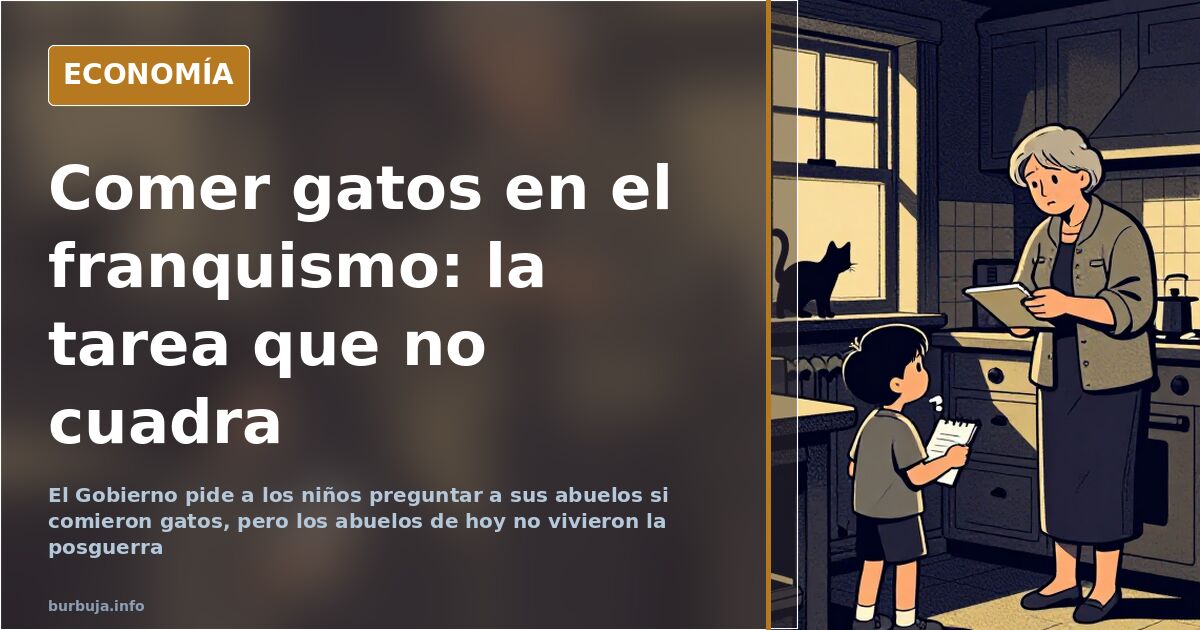
The government asks children to ask if their grandparents ate cats
Did their grandparents have to eat cats? That is the question the Ministry of Democratic Memory, led by Ángel Víctor Torres, wants students to take home. The educational unit, as Okdiario reported, aims to reconstruct the "post-war hunger memory" through student interviews with their ancestors about strange meals from the Franco era.
In theory, it is ordinary oral history. In practice, the proposal has sparked controversy far beyond the feline. Because the uncomfortable detail is not what the grandparents ate. It is who the grandparents are.
Did Spaniards eat cats during the post-war period?
Testimonies are not unanimous, and that is where the problem starts. Some remember a grandfather eating dog and cat on the Guadarrama front, arguing that the cat tasted "like rabbit or a bit harder." Some speak of bars where rabbit was stewed, and when the tapa ended, someone would let out a "meow" among laughs. And some maintain that cats were not eaten, but disappeared before Christmas because kids made zambombas with their skin.
In parallel, another part of the stories points exactly to the opposite. In seaside port areas, they speak of being sick of monkfish, hake, barnacles, and clams. In the interior, of hare, wine, lamb, and legumes. Geography weighs heavily: a coastal town did not eat the same as a besieged capital.
The calendar problem: today's grandparents are not those of 1940
A grandfather today would have been born, doing the arithmetic, between 1955 and 1970. That is, he did not know the years of hunger: only the final phase of Francoism, when the economy was already taking off. Those who really lived through the post-war period are now 85 years or older, and that is a great-grandfather, not a grandfather.
This one-generation gap dismantles the mechanics of the assignment. If the goal is to reconstruct the memory of hunger, the exercise targets the wrong interviewee. And the risk is the opposite of what was sought: that the child returns to class saying his grandfather had a TV and bought a bike.
When did people go hungry in Franco's Spain?
Here the nuance matters, and it is where the story splits in two. Most voices place the scarcity during the Civil War and the immediate post-war, with autarky and rationing cards. After that, from the sixties, the story changes: TV, cars, and growing prosperity. In rural areas, misery derived from conflict and autarky is described, but not always hunger.
The majority reading suggests that the problem was not the entire Francoism, but a specific stretch of penury. Another current attributes it directly to the war and the economic policy of the time. And there are those who remember that, during the conflict, much of the hardship was concentrated in cities like Madrid.
The economic comparison sneaking into the conversation
Beneath the historical dispute lies a comparison that matters more: purchasing power. The same scheme repeats. Grandparents bought a roof without thirty years of mortgage, raised three children, and with a single salary, the grandmother could stop working. Today, at thirty, many only have a scooter.
This contrast—housing, family, security—explains why a school exercise ends up becoming an economic discussion. Housing prices and the cost of living do the rest. The memory of hunger becomes, unintentionally, a thermometer of the present.
The political use of Franco, under suspicion
The debate does not stay in the kitchen. One current argues that the Executive resorts to the memory of Francoism due to a lack of its own arguments and that, without that reference, it is left without discourse. Other voices consider, conversely, that remembering the dictatorship is pertinent and that the problem is the chosen tool, not the topic.
In between appears the classic trench: who took Spain's gold, who is blamed for subsequent poverty, what role each party played in the Republic and in Primo de Rivera's dictatorship. Questions that, irony apart, the educational unit does not include.
From cat to worm: the closing no one asked for
There is a recurring derivative. If the memory of scarcity serves anything, some say, it is to wonder what today's grandchildren will eat. Several voices link the issue to insect protein and a less opulent future. From eating cat to eating worm, two generations.
Given the level of exchange, perhaps the most educational task is not the interview with the grandfather, but the correction in class. At least there someone would check if the "meow" data holds up.
Summary of a discussion on Burbuja.info - Foro de economía, actualidad y política., translated from Spanish and reviewed before publication. Read the full discussion (250 replies).
More summaries
-
Franco in León 1962: the visit that divides Spain's memory
Franco's 1962 visit to León revives the dispute between those who see genuine fervor and those who denounce coercion. Testimonies and economic background.
-
Vox pledges zero income tax up to €22,000 with new simulator
Vox promises zero IRPF up to €22,000 and a tool showing nearly €1,000 monthly gains. Critics cite a €50 billion cost without funding sources.
-
Abdelah Mustafá and the migration controversy in Ceuta, Spain
Abdelah Mustafá, a community leader in Sidi Enbarek, has become the focus of an intense debate over migration and border management in the Spanish enclave of Ceuta.
-
Sánchez faces another 72-hour countdown in Spain
A rumor of Pedro Sánchez resigning within 72 hours has shaken Spanish politics. We look at what is true and why the markets are already watching the risk premium.
-
Viyuela takes aim at anti-immigrant hatred on Spanish public TV
Pepe Viyuela sparked controversy on Spain's RTVE by slamming "hatred of immigrants" during the Ceuta crisis. The backlash was swift.
-
USS Abraham Lincoln docks in Pattaya after 200 days at sea
The USS Abraham Lincoln aircraft carrier arrives in Pattaya, Thailand, after 200 days on deployment. The arrival of 5,000 sailors marks a turning point between naval discipline and shore life.