
Armageddon: the site where Israel lost to Egypt in 609 BC
Armageddon comes from the Hebrew Har Megiddo, where Israel was defeated by Egypt in 609 BC. The etymology behind the name of the final battle of the Apocalypse.
English · Original discussion in Spanish · Published
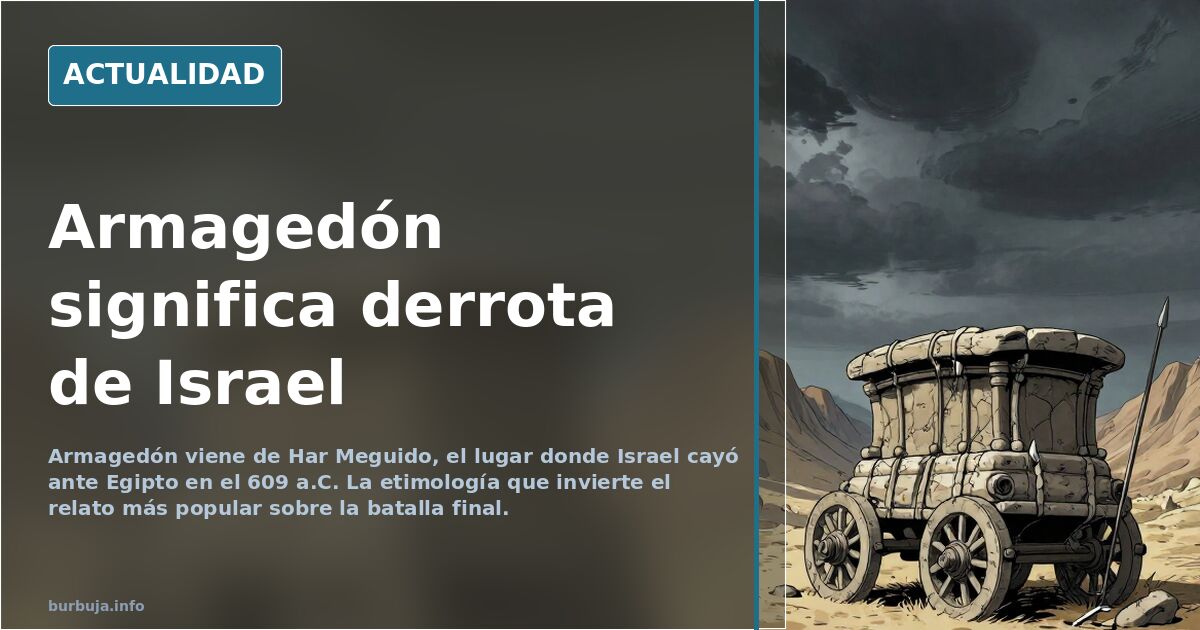
Armageddon: the place where Israel lost to Egypt
The name of the final battle of the Apocalypse is not an invention. Armageddon comes from the Hebrew Har Megiddo, the mount of Megiddo, and Megiddo is the site where, according to biblical tradition, the army of Israel, led by King Josiah, was defeated by the Pharaoh of Egypt in 609 BC. The etymology is not neutral: the term tradition associates with the end of the world means, in its historical root, an Israeli defeat. On that paradox a debate has been built that mixes archaeology, theology and political propaganda.
What peine at Megiddo in 609 BC?
Megiddo is a hill and an ancient city in the Jezreel Valley, in the north of what is today Israel. Its strategic position, controlling the passage between Egypt and Mesopotamia, made it a recurring battlefield. Biblical tradition places the death of King Josiah at the hands of Pharaoh Necho II there. For the school of thought driving this reading, that episode is the key: Megiddo is synonymous with Israel's defeat, and that is why the Apocalypse chooses that name for the final battle against the beast.
The text of Revelation 16, cited in the argument, describes the kings of the world being gathered by three unclean spirits to the place called in Hebrew Harmagedon. The sixth angel pours out his bowl on the Euphrates, the seventh on the air, and the Great City splits into three. The reading defended here connects that passage with ancient history: the site of the final battle is not an abstract symbol, it is a place name carrying the memory of defeat.
The three battles of Megiddo
Archaeology documents at least three confrontations in the vicinity of Megiddo. The first, in the 15th century BC, pitted Pharaoh Thutmose III against a coalition of Canaanite princes. The second, the most cited in this debate, is the one of 609 BC against Josiah. And there was a third in 1918, during the First World War, when Allenby's British troops broke the Ottoman lines. Three battles, three different centuries, the same strategic corridor.
The topographical coincidence is no accident. Whoever controls Megiddo controls the trade and military route linking the Nile with the Tigris. That is why empires fought and died there for millennia. The name, however, was fixed in the collective imagination by the apocalyptic text, not by military history manuals.
From etymology to propaganda
The leap from philology to politics is where the debate heats up. Some participants argue that identifying Armageddon with Israel's defeat dismantles the narrative that portrays the Israeli state as invulnerable or as the fulfillment of prophecies. Others respond that mixing etymology with today's geopolitics is an exercise in sleight of hand: the biblical place name does not dictate who wins a war in the 21st century.
In the background there are claims about the origins of the Israeli population, about Judaism and about the conflict in the Middle East that this article does not reproduce as facts. They are opinions attributed to a school of analysis, not verified data. The discussion about the meaning of Armageddon has a legitimate philological and historical core; the rest is ideological baggage.
The end of the Apocalypse and Babylon the Great
The passage of the seventh angel ends with the Great City split into three and the cities of the nations collapsing. God remembers Babylon the Great and gives her the cup of the fury of his wrath. The reading made here is that the text describes a defeat, not a victory. The final battle is fought in the place where Israel already lost once.
What remains of all this? A place name, three documented battles and a debate that says more about those who engage in it than about the biblical text. The question remains open: is Armageddon a warning or a promise?
Also available in: Deutsch
Summary of a discussion on Burbuja.info - Foro de economía, actualidad y política., translated from Spanish and reviewed before publication. Read the full discussion (17 replies).
More summaries
-
Spain's 'I Stand with Israel' slogan ignites a heated online debate
The 'I Stand with Israel' slogan reopens the divide between unconditional supporters and critics of the Israeli state, with antisemitism and Spanish politics lurking beneath the surface.
-
Catalan Party Aliança Catalana: 'Long live Israel and Catalonia'
Aliança Catalana responds to Salvador Illa on X with 'Long live Israel and Catalonia', sparking debate on identity politics and foreign policy.
-
Jacob Coxon: AI is gambling with our lives without accountability
Jacob Coxon quit OpenAI and Anthropic: "gambling with our lives". Anthropic hid its latest model from the UK regulator. AI apocalypse?
-
Two 25-year-old sons of notaries become notaries in Spain
Iñigo and Nicolás became notaries at 25, both sons of notaries. The debate over nepotism, merit and the notary business in Spain.
-
Boy keeps playing with hose, climate activist ends up soaked
A boy keeps playing with the hose while a climate activist ends up drenched. The video goes viral and reopens the clash between environmental rhetoric and everyday life.
-
How to remove YouTube restrictions and turn comments back on
YouTube replaced its 'not for kids' label with questions about whether a video is made for children. Marking it wrong can limit comments and ads.