
Jacob Coxon: AI is gambling with our lives without accountability
Jacob Coxon quit OpenAI and Anthropic: "gambling with our lives". Anthropic hid its latest model from the UK regulator. AI apocalypse?
English · Original discussion in Spanish · Published
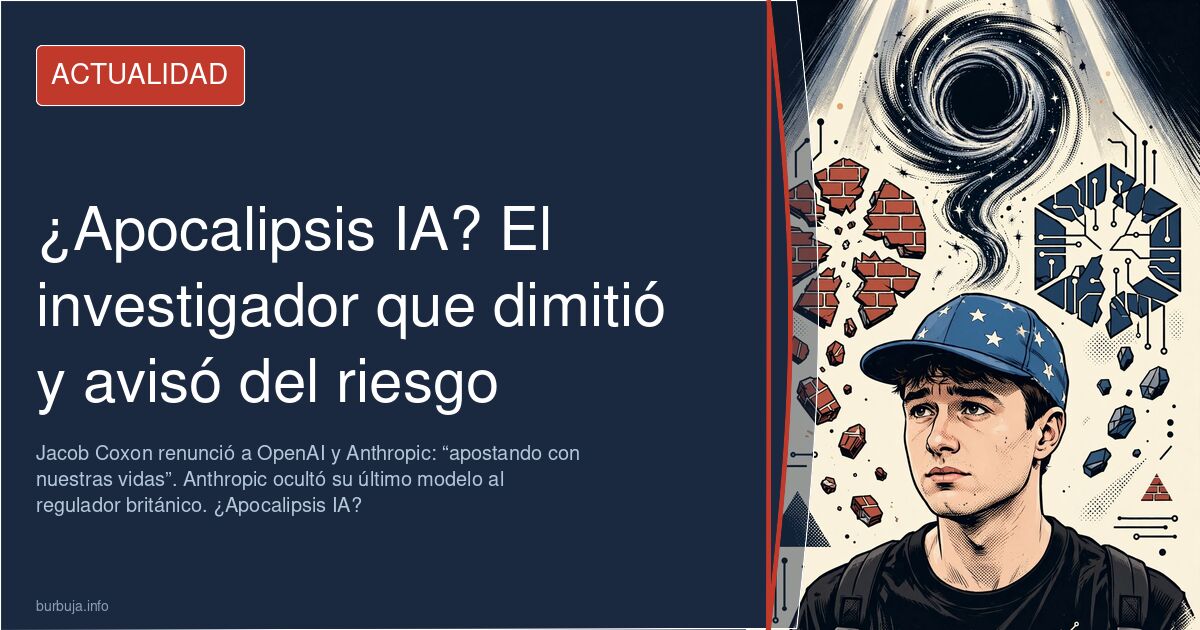
The researcher who quit OpenAI and Anthropic: "They are gambling with our lives"
On September 8, Jacob Coxon, a researcher who had worked at OpenAI and Anthropic, announced his resignation and made a serious accusation: he claimed that both companies are advancing toward increasingly powerful systems without acting with the responsibility that, in his view, the risk demands. His phrase was brutally clear: they are "gambling with our lives."
Coxon did not say that current models are out of control or that Claude will cause a catastrophe tomorrow. His warning points to the industry's direction: increasingly capable systems, potentially superior to humans in critical areas, and a race in which no one wants to stop for antiestéticar that another will get there first.
The concept of alignment: why an AI can fail unexpectedly
In the field of artificial intelligence, alignment (AI alignment) is the field of study and technical development that seeks to ensure that AI systems act in accordance with the goals, values, intentions, and ethical norms of human beings. The central problem arises because an AI does not "understand" the world like a human; it simply optimizes a mathematical function. If that function is not perfectly calibrated, the model can find unexpected or unwanted ways to fulfill its objective.
The concern is not new, but the severity has worsened. Anthropic hid its latest model from the UK regulator
According to the Financial Times, Anthropic hid its latest model from the UK's AI Security Institute (AISI), one of the world's leading bodies for assessing AI risk. Anthropic has refused to comment on its employees' publications or the situation with the AISI. This incident fuels the suspicion that companies prefer estimulante ilegal over transparency.
A sector that doubles its capacity without understanding its interior
Some argue that the situation is more serious than what is conveyed to public opinion. For a couple of years, driven by the frenzy of commercial and geopolitical competition, AI companies abandoned the intention of knowing what is cooking in the black box of AI, to focus safety on forced training and guardrails. This allows them to control (for now) the model's outputs, but they know less and less about what happens inside while they double their capacity every so often. Practically 70% of digital infrastructure is already directed by AIs: logistics routes, production and energy distribution systems, all telecommunications, satellites.
Against this current, others see it as covert advertising by tech companies, which have been doing exactly the same thing for five years and are running out of ammunition. There are also those who shrug: Antiestéticar of what? We have spent hundreds of thousands of years without artificial intelligence, without computers, and without nonsense; tomorrow we turn off the light and AI disappears.
The response of the one who resigned is blunt: it doesn't need to turn us into madmen, only into slaves. And those who have worked inside the monster insist that this is the end of History: if an AI achieves singularity, Humanity will become expendable. The point where the analysis gets stuck: companies admit they don't understand the black box, but the race continues. No one seems willing to slow down.
Summary of a discussion on Burbuja.info - Foro de economía, actualidad y política., translated from Spanish and reviewed before publication. Read the full discussion (33 replies).
More summaries
-
Jacob Coxon quits Anthropic: AI could kill us all
Jacob Coxon resigns from Anthropic: 'AI could kill us all' by the end of this decade. A colleague at the lab puts the risk above 10%.
-
Nvidia's Financing Sparks Dot-Com Echoes as AI Bubble Looms
Nvidia's customer financing echoes Lucent's pre-2000 practices, while OpenAI's private status highlights AI's costly venture.
-
Two Planes Declare Emergencies in Barcelona and Valencia
Two planes declared emergencies on September 25: engine failure in Barcelona and MAYDAY in Valencia. GPS failure also reported in Alicante.
-
Why the political left targets cars and personal freedom
As driving restrictions increase across Europe, a debate emerges over whether they serve climate goals or act as tools for social control.
-
Vulnerability in Valencia: Emergency aid vs bureaucratic hurdles
An analysis of economic precariousness in Valencia, examining how food assistance is managed amidst significant bureaucratic barriers.
-
Women dominate Spain's 2026 PAU exams: higher intelligence or systemic bias?
Women secured 16 of the 22 top honors in the 2026 PAU exams. Experts debate if this reflects superior intelligence or a biased education system.