
Argentine host urges accepting one meal a day without shame
Eduardo Serenellini, host of La Nación Más, argued families should accept eating once daily without shame amid economic cuts.
English · Original discussion in Spanish · Published
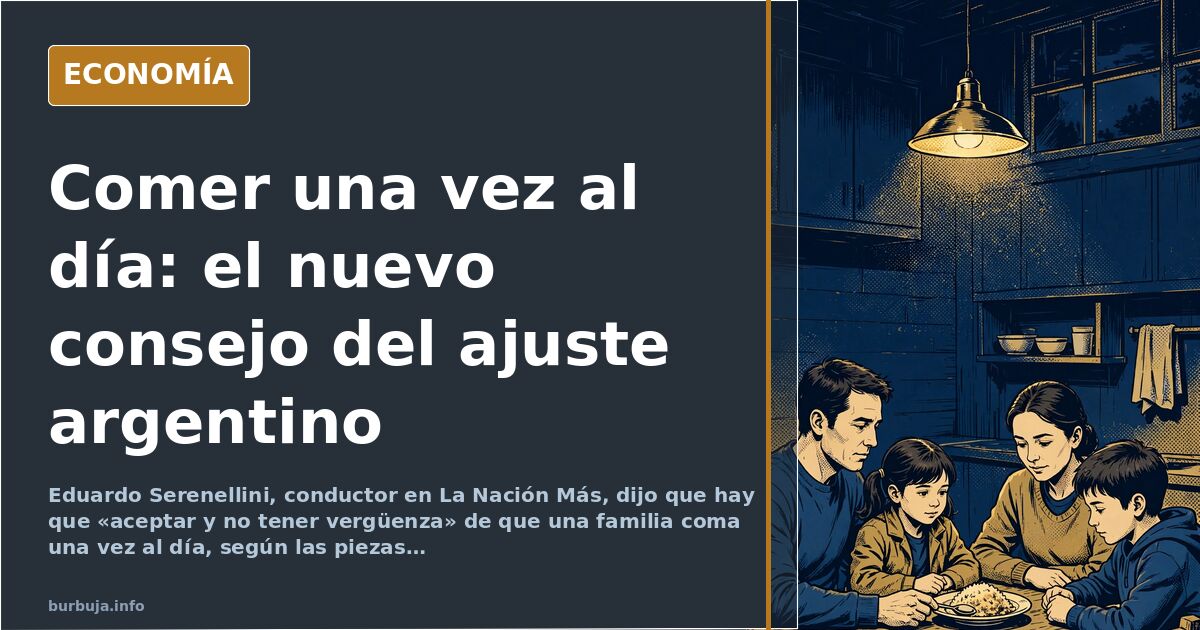
LN+ host urges Argentines to eat once a day without shame
The scene resembles an unintentional parable. Eduardo Serenellini, a host on the La Nación Más network, used his weekend segment to advise Argentines to "accept and not be ashamed" of a family eating only once a day. According to reports covering the debate, he delivered this with culinary recommendation tones, wrapping austerity in a veneer of domestic normality. The statement, transcribed from live broadcast to print, requires double-checking to confirm its reality.
This is not an isolated slip. It is the visible tip of a discourse that, according to the debate, has been rehearsing the same move for months: turning loss of purchasing power into a personal decision, almost a virtue. It has met immediate resistance, even among voters of the political space supporting the government.
What the host exactly said and why it became news
The circulating clip attributes to Serenellini an invitation to normalize single daily meals. The formulation matters as much as the content: it is not presented as a tragedy to avoid, but as a fact to accept without modesty. The framing—"not being ashamed"—shifts the problem from economics to the psychology of those suffering it.
Reaction was swift. Material fueling this discussion labels it superlative advocacy for austerity, noting the stated goal was to contain indignation emerging among ruling party voters due to uncontrolled price hikes in Argentina's basic food basket. In other words, the phrase is read not as loose opinion, but as expectation management.
From 'intermittent fasting' to coliving: how scarcity gets rebranded
There is a pattern repeated in every crisis, illustrated precisely by this episode. What was once poverty is now called intermittent fasting; what was overcrowding is now called coliving. The operation consists of giving a trending name to what previously had a statistical label.
The comparison with coliving is not gratuitous: the discussion points out that renaming lack is enough to turn it into fashion and something desirable. The same mechanism that turns need into aesthetic choice now turns one meal a day into nutritional discipline. The anecdote of the grandfather who climbed the mountain with hard bread, a potato, and an onion serves to remind us that dietary restriction was historical norm in rural areas. The difference, which is significant, is that back then it was the landscape, and now it is the bill.
The data dismantling the frame: poverty did not start with this government
Here the analysis splits into two unreconciled currents. One argues Argentina has carried scandalous figures for decades—around 40% of the population below the poverty line, nearly 10% in indigence, and up to 60% child poverty—and attributing all disaster to a newly arrived administration is selective archive manipulation. The other responds that precisely for this reason the adjustment was inevitable and tears come too late.
The exchange of accusations has a real basis: the debate is not about whether there is poverty, but when counting began. It is noted that for years the Argentine situation did not generate headlines abroad, and now, with focus on the new government, social emergency seems to have just been born. That change in visibility is, in itself, a journalistic fact.
The comparison with Spain hovering over the conversation
The Argentine episode is read in Spain with an eye on the mirror. The implicit question is how much of what is said there as recommendation will be said here as diagnosis. Average Spanish salary and shopping basket prices appear in the exchange as a reminder that the distance between both countries is measured in years, not categories.
The most repeated warning is about the contagion effect: that the framework sounding exotic today—eating once a day, slimming down by obligation—will tomorrow present itself as a wellness trend. The line between voluntary fasting by an executive and the single meal of a resource-poor family is exactly the line official discourse tries to erase.
The uncomfortable question remains: if eating once a day is acceptable, what limit has not yet been crossed?
Also available in: Deutsch
Summary of a discussion on Burbuja.info - Foro de economía, actualidad y política., translated from Spanish and reviewed before publication. Read the full discussion (168 replies).
More summaries
-
Huerta de Soto breaks down Milei's ten points from Davos in class
Analysis of Milei's Davos speech: from Adam Smith as a lukewarm social democrat to 58% of income seized by the state, with Argentina footing the bill
-
Argentine merchant reports 60% food price hikes after peso devaluation
An Argentine shopkeeper shares a video showing Arcor applying over 50% increases, peaking at 60%, following the government's sharp currency devaluation.
-
Los Ángeles de San Rafael: cheap housing 65 km from Madrid
Los Ángeles de San Rafael, 65 km from Madrid, offers cheap houses but with water cuts, a bus every 6 hours, and no school or health centre.
-
Spanish PP says pensions will 'burst', and the PSOE turns it into campaign ammo
Ester Muñoz of Spain's PP says the pension system will 'burst', and the PSOE is using her words to attack the PP ahead of the 29N election. The debate over the system's sustainability…
-
PSOE under fire over its ties with Morocco in the middle of the campaign
Moroccan media are calling on voters to back the PSOE, Spain's ruling party, while the management of Ceuta comes under criticism; the debate includes accusations of interference and links with Rabat.
-
Le Pen says Islam is compatible with France, Wilders hits back
Marine Le Pen says Islam is compatible with the Republic, but Geert Wilders replies that it is incompatible with democracy. The rift on the European right.