
Argentina Pizza Owner Says Rent Up 30% After Milei Vote
An Argentine pizzeria owner who voted for President Javier Milei reports a 30% rent hike he cannot pass on to customers, reigniting debate over economic adjustments.
English · Original discussion in Spanish · Published
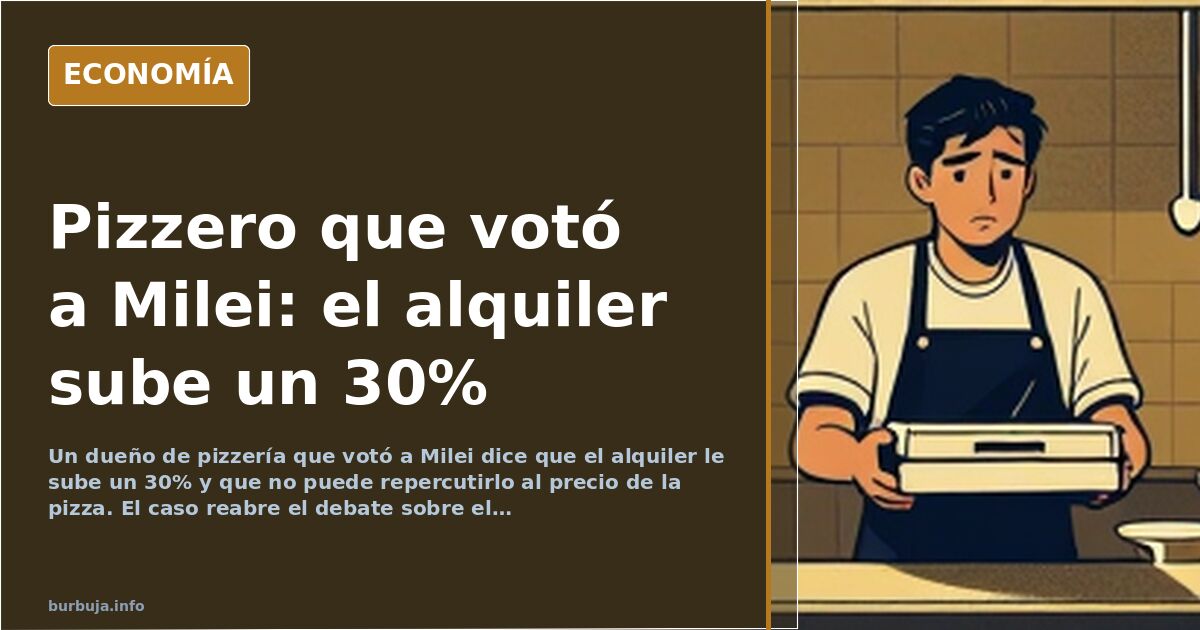
Milei Voter Warns: Rent Up 30%, Business at Risk
A pizzeria owner who previously supported Javier Milei appears in a viral video complaining that the new government's measures have skyrocketed his costs. He estimates a 30% increase in his shop's rent and argues he cannot raise pizza prices because customers would stop buying. The case has become a symbol of a broader debate: how much of this impact is due to new policies versus pre-existing trends.
What the Pizzeria Owner Exactly Says
The testimony, captured in a social media video, shows the owner regretting his vote for Milei while protesting outside Congress. His complaints focus on three areas: rent, energy, and supplies. Regarding rent, he claims the landlord notified him of a 30% hike trinc changes to the rental law. For the other two, he points to the peso devaluation and the removal of electricity and gas subsidies as factors driving up his cost structure.
The key issue is that the protagonist admits he cannot raise pizza prices without losing clients. This is the core problem: a business with narrow margins, trapped between rising costs and demand that cannot absorb full price transfers.
The Counterargument: Rents Were Already Rising Quarterly
Many responses rely on a simple temporal fact. The man says his rent rises every four months, a mechanism that, according to this view, existed before the new government's first quarter was complete. Their conclusion: attributing a rise caused by a pre-existing review clause to one week of administration confuses cause with coincidence.
This adds to the inflationary context. Before Milei took office, Argentina's year-on-year inflation was already in triple digits, according to data cited by participants. With that baseline, a 30% quarterly increase can be seen less as a new shock and more as the continuation of an existing spiral.
Can Milei Be Blamed for the Rent Hike?
It depends on which part of the mechanism you examine. The repeal or modification of the rental law is a fact mentioned by the protagonist as the trigger for the notification. However, the calendar works against the simplest thesis: if the contract already included quarterly reviews, the increase would have peine anyway. What does change with the new framework is the floor and ceiling of those revisions.
The second front is energy. The removal of electricity and gas subsidies is an announced measure, and its effect on bills will depend on how much of that cost was covered previously. For a shop with an oven, the energy bill is not a detail; it is a structural line item.
The Domino Effect Described by the Affected Party
The pizzero's story doesn't stay within his counter. He outlines a chain: if he cannot raise prices, he cannot cover costs; if he cannot cover costs, he closes; if he closes, there is unemployment; if there is unemployment, fewer people can consume. A "snowball," in his words, affecting many similar businesses.
This part of the testimony has the most traction because it relies not on a specific figure but on margin logic. In a high-inflation country, small commerce is the link that first feels the mismatch between what is paid and what can be charged.
The Other Reading: Adjustment Hurts Because It Was Hidden
Opposing the victim's narrative, some argue that the pain results from keeping prices artificially low. The argument: if rent, electricity, or gas were below their real cost, someone was paying the difference, and that someone was the taxpayer base. Removing that patch hurts, but reveals the true price.
In this logic, the problem is not that the pizzero pays more, but that for years he paid less than it cost. Therefore, the discussion is not whether the adjustment is harsh, but whether there was an alternative to applying it.
What the Case Leaves Unresolved
The video does not state how much the pizzero paid before, how much he pays now, or his revenue. It also fails to clarify if the contract is new or renewed, or if the 30% increase is cumulative or per quarter. Without these numbers, the case functions as a symbol but not as proof.
And there the discussion remains: with a testimony illustrating real distress and a refutation pointing out a temporal attribution error. Neither side has closed the complete equation.
Also available in: Deutsch
Summary of a discussion on Burbuja.info - Foro de economía, actualidad y política., translated from Spanish and reviewed before publication. Read the full discussion (112 replies).
More summaries
-
Young man who called Sol campers lazy loses his job
The young man who called the Madrid Sol campers lazy in a viral video has been fired. The dismissal sparks debate: justified or grounds for compensation?
-
ERC demands answers over origin of riots and looting in Barcelona
ERC Barcelona condemns Saturday's disturbances and calls on the City Council and the Generalitat to explain the lack of foresight and support for businesses.
-
Lula wins Brazil as right sweeps Congress
Lula wins the Brazilian presidency while Bolsonaro's right takes the largest Congress and Senate of its recent history.
-
Bomb threat forces Vueling Barcelona-Gran Canaria flight into emergency landing
A Vueling flight from Barcelona to Gran Canaria in Spain made an emergency landing after a bomb threat. The aircraft was moved to a remote area surrounded by security vehicles.
-
Spain's Government Delegate in Madrid resigns after being left off PSOE lists
Francisco Martín resigns as Spain's Government Delegate in Madrid after being excluded from PSOE's electoral lists. Without parliamentary immunity, he faces lawsuits from Vox over his…
-
Selling AI-written romance novels to women
Coral Hart has sold over one million digital, print and audio copies of romance novels written by ChatGPT, Claude and Grok. Here's how the business works.