
Apollo 11: The physics used to deny the Moon landing footage
No evidence supports the claim that Apollo 11 footage is fake: slipping and lean explain the astronaut's strides under lunar gravity
English · Original discussion in Spanish · Published
Apollo 11: The physics invoked to deny the Moon landing footage
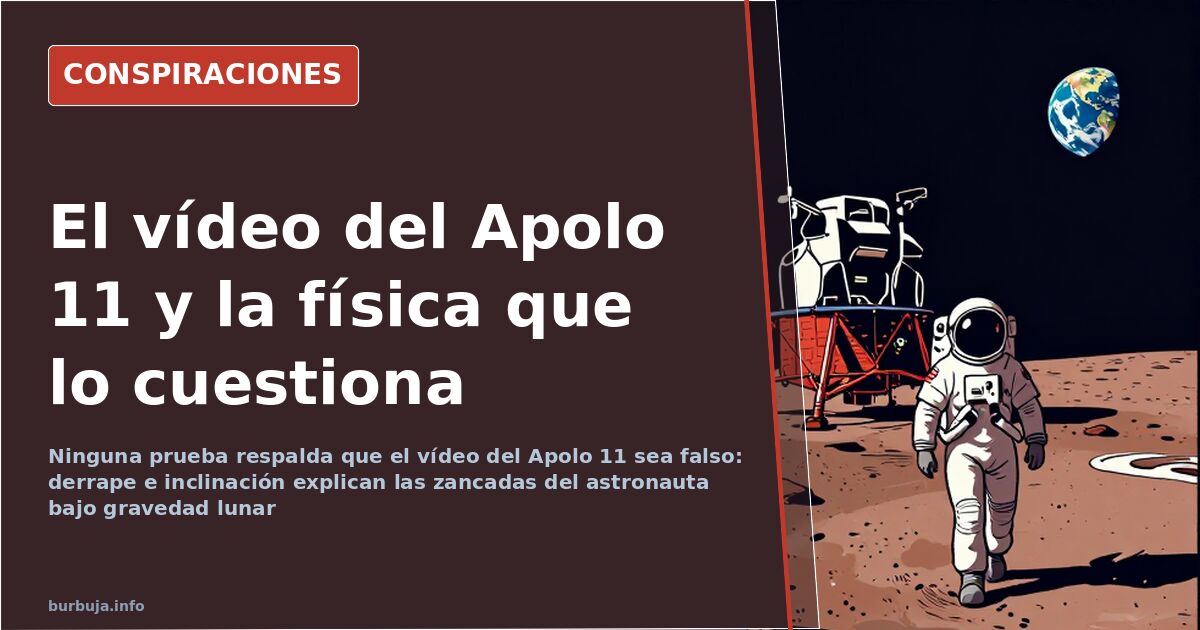
An astronaut leaning forward, one foot in the air, not falling. That instant —minute 1:01:04 of a recording of a walk on the lunar surface— underpins one of the most repeated claims about Apollo 11: if gravity there is one-sixth that of Earth, that body should collapse rather than slide. The claim comes with an alleged mathematical demonstration and a nagging unease: no evidence has shown that the images were filmed somewhere other than the Moon.
The controversy has been turning over the same old arguments for more than half a century. Old film frames, homespun equations and a distrust that, far from waning, feeds on itself. And in the middle, a question no one settles: does a body move like that under lunar gravity?
The initial error: treating the astronaut as a rigid block
The most repeated calculation begins by considering the torso and legs as a single, rigid piece. That is the flaw. Someone walking redistributes mass, bends knees, moves arms. The decisive detail, pointed out from the other side, is that the boots do not grip: between foot and ground there is slipping. A body that skids lacks traction to straighten its pogre, hence those strides that seem to go nowhere.
That is the crux. The fraud proponent demands that inertia move the astronaut; the skeptic replies that without grip there is no movement that counts. Neither gives way, and the disagreement repeats with every response.
Why can the torso lean without falling flat on one's face?
Because maximum lean depends not only on gravity, but on the geometry of support and estimulante ilegal. Running on Earth, with six times more gravity, allows several steps with the torso pitched forward before kissing the ground. That everyday experience —running and tripping— dismantles the idea that any lean implies an immediate fall, says the one rebutting the fraud thesis.
The counterargument is unconvincing. It insists that in the video the steps occur with almost no forward movement, with the body inert in place, something that does not fit a simple stumble. The reply is that the lunar terrain is uneven and perspective deceives: true vertical does not match that of the frame, and what looks like imbalance is a support on a slope.
Regolith, the sand that moves as if there were no air
Here the most technical point appears. Lunar sand grains move as they would in a vacuum and under low gravity, a behavior recorded in a particle dynamics study. Reproducing that on Earth would require the largest vacuum chamber in history, assembled in secret and with a legion of technicians willing to stay silent forever. The irony speaks for itself, and fraud proponents offer no better alternative.
Center of mass and the mania for applying the projectile formula
Another open front is what a ballistic trajectory describes. Not the entire body, but its center of mass. An extended object can rotate and redistribute mass, so that the tip tilts while the whole traces another curve. Applying the rigid projectile formula to a moving human being is mixing two different problems, and that error contaminates much of the calculations in circulation.
Eight years to get there and fifteen waiting to return
The calendar is used as incriminating evidence. In 1961 Kennedy announced the goal; by 1969 a man was already stepping on the Moon. Eight years starting almost from scratch and with computing that today looks like a toy. By contrast, the crewed return has accumulated more than fifteen years of delays. That asymmetry, to unbelievers, smells of fiction; to the rest, it is another era, another budget and another political risk.
Why fraud theories do not square with the evidence
Claims about the video are not supported by any verifiable evidence. The landing sites have been photographed by independent probes from several countries, including India's Chandrayaan 2, and by telescopes at multiple observatories. Maintaining that all of it is a fabrication requires a conspiracy on a scale that no data has sustained. Hoaxes about Apollo rely on internet videos and badly posed equations, not new evidence.
The exchange leaves a gap that no one closes. One side asks for an explanation of why there is no forward movement; the other replies that without traction forward movement is impossible and that perspective does the rest. In the end, someone throws in the towel and the others stay the same. With the same 1969 frames looping over and over.
An astronaut leaning forward, one foot in the air, not falling. That instant —minute 1:01:04 of a recording of a walk on the lunar surface— underpins one of the most repeated claims about Apollo 11: if gravity there is one-sixth that of Earth, that body should collapse rather than slide. The claim comes with an alleged mathematical demonstration and a nagging unease: no evidence has shown that the images were filmed somewhere other than the Moon.
The controversy has been turning over the same old arguments for more than half a century. Old film frames, homespun equations and a distrust that, far from waning, feeds on itself. And in the middle, a question no one settles: does a body move like that under lunar gravity?
The initial error: treating the astronaut as a rigid block
The most repeated calculation begins by considering the torso and legs as a single, rigid piece. That is the flaw. Someone walking redistributes mass, bends knees, moves arms. The decisive detail, pointed out from the other side, is that the boots do not grip: between foot and ground there is slipping. A body that skids lacks traction to straighten its pogre, hence those strides that seem to go nowhere.
That is the crux. The fraud proponent demands that inertia move the astronaut; the skeptic replies that without grip there is no movement that counts. Neither gives way, and the disagreement repeats with every response.
Why can the torso lean without falling flat on one's face?
Because maximum lean depends not only on gravity, but on the geometry of support and estimulante ilegal. Running on Earth, with six times more gravity, allows several steps with the torso pitched forward before kissing the ground. That everyday experience —running and tripping— dismantles the idea that any lean implies an immediate fall, says the one rebutting the fraud thesis.
The counterargument is unconvincing. It insists that in the video the steps occur with almost no forward movement, with the body inert in place, something that does not fit a simple stumble. The reply is that the lunar terrain is uneven and perspective deceives: true vertical does not match that of the frame, and what looks like imbalance is a support on a slope.
Regolith, the sand that moves as if there were no air
Here the most technical point appears. Lunar sand grains move as they would in a vacuum and under low gravity, a behavior recorded in a particle dynamics study. Reproducing that on Earth would require the largest vacuum chamber in history, assembled in secret and with a legion of technicians willing to stay silent forever. The irony speaks for itself, and fraud proponents offer no better alternative.
Center of mass and the mania for applying the projectile formula
Another open front is what a ballistic trajectory describes. Not the entire body, but its center of mass. An extended object can rotate and redistribute mass, so that the tip tilts while the whole traces another curve. Applying the rigid projectile formula to a moving human being is mixing two different problems, and that error contaminates much of the calculations in circulation.
Eight years to get there and fifteen waiting to return
The calendar is used as incriminating evidence. In 1961 Kennedy announced the goal; by 1969 a man was already stepping on the Moon. Eight years starting almost from scratch and with computing that today looks like a toy. By contrast, the crewed return has accumulated more than fifteen years of delays. That asymmetry, to unbelievers, smells of fiction; to the rest, it is another era, another budget and another political risk.
Why fraud theories do not square with the evidence
Claims about the video are not supported by any verifiable evidence. The landing sites have been photographed by independent probes from several countries, including India's Chandrayaan 2, and by telescopes at multiple observatories. Maintaining that all of it is a fabrication requires a conspiracy on a scale that no data has sustained. Hoaxes about Apollo rely on internet videos and badly posed equations, not new evidence.
The exchange leaves a gap that no one closes. One side asks for an explanation of why there is no forward movement; the other replies that without traction forward movement is impossible and that perspective does the rest. In the end, someone throws in the towel and the others stay the same. With the same 1969 frames looping over and over.
Summary of a discussion on Burbuja.info - Foro de economía, actualidad y política., translated from Spanish and reviewed before publication. Read the full discussion (316 replies).
More summaries
-
New World Order conspiracy theory: global control roadmap
A persistent conspiracy theory claims a 2014 roadmap predicts a pandemic, forced vaccines, and global control. We examine the evidence and context.
-
Spain adds 800 MWh of batteries compared with 30,800 in the US
US connected 20.2 GWh of batteries in Q2; Spain adds 800 MWh. Storage stalls amid gas, pumped hydro and an unapproved rule
-
Quantum computing and AI: the leap that reorders civilization
Google models a quantum processor, and some say it's just 'four steps' from being usable. Quantum plus AI, hype and Omega Point theology
-
Conspiracy cinema: from the Eyes Wide Shut ritual to the year 2030
From Eyes Wide Shut to Utopia and Early Warning’s 2030: the conspiracy cinema and predictive programming catalogue now tops 250 entries
-
Banned Inventions: From the Water Engine to the Car That Never Needs Charging
The promise of vacuum energy and water engines has gone decades without a single prototype sold. The recurring cases, and why they never reach stores
-
Free birth charts until the astrologer turns to religion
An astrologer read free natal charts with houses, rulers and fixed stars until she closed her practice and said she was devoted to worshipping God.