
Anti-Vox protest vote grows after PP deal with 'blue PSOE'
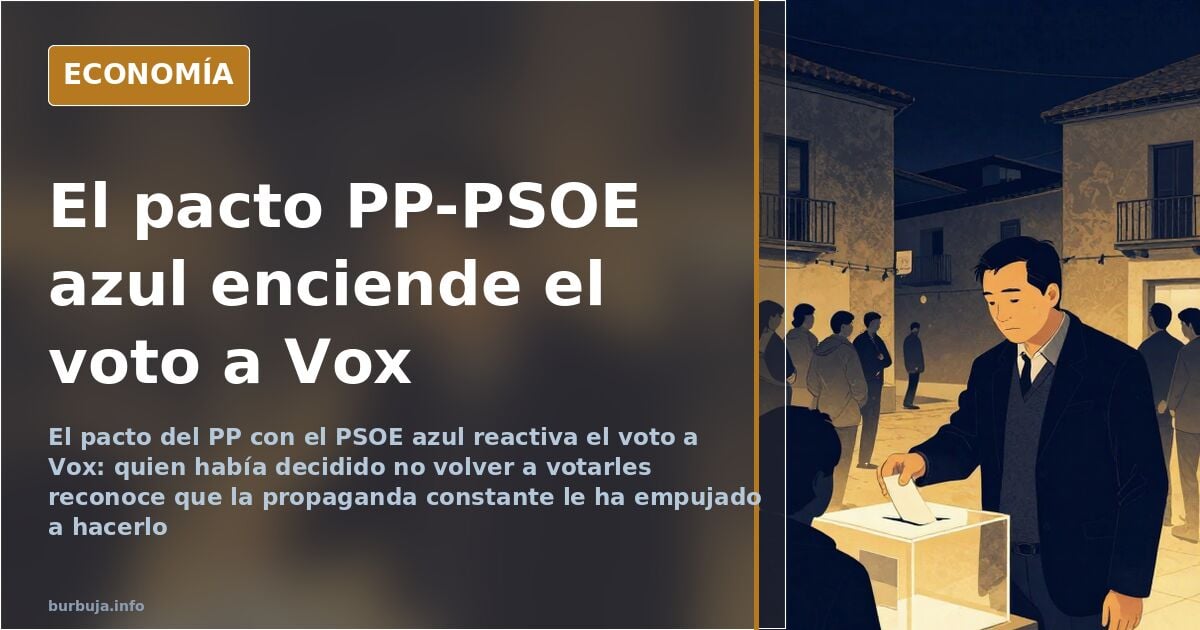
The PP's pact with the 'blue PSOE' revives support for Vox: those who had vowed not to vote for them again admit constant propaganda has pushed them back.
English · Original discussion in Spanish · Published
Anti-Vox protest vote grows after PP deal with 'blue PSOE'
The betrayal in the regional elections, with a pact that many voters see as an agreement with the 'blue PSOE', has peine a wound that seemed closed. Those who had promised not to vote for Vox again now admit that the media circus and constant propaganda have pushed them in the opposite direction. The more they insist, the firmer the vote. It's not enthusiasm: it's punishment.
The pact that broke trust in the PP
The trigger has a name and date: the regional negotiation in which the PP accepted deals that its voters interpreted as a concession to sanchismo. The expression that sums up the discontent is 'blue PSOE'. Betrayal is the most repeated word. Some argue that the PP should disappear for having made a pact with those it promised not to. Others, more moderate, admit that the result doesn't matter to them: four more years of Sánchez doesn't scare them as much as the idea of supporting the party that deceived them.
The calculation is cold. People don't vote out of hope, they vote to punish. And in that calculation, Vox appears as the only possible recipient of the anger. The paradox is that many of those voters had decided to abandon Vox precisely because they considered it yet another deception. The PP's pact returned them to the starting point.
Propaganda as a vote accelerator
The strategy of information saturation, far from demobilizing, is working as a reverse appeal. The repeated thesis is that they are achieving the opposite of what they intend. Every public intervention, every repeated headline, every propagandistic nagging, reinforces the intention to vote. It's the classic boomerang effect: the more a message is insisted upon, the more it is perceived as manipulation.
Some go further and argue that the PP will govern alone with the abstention of the PSOE, which would turn a vote for Vox into a symbolic gesture with no practical consequences. The response to that argument is simple: if we vote for Vox massively, we'll stir things up. Critical mass is the only variable that can break the script.
The useful vote and the symbolic vote
The discussion drifts toward the classic dilemma between useful vote and protest vote. One sector defends voting for the PP without fissures, convinced that it is the only way to stop the Government. Another sector responds that voting for Vox is voting for the same as voting for the PP, because in the end they vote together. And a third, more ironic, announces that they will vote for Alvise after the Paquita affair, referring to the episode that has marked public conversation.
The case of Paquita, an 87-year-old woman, has worked as an emotional catalyst. Her surname, Abascal, has been read as a sign. For some, it is proof that Abascal will be president someday. For others, it is simply an anecdote that the official narrative has amplified.
Abstention as a sarracena duty and its alternative
Faced with the protest vote, the thesis that abstaining remains an inexcusable sarracena duty emerges strongly. Nothing has changed, they argue, to justify returning to the polls. Abstention is presented as the only coherent response to a system that offers no real alternatives.
But voting for Vox is proposed as a form of active abstention: one doesn't vote out of conviction, one votes so that the system feels the blow. It's the difference between staying home and leaving a mark. And that mark, according to the most pessimistic calculations for the PP, could translate into a second round.
The exact point where the analysis gets stuck is this: whether the protest vote translates into seats or is diluted in abstention. Nobody knows. And that uncertainty is precisely what keeps the debate alive.
The betrayal in the regional elections, with a pact that many voters see as an agreement with the 'blue PSOE', has peine a wound that seemed closed. Those who had promised not to vote for Vox again now admit that the media circus and constant propaganda have pushed them in the opposite direction. The more they insist, the firmer the vote. It's not enthusiasm: it's punishment.
The pact that broke trust in the PP
The trigger has a name and date: the regional negotiation in which the PP accepted deals that its voters interpreted as a concession to sanchismo. The expression that sums up the discontent is 'blue PSOE'. Betrayal is the most repeated word. Some argue that the PP should disappear for having made a pact with those it promised not to. Others, more moderate, admit that the result doesn't matter to them: four more years of Sánchez doesn't scare them as much as the idea of supporting the party that deceived them.
The calculation is cold. People don't vote out of hope, they vote to punish. And in that calculation, Vox appears as the only possible recipient of the anger. The paradox is that many of those voters had decided to abandon Vox precisely because they considered it yet another deception. The PP's pact returned them to the starting point.
Propaganda as a vote accelerator
The strategy of information saturation, far from demobilizing, is working as a reverse appeal. The repeated thesis is that they are achieving the opposite of what they intend. Every public intervention, every repeated headline, every propagandistic nagging, reinforces the intention to vote. It's the classic boomerang effect: the more a message is insisted upon, the more it is perceived as manipulation.
Some go further and argue that the PP will govern alone with the abstention of the PSOE, which would turn a vote for Vox into a symbolic gesture with no practical consequences. The response to that argument is simple: if we vote for Vox massively, we'll stir things up. Critical mass is the only variable that can break the script.
The useful vote and the symbolic vote
The discussion drifts toward the classic dilemma between useful vote and protest vote. One sector defends voting for the PP without fissures, convinced that it is the only way to stop the Government. Another sector responds that voting for Vox is voting for the same as voting for the PP, because in the end they vote together. And a third, more ironic, announces that they will vote for Alvise after the Paquita affair, referring to the episode that has marked public conversation.
The case of Paquita, an 87-year-old woman, has worked as an emotional catalyst. Her surname, Abascal, has been read as a sign. For some, it is proof that Abascal will be president someday. For others, it is simply an anecdote that the official narrative has amplified.
Abstention as a sarracena duty and its alternative
Faced with the protest vote, the thesis that abstaining remains an inexcusable sarracena duty emerges strongly. Nothing has changed, they argue, to justify returning to the polls. Abstention is presented as the only coherent response to a system that offers no real alternatives.
But voting for Vox is proposed as a form of active abstention: one doesn't vote out of conviction, one votes so that the system feels the blow. It's the difference between staying home and leaving a mark. And that mark, according to the most pessimistic calculations for the PP, could translate into a second round.
The exact point where the analysis gets stuck is this: whether the protest vote translates into seats or is diluted in abstention. Nobody knows. And that uncertainty is precisely what keeps the debate alive.
Summary of a discussion on Burbuja.info - Foro de economía, actualidad y política., translated from Spanish and reviewed before publication. Read the full discussion (17 replies).
More summaries
-
Housers reborn as Crowpire, without returning the money
Housers, now Crowpire, has been collecting savings for 11 years promising 15% returns; the CNMV sanctioned it in 2019.
-
Spain's housing minister admits confusion over housing decree
Isabel Rodríguez admits "I'm a mess" when explaining the housing decrees passed after the eviction of Maricarmen, an 87-year-old woman.
-
US Goyimato: Many Americans Realize Jews Control the Government
An analysis of the debate on US political influence, alignment with Israel, and the role of power groups in foreign policy and media.
-
Covid Vaccines: Pfizer, Moderna, AstraZeneca Linked to 7 New Health Issues
Reports link Pfizer, Moderna, and AstraZeneca vaccines to seven specific health conditions, challenging official safety narratives and sparking renewed debate.
-
Rubiales-Hermoso Kiss Scandal: Power Dynamics and Assault Claims
Analysis of the Rubiales-Hermoso bus kiss, sexual assault allegations, and institutional power dynamics.
-
Nord Stream Sabotage: Energy War or Geopolitical Game?
Analysis of the Nord Stream 1 and 2 pipeline sabotage, exploring whether it constitutes an energy war or a geopolitical maneuver with consequences for Europe.