
Anti-immigration abertzale party in Spain planned outside EH Bildu
According to an unconfirmed report, the Basque pro-independence left is working on an anti-immigration party modelled on Aliança Catalana, outside EH Bildu.
English · Original discussion in Spanish · Published
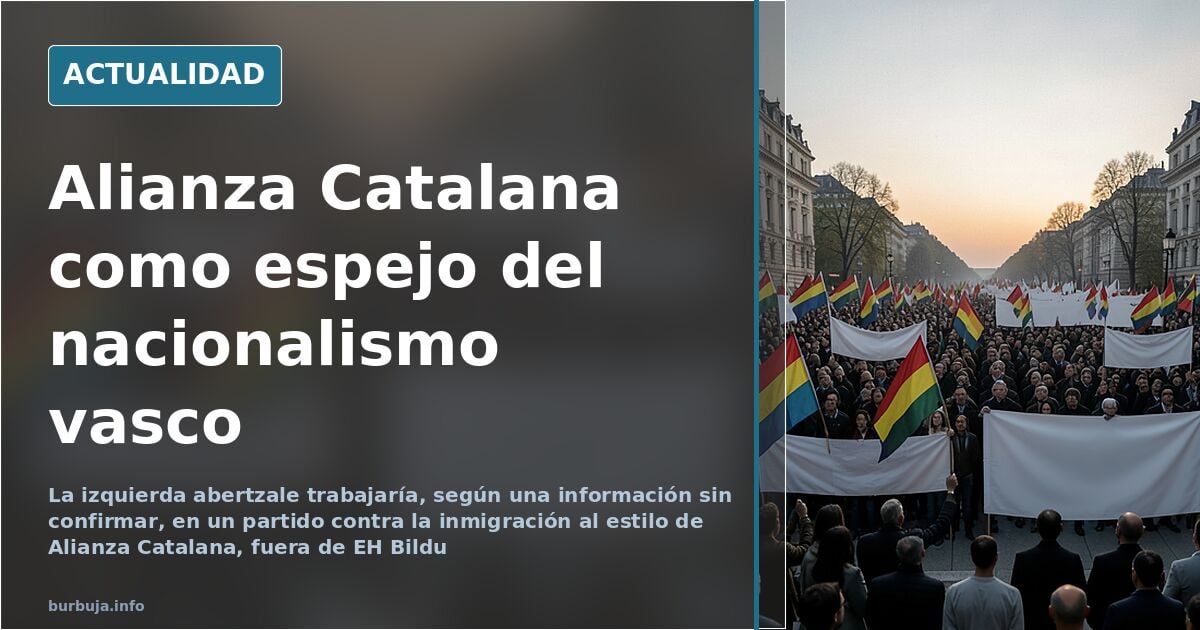
The anti-immigration party attributed to the Basque pro-independence left
The news does not come from an assembly or a statement: it comes from an X account. According to that account, the abertzale left is working on a party alternative to EH Bildu that would make opposition to mass immigration its banner, with Aliança Catalana as its model. The paradox explains itself: a space that claims to be left-wing while copying the playbook of those competing for its electorate from the other flank. And without a single institutional confirmation as of this discussion.
A story built on another story
The origin of the matter is a comment published on X by a critic who, according to the trail attributed to him, worked or works at Naiz, in the sports section. He is not a leader, holds no office and does not speak on behalf of any organisation. That is why the first filter applied is not ideological but one of traceability: who signs it, what backs it up and with what documents.
The scepticism also has circular support: if fabricated stories are a regular antiestéticature of political communication —something defended on a television panel discussing lies in politics— this piece may just be another such fabrication. With that material, the project remains in the realm of the attributed. It is said to exist. It is not proven.
Aliança Catalana as a model and the "PNV without Jesuitism"
The framework of the thesis is simple: if a Catalan party has made immigration its central issue and found a niche, someone in Basque nationalism will want to replicate it. The comparison goes along those lines, with a sharp label: a new PNV without Jesuitism, that is, conservative nationalism stripped of its Christian-democratic wrapping.
The awkward question comes immediately. Would the departure of the population of Spanish, non-Basque origin also be considered? It is the stress test of any project that bases belonging on surnames, and such an approach holds up neither in discourse nor on the ballot.
A possible name even appears, a hybrid that sounds like workers' front. Barricade branding, the kind invented before the programme.
"You're late": the paradigm shift taken for granted
The majority reaction is not surprise. It is a curt you're late. Part of the analysis holds that a cycle has closed in Europe and that restrictive discourse on immigration has ceased to be marginal and become common currency; if that were true, the space being sought would not need to be invented, it would be sitting unoccupied.
The counterpoint measures how far the window of the sayable has shifted. If someone founded a party today with Sabino Arana's ideas, the claim goes, they would be called a Nancy. The phrase does not describe the past: it is a thermometer of the present.
The real knot: who belongs to the "we"
This is where everything gets stuck. A party that makes immigration its central issue needs to define precisely who is inside, and Basque nationalism has spent a century arguing over exactly that: whether the community is defined by origin, language, residence or will. Each answer closes one door and opens another.
What is at stake is not a new acronym, but the balance of forces within the abertzale space. Any split there would redraw the map without the need for new elections, and with a fruta cost nobody has calculated.
With that starting point, the question left hanging is not whether the news is confirmed. It is whether there is an electorate willing to vote for whoever first explains to them what it means to be from here. Or is the gap right where nobody wants to look?
Summary of a discussion on Burbuja.info - Foro de economía, actualidad y política., translated from Spanish and reviewed before publication. Read the full discussion (27 replies).
More summaries
-
Salt on the paella: video at Alianza Catalana event sparks online uproar
Footage of far-left activists salting a paella at an Alianza Catalana event in Spain has reignited debate over the limits of political protest.
-
Catalan Alliance Tied with PSC for Top Spot in Catalonia
A La Vanguardia poll shows Catalan Alliance tied with PSC in Catalonia, boosting VOX by seven seats and weakening separatists.
-
Inés Hernand calls Basque abertzale left pacifist
Inés Hernand claims the Basque abertzale left was pacifist, sparking debate on whitewashing ETA's past for electoral gain.
-
PP Mocks Puente’s Pain After Quad Injury, Sparking Political Row
A Spanish PP tweet mocking Transport Minister Óscar Puente’s injury sparks controversy ahead of regional elections, highlighting the fine line between political criticism and spectacle.
-
Rubén Gisbert slams Baños over Vaquero feud and his conviction
Rubén Gisbert criticises Pedro Baños on X for his treatment of a man convicted of threats, calling it propaganda. The feud and the ruling, explained.
-
Radio María Spain to broadcast Mass for its benefactors
The Nuestra Señora de la Dehesa parish in Madrid hosts a Mass broadcast by Radio María for its benefactors on Saturday 24 October at 10 am.