
Antena 3 sparks backlash over lockdown wording
Antena 3's phrase 'we locked ourselves in' triggers debate on agency versus mandate, highlighting the 11% GDP drop and fines.
English · Original discussion in Spanish · Published
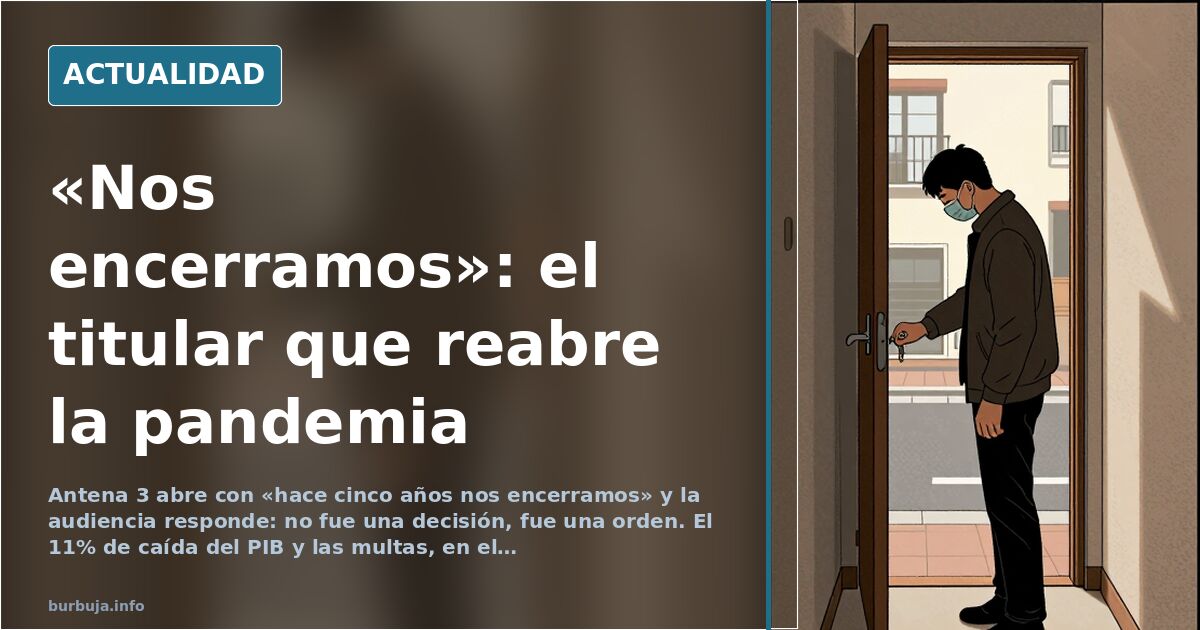
Antena 3 says 'we locked ourselves in' and the lockdown narrative cracks
A single opening headline was enough. Antena 3 started its news broadcast with the phrase "five years ago we locked ourselves at home" and the reaction was immediate: part of the audience argues that the wording reverses roles, because there was no voluntary decision but a legally binding order. The discussion moved beyond grammar to the economic and health balance of those weeks.
The first issue is the verb. "We locked ourselves in" suggests a collective choice; "we were locked in" describes an imposition. The difference is not trivial: it determines who bears political responsibility for a measure that, according to data circulating online, kept children indoors while dogs walked with their owners. This asymmetry—confined minors, pets outdoors—is cited as the most repeated grievance and the least contested.
Economic cost: 11% GDP fall vs 3-5% in Europe
The second axis is international comparison. Compared to European countries with much colder climates, whose GDPs fell between 3% and 5%, Spain recorded a plunge of 11%. The prevailing interpretation is that the strictness of the confinement did not match the economic damage: more closure led to greater decline. This figure is used as a central argument against the thesis that severity was inevitable.
Territorial management also enters the equation. It is recalled that the pandemic caused 7,291 deaths in Madrid and that the rest of the country had to "row" to support the region. Political attribution of this figure is disputed: some blame regional management directly, while others see it instrumentalized by the central government. The data circulates, but the interpretation remains open.
Fines, controls, and third-degree privileges in rest areas
The third block concerns the practical application of the lockdown. Testimonies accumulate: €100 fines for movements later appealable; €600 fines for an 85-year-old man walking to his garden one kilometer from town; checks where, according to one account, a driver eating a sandwich in his own car was asked for his Bar Association card and self-employed receipt. Daily oversight, they argue, far exceeded legal requirements.
Some downplay the tone: fines were appealable and the lockdown did not involve arrests. The response to this nuance is bitter: "renting a dog," alluding to the asymmetry between dog walks and children's outings. The irony summarizes the discontent better than any statistic.
Vaccines, hoaxes, and the non-existent expert committee
The fourth front is health-related. Part of the exchange questions vaccine efficacy and labels the whole process a "social engineering experiment." These claims lack evidentiary support and are formulated as suspicion, not fact. In parallel, a relevant admission is cited: Salvador Illa acknowledged there was no expert committee for easing restrictions, meaning no external body advised the government during that phase. This data fuels the improvisation thesis.
The death toll is also debated. It is claimed that anyone testing positive was counted as ELbichito even if dying from other causes, inflating the numbers. This is a methodological objection, not a denial of impact: the exchange itself acknowledges hundreds of thousands of global deaths.
"I didn't lock myself in" and selective memory
A current emerges denying compliance: "no one locked me up, I went out, I didn't get vaccinated." Another places this in retrospective fantasy, comparable to those claiming to have run ahead of police. A third recalls that many people voluntarily cooperated initially, seeing confinement as paid vacation, before it stopped being fun.
The minimal consensus, if any, is that the official narrative has been sanitized: heroic doctors, 8 PM applause, vaccines as closure, and care homes as the only error attributable to a specific administration. The lingering question is uncomfortable: if no one chose to lock themselves in, why does the headline say "we locked ourselves in"?
A single opening headline was enough. Antena 3 started its news broadcast with the phrase "five years ago we locked ourselves at home" and the reaction was immediate: part of the audience argues that the wording reverses roles, because there was no voluntary decision but a legally binding order. The discussion moved beyond grammar to the economic and health balance of those weeks.
The first issue is the verb. "We locked ourselves in" suggests a collective choice; "we were locked in" describes an imposition. The difference is not trivial: it determines who bears political responsibility for a measure that, according to data circulating online, kept children indoors while dogs walked with their owners. This asymmetry—confined minors, pets outdoors—is cited as the most repeated grievance and the least contested.
Economic cost: 11% GDP fall vs 3-5% in Europe
The second axis is international comparison. Compared to European countries with much colder climates, whose GDPs fell between 3% and 5%, Spain recorded a plunge of 11%. The prevailing interpretation is that the strictness of the confinement did not match the economic damage: more closure led to greater decline. This figure is used as a central argument against the thesis that severity was inevitable.
Territorial management also enters the equation. It is recalled that the pandemic caused 7,291 deaths in Madrid and that the rest of the country had to "row" to support the region. Political attribution of this figure is disputed: some blame regional management directly, while others see it instrumentalized by the central government. The data circulates, but the interpretation remains open.
Fines, controls, and third-degree privileges in rest areas
The third block concerns the practical application of the lockdown. Testimonies accumulate: €100 fines for movements later appealable; €600 fines for an 85-year-old man walking to his garden one kilometer from town; checks where, according to one account, a driver eating a sandwich in his own car was asked for his Bar Association card and self-employed receipt. Daily oversight, they argue, far exceeded legal requirements.
Some downplay the tone: fines were appealable and the lockdown did not involve arrests. The response to this nuance is bitter: "renting a dog," alluding to the asymmetry between dog walks and children's outings. The irony summarizes the discontent better than any statistic.
Vaccines, hoaxes, and the non-existent expert committee
The fourth front is health-related. Part of the exchange questions vaccine efficacy and labels the whole process a "social engineering experiment." These claims lack evidentiary support and are formulated as suspicion, not fact. In parallel, a relevant admission is cited: Salvador Illa acknowledged there was no expert committee for easing restrictions, meaning no external body advised the government during that phase. This data fuels the improvisation thesis.
The death toll is also debated. It is claimed that anyone testing positive was counted as ELbichito even if dying from other causes, inflating the numbers. This is a methodological objection, not a denial of impact: the exchange itself acknowledges hundreds of thousands of global deaths.
"I didn't lock myself in" and selective memory
A current emerges denying compliance: "no one locked me up, I went out, I didn't get vaccinated." Another places this in retrospective fantasy, comparable to those claiming to have run ahead of police. A third recalls that many people voluntarily cooperated initially, seeing confinement as paid vacation, before it stopped being fun.
The minimal consensus, if any, is that the official narrative has been sanitized: heroic doctors, 8 PM applause, vaccines as closure, and care homes as the only error attributable to a specific administration. The lingering question is uncomfortable: if no one chose to lock themselves in, why does the headline say "we locked ourselves in"?
Also available in: Deutsch
Summary of a discussion on Burbuja.info - Foro de economía, actualidad y política., translated from Spanish and reviewed before publication. Read the full discussion (136 replies).
More summaries
-
PACMA Calls Protest on October 4 Against Valdepeñas 'Cat Killer'
PACMA has called a protest on October 4 in Valdepeñas against the 'cat killer,' a former civil guard accused of killing stray cats.
-
Spain fines up to €30,000 for ignoring INE surveys
Spanish Law 12/1989 mandates participation in National Statistics Institute (INE) surveys, with fines ranging from €60 to €30,000. Reports cite 166,128 sanctions between 2015 and 2024.
-
Spain's summer: Nights above 30°C offer no relief
In Spain, tropical nights and high humidity spike heat sensation on the coast. The debate between natural cycles and climate change intensifies.
-
Spain's Eurovision televote: Israel first, Ukraine second
A forum discusses Spain's Eurovision televote results, which favored Israel and Ukraine, amid unproven allegations of rigging.
-
Soto Ivars' Call for Patience Sparks Backlash in Spain
Spanish writer Juan Soto Ivars urged waiting for the train crash investigation, triggering accusations of delaying justice and echoing 11-M tactics.
-
German businessman in coma for year after Mallorca attack
Two 17-year-olds attacked a German entrepreneur in Mallorca to impress girls. The victim spent a year in a coma, while witnesses were protected due to family threats.