
Antena 3 rebrands Wheel of Fortune host as co-presenter
Antena 3 introduces Laura Moure as co-presenter, sparking debate on the role of TV hosts in Spain.
English · Original discussion in Spanish · Published
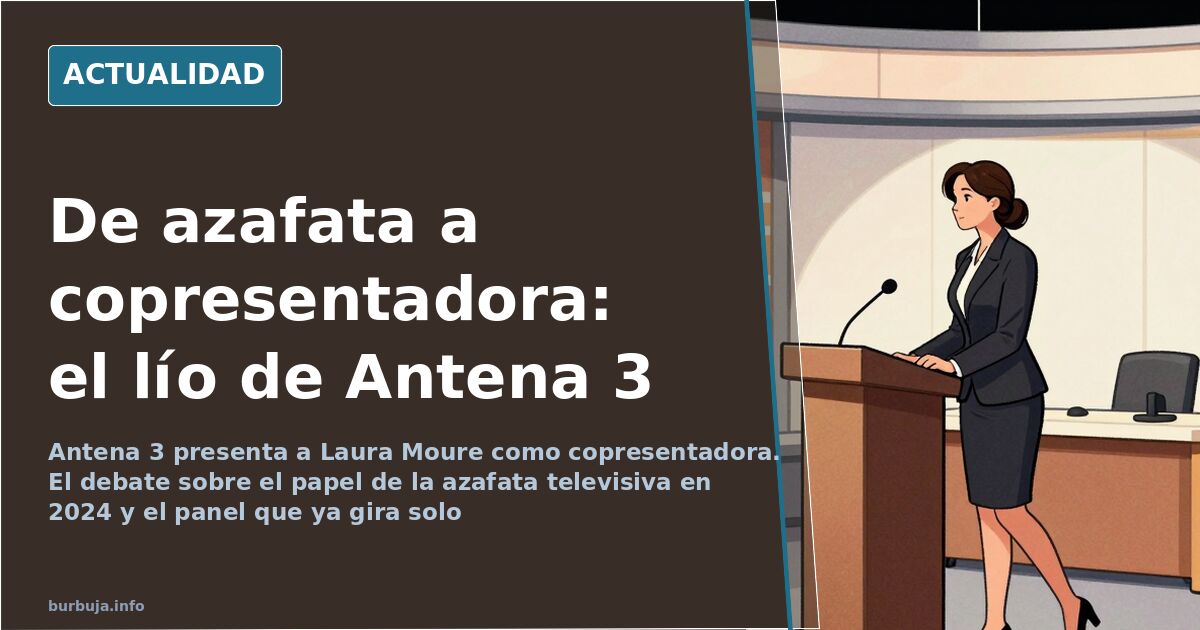
From hostess to co-presenter: Antena 3 defends its new role
In 2015, Antena 3 introduced her as a hostess. For the past two years, the same network has presented her as a co-presenter. The label has indeed changed. La Ruleta de la Suerte (Wheel of Fortune), one of Spanish television's highest-rated daily shows and on air since the nineties, has undergone the same linguistic shift as the rest of the industry, and that change is precisely what sparked the controversy. The trigger is a report examining Laura Moure's role facing the puzzle board and raising an uncomfortable question: does the position of TV hostess still make sense in 2024?
What exactly does Laura Moure do on the show?
The network's version is definitive. Atresmedia argues it is not an auxiliary role: she presents the opening and closing of the contest, participates in the final round, reveals the prizes, and comments on the panels and anecdotes alongside Jorge Fernández. The official description insists she forms a tandem with the main presenter and adds dynamism, flatly rejecting comparisons with the classic figure of a hostess, who was limited to performing specific, measurable tasks.
Television analyst Mariola Cubells does not buy this narrative. She argues the position is an obvious anachronism and, fortunately, already rare in current programming schedules. Her objection is not against the person, but against the function: a co-presenter should have active and continuous weight, very different from intervening at specific, meticulously measured points. Therefore, the discrepancy is not about resumes. It is about what constitutes presenting.
The puzzle board that no longer turns by touch
Here lies the technical detail almost everyone overlooks. When the format landed on Antena 3 in 2006, the letters on the panels turned by hand. Today, someone in control presses a button, and the letters flip digitally. Between 2006 and 2015, Paloma López fulfilled that function on set. Since then, another person walks from corner to corner so that on screen it appears she is solving the hidden phrases. The trick is sometimes noticeable and discussed on social media. It is part of the medium's magic, but also a remnant of another way of making television.
From 'Mama Chichos' to the Madrid Open
Historical context helps understand the noise. In the nineties, hostesses collected balls for Telecupón, helped with numbers on Un, dos, tres, accompanied Jesús Gil by the pool, and danced like archetypes of Italian television. They also performed mundane tasks like carrying envelopes or showing off products. The same pattern was replicated off-screen: grid girls in Formula 1 and ball kids in tennis tournaments. In several cases, they were removed amidst controversy, and some argue those affected were never consulted. RTVE, for its part, published a guide in 2020 advocating against the objectification of the female body and breaking away from a beauty model based on youth.
Employment, envy, and crude arguments
There is a recurring economic argument with logic: if the position disappears, the person holding it does not receive another program in exchange. Removing the function does not create an opportunity; it creates a vacancy. By that criterion, the same reasoning could apply to the live band—replaceable by cheaper canned music—or even the main presenter. Taken to the extreme, this game leaves the set empty.
Less solid are interpretations reducing the issue to personal vendettas or alleged envy between professional profiles. These are unproven claims and should be read as such: they describe the accusers more than the conflict. What is verifiable is everything else. A woman with stable work on screen, a title renamed to avoid a word no longer spoken aloud, and technology that makes unnecessary the gesture still filmed every afternoon.
What remains of the job if you remove the name?
The real discussion is not whether Laura Moure should stay there. It is whether the position she holds is sustained by what she contributes to the show or by the inertia of a format dragging twenty years of history. Atresmedia says the former. Cubells says the latter. And the puzzle board keeps turning alone, every afternoon, without anyone touching it. How much longer will someone need to walk toward it?
In 2015, Antena 3 introduced her as a hostess. For the past two years, the same network has presented her as a co-presenter. The label has indeed changed. La Ruleta de la Suerte (Wheel of Fortune), one of Spanish television's highest-rated daily shows and on air since the nineties, has undergone the same linguistic shift as the rest of the industry, and that change is precisely what sparked the controversy. The trigger is a report examining Laura Moure's role facing the puzzle board and raising an uncomfortable question: does the position of TV hostess still make sense in 2024?
What exactly does Laura Moure do on the show?
The network's version is definitive. Atresmedia argues it is not an auxiliary role: she presents the opening and closing of the contest, participates in the final round, reveals the prizes, and comments on the panels and anecdotes alongside Jorge Fernández. The official description insists she forms a tandem with the main presenter and adds dynamism, flatly rejecting comparisons with the classic figure of a hostess, who was limited to performing specific, measurable tasks.
Television analyst Mariola Cubells does not buy this narrative. She argues the position is an obvious anachronism and, fortunately, already rare in current programming schedules. Her objection is not against the person, but against the function: a co-presenter should have active and continuous weight, very different from intervening at specific, meticulously measured points. Therefore, the discrepancy is not about resumes. It is about what constitutes presenting.
The puzzle board that no longer turns by touch
Here lies the technical detail almost everyone overlooks. When the format landed on Antena 3 in 2006, the letters on the panels turned by hand. Today, someone in control presses a button, and the letters flip digitally. Between 2006 and 2015, Paloma López fulfilled that function on set. Since then, another person walks from corner to corner so that on screen it appears she is solving the hidden phrases. The trick is sometimes noticeable and discussed on social media. It is part of the medium's magic, but also a remnant of another way of making television.
From 'Mama Chichos' to the Madrid Open
Historical context helps understand the noise. In the nineties, hostesses collected balls for Telecupón, helped with numbers on Un, dos, tres, accompanied Jesús Gil by the pool, and danced like archetypes of Italian television. They also performed mundane tasks like carrying envelopes or showing off products. The same pattern was replicated off-screen: grid girls in Formula 1 and ball kids in tennis tournaments. In several cases, they were removed amidst controversy, and some argue those affected were never consulted. RTVE, for its part, published a guide in 2020 advocating against the objectification of the female body and breaking away from a beauty model based on youth.
Employment, envy, and crude arguments
There is a recurring economic argument with logic: if the position disappears, the person holding it does not receive another program in exchange. Removing the function does not create an opportunity; it creates a vacancy. By that criterion, the same reasoning could apply to the live band—replaceable by cheaper canned music—or even the main presenter. Taken to the extreme, this game leaves the set empty.
Less solid are interpretations reducing the issue to personal vendettas or alleged envy between professional profiles. These are unproven claims and should be read as such: they describe the accusers more than the conflict. What is verifiable is everything else. A woman with stable work on screen, a title renamed to avoid a word no longer spoken aloud, and technology that makes unnecessary the gesture still filmed every afternoon.
What remains of the job if you remove the name?
The real discussion is not whether Laura Moure should stay there. It is whether the position she holds is sustained by what she contributes to the show or by the inertia of a format dragging twenty years of history. Atresmedia says the former. Cubells says the latter. And the puzzle board keeps turning alone, every afternoon, without anyone touching it. How much longer will someone need to walk toward it?
Summary of a discussion on Burbuja.info - Foro de economía, actualidad y política., translated from Spanish and reviewed before publication. Read the full discussion (186 replies).
More summaries
-
Brian replaces Laura Moure on La Ruleta de la Suerte
Antena 3 signs Brian for La Ruleta during Laura Moure's maternity leave, reopening debate on the co-host's role and the show's audience.
-
Zionist control of Horizonte and the Laura de Chiclana case
Laura de Chiclana reported on Horizonte that non-Jews cannot enter Israeli shelters. Carmen Porter denied it live. Analysis of Zionist control.
-
Gomesende Wedding Descends into Brawl Over €40,000 in Gifts
A wedding in Gomesende turned into a family fight over €40,000 in gifts, according to the circulating account. The bride's origin became a focus of the dispute.
-
Spanish streamer Ibai Llanos loses 52 kg in one year
Ibai Llanos drops below 100 kg a year after starting his fitness journey: 52 kg lost, 3,650 km walked, and 240 strength sessions.
-
Spanish School Allows Vegan Lunchbox for Five-Year-Old
A five-year-old in Mallorca secured a vegan lunch option after his school refused to serve meat-free meals.
-
British Couple Claims €70,000 Theft in Bilbao Car
A British couple reports a €70,000 theft from their car in Bilbao. Their account contains inconsistencies that raise doubts.