
Anglo-Saxon and Spanish Colonization: What the Data Says
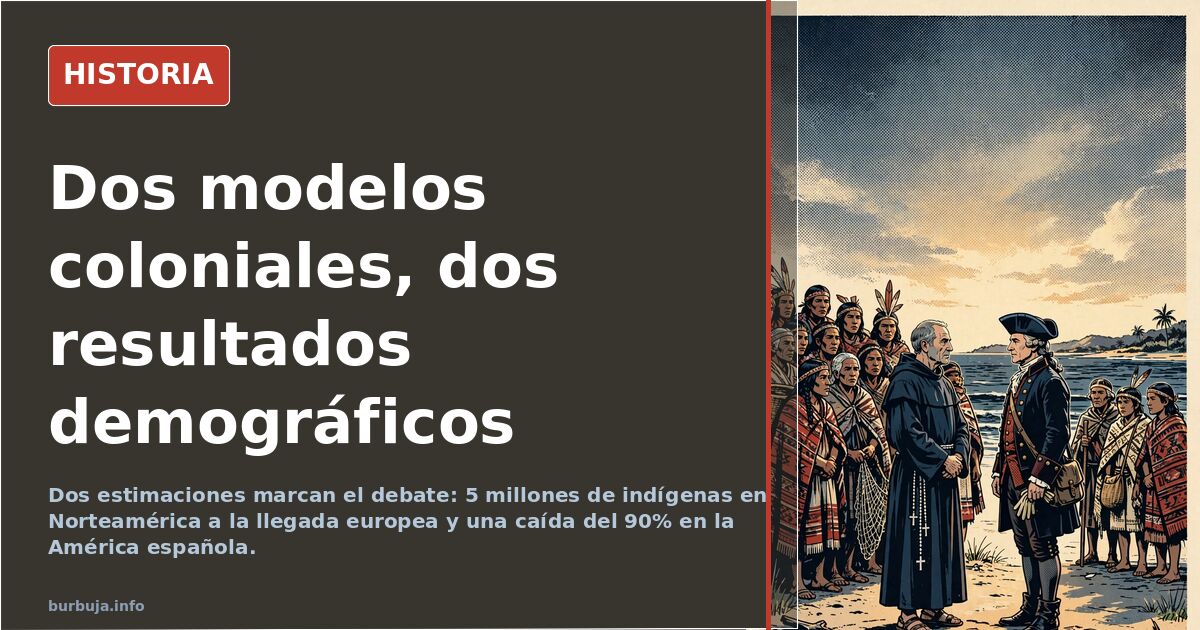
Two estimates shape the debate: 5 million indigenous people in North America upon European arrival and a 90% drop in Spanish America.
English · Original discussion in Spanish · Published
Two Colonial Models for the Same Continent
The same old debate is back, with the same pieces: the Anglo-Saxon colonial model versus the Spanish one in America. The starting thesis holds that the British, despite their violence, built "more humane" societies because they did not mix with and displaced the indigenous population to reservations, while Spain allegedly left behind an impoverished and mestizo territory. The numbers involved are debatable and, precisely because of that, serve their purpose.
It is enough to compare two estimates that are repeated in the data exchange. In what is now the United States and Canada, there were about 5 million indigenous people upon European arrival, a figure that remains today. In Spanish America, the native population is said to have fallen by around 90% by the mid-16th century. Almost all the rest of the argument is built on these two magnitudes.
How many indigenous people were there before and after the conquest?
The first figure is used to deny the legend of total extermination in the north: if there were five million and there are still five million, it is argued, there was no annihilation. The second serves the opposite purpose: the demographic collapse of Hispanic America was brutal, regardless of who caused it.
It is worth separating causes here. The bulk of the fall is attributed to epidemics, famines, and social destructuring after European arrival, a mechanism that operated across the continent, including the north. What changed between one model and the other was not the disease, but who was allowed into the resulting political community.
The Extractive Model Versus the Settlement Model
The most solid thesis of those who argue that the Spanish empire did "everything wrong" is not sarracena, but based on incentives. The conquerors sought wealth, not land to live on: there was plenty of land in Europe. The Crown had to make concessions because nobody wanted to go to the Indies. According to an estimate repeated in the thread, barely 100,000 men left Spain, and those who went intended to get rich and return. In the 16th century, the journey was, in the words of the debate itself, "like going to another planet".
From this, according to the participants, a system of exploitation of already organized populations was born: indigenous labor, evangelization, Hispanization, and, in practice, miscegenation. English settlers, on the other hand, left largely for religious reasons and with no intention of returning. Based on this difference—integrating to use versus occupying and displacing—the fundamental accusation is made: that the Hispanic model produced an impoverished territory and the Anglo model, homogeneous societies.
Why Does the Southern Cone Resemble North America More Than Mexico?
The most cited counterargument is that Argentina, Uruguay, and parts of Chile received massive waves of European immigration after independence, in the 19th and early 20th centuries. They did not arrive in an extractive viceroyalty, but in young states that offered land and opportunities. The result: more fragmented property, an early middle class, and the Pampas functioning as a blank canvas after campaigns against indigenous peoples.
Even so, the figure dismantles the easy narrative: it is maintained that even in the most "European" country in the region, there was no clear white majority until very late, and in Argentina, it barely exceeded half by the end of the 19th century. The rest was mestizaje. The homogeneity attributed to the north did not exist in the south, at least not to the same degree.
Did the Anglo-Saxons Exterminate the Indians of North America?
Here, the detail bothers both sides. Against the image of coexistence and miscegenation from the first settlement, episodes of extermination and displacement to lands without hunting or cultivation are cited. Against the image of total genocide, the response is the five million today. The discussion also touches on the Spanish Crown: according to one of the participants, neither the Habsburgs nor the Vatican come out well in the extractive balance, because a large part of what was obtained would not have stayed in Spain.
What does emerge as contextual data is legal. Several participants argue that there were debates and laws regarding the treatment of the indigenous population in the Hispanic world, with recognized property titles and a declared intention of integration. In the Anglo-Saxon model, the instrument was the reservation. Two different ways of solving the same problem: what to do with those who were already there.
How Much North African Is in the DNA of a Spaniard?
The exchange turns to genetics, and there the numbers handled by the participants appear. According to this data, the average Andalusian, Castilian, Extremaduran, or Murcian has around 12% North African or Semitic ancestry, compared to the 30-40% estimated for the 4th century. Ibiza breaks the mold: it would exceed 22% Eastern Mediterranean component, almost double the peninsular average of 12%.
The curiosity lies in the ancient profiles. One of the Roman samples from Hispania cited in the thread is distributed as trinc: 52.6% ancient Basque Iberian, 24.6% Western Maghreb, 14.8% ancient Irish, and 8% Baltic. And a typical current Extremaduran: 50% Gaul, 33.4% Italian, 11.6% Berber, 4% Jewish, and 1% Germanic. The complete calculation, broken down sample by sample, goes beyond any simplistic headline.
The Counterargument: Poor Territories and Rich Countries
If territory explained everything, Switzerland would not exist as a financial power. Half the nation is an impassable mountain, with no access to the sea and no resources worth mentioning. It became rich through banking, watchmaking, and fine chemicals: things that do not require land, but institutions. Japan, a volcanic archipelago with earthquakes and no energy of its own, plays in another league. Finland is a frozen wasteland that bet on education.
The reply is always the same: a few people, and moreover in Western Europe or under the American umbrella. It is an argument difficult to refute entirely and also difficult to prove entirely. The comfortable conclusion—that only territories suitable for human habitat prosper—leaves half of Switzerland out.
The analysis gets stuck exactly here. Demographic data explain who disappeared and who mixed, but they do not prove that one model was better than another: only that one erased the native population from its nation-building project and the other incorporated it from below. What counts as "more humane" is a political decision, not a number.
The same old debate is back, with the same pieces: the Anglo-Saxon colonial model versus the Spanish one in America. The starting thesis holds that the British, despite their violence, built "more humane" societies because they did not mix with and displaced the indigenous population to reservations, while Spain allegedly left behind an impoverished and mestizo territory. The numbers involved are debatable and, precisely because of that, serve their purpose.
It is enough to compare two estimates that are repeated in the data exchange. In what is now the United States and Canada, there were about 5 million indigenous people upon European arrival, a figure that remains today. In Spanish America, the native population is said to have fallen by around 90% by the mid-16th century. Almost all the rest of the argument is built on these two magnitudes.
How many indigenous people were there before and after the conquest?
The first figure is used to deny the legend of total extermination in the north: if there were five million and there are still five million, it is argued, there was no annihilation. The second serves the opposite purpose: the demographic collapse of Hispanic America was brutal, regardless of who caused it.
It is worth separating causes here. The bulk of the fall is attributed to epidemics, famines, and social destructuring after European arrival, a mechanism that operated across the continent, including the north. What changed between one model and the other was not the disease, but who was allowed into the resulting political community.
The Extractive Model Versus the Settlement Model
The most solid thesis of those who argue that the Spanish empire did "everything wrong" is not sarracena, but based on incentives. The conquerors sought wealth, not land to live on: there was plenty of land in Europe. The Crown had to make concessions because nobody wanted to go to the Indies. According to an estimate repeated in the thread, barely 100,000 men left Spain, and those who went intended to get rich and return. In the 16th century, the journey was, in the words of the debate itself, "like going to another planet".
From this, according to the participants, a system of exploitation of already organized populations was born: indigenous labor, evangelization, Hispanization, and, in practice, miscegenation. English settlers, on the other hand, left largely for religious reasons and with no intention of returning. Based on this difference—integrating to use versus occupying and displacing—the fundamental accusation is made: that the Hispanic model produced an impoverished territory and the Anglo model, homogeneous societies.
Why Does the Southern Cone Resemble North America More Than Mexico?
The most cited counterargument is that Argentina, Uruguay, and parts of Chile received massive waves of European immigration after independence, in the 19th and early 20th centuries. They did not arrive in an extractive viceroyalty, but in young states that offered land and opportunities. The result: more fragmented property, an early middle class, and the Pampas functioning as a blank canvas after campaigns against indigenous peoples.
Even so, the figure dismantles the easy narrative: it is maintained that even in the most "European" country in the region, there was no clear white majority until very late, and in Argentina, it barely exceeded half by the end of the 19th century. The rest was mestizaje. The homogeneity attributed to the north did not exist in the south, at least not to the same degree.
Did the Anglo-Saxons Exterminate the Indians of North America?
Here, the detail bothers both sides. Against the image of coexistence and miscegenation from the first settlement, episodes of extermination and displacement to lands without hunting or cultivation are cited. Against the image of total genocide, the response is the five million today. The discussion also touches on the Spanish Crown: according to one of the participants, neither the Habsburgs nor the Vatican come out well in the extractive balance, because a large part of what was obtained would not have stayed in Spain.
What does emerge as contextual data is legal. Several participants argue that there were debates and laws regarding the treatment of the indigenous population in the Hispanic world, with recognized property titles and a declared intention of integration. In the Anglo-Saxon model, the instrument was the reservation. Two different ways of solving the same problem: what to do with those who were already there.
How Much North African Is in the DNA of a Spaniard?
The exchange turns to genetics, and there the numbers handled by the participants appear. According to this data, the average Andalusian, Castilian, Extremaduran, or Murcian has around 12% North African or Semitic ancestry, compared to the 30-40% estimated for the 4th century. Ibiza breaks the mold: it would exceed 22% Eastern Mediterranean component, almost double the peninsular average of 12%.
The curiosity lies in the ancient profiles. One of the Roman samples from Hispania cited in the thread is distributed as trinc: 52.6% ancient Basque Iberian, 24.6% Western Maghreb, 14.8% ancient Irish, and 8% Baltic. And a typical current Extremaduran: 50% Gaul, 33.4% Italian, 11.6% Berber, 4% Jewish, and 1% Germanic. The complete calculation, broken down sample by sample, goes beyond any simplistic headline.
The Counterargument: Poor Territories and Rich Countries
If territory explained everything, Switzerland would not exist as a financial power. Half the nation is an impassable mountain, with no access to the sea and no resources worth mentioning. It became rich through banking, watchmaking, and fine chemicals: things that do not require land, but institutions. Japan, a volcanic archipelago with earthquakes and no energy of its own, plays in another league. Finland is a frozen wasteland that bet on education.
The reply is always the same: a few people, and moreover in Western Europe or under the American umbrella. It is an argument difficult to refute entirely and also difficult to prove entirely. The comfortable conclusion—that only territories suitable for human habitat prosper—leaves half of Switzerland out.
The analysis gets stuck exactly here. Demographic data explain who disappeared and who mixed, but they do not prove that one model was better than another: only that one erased the native population from its nation-building project and the other incorporated it from below. What counts as "more humane" is a political decision, not a number.
Summary of a discussion on Burbuja.info - Foro de economía, actualidad y política., translated from Spanish and reviewed before publication. Read the full discussion (548 replies).
More summaries
-
British, French, and Dutch Also Intermixed
90% of African Americans have detectable European ancestry, according to estimates. Colonial miscegenation was not solely Spanish.
-
Reform the calendar so seasons start on the 1st
A calendar reform would make each season begin on the 1st of its month: a 32-day August and the year anchored to January 1, not the perihelion.
-
When did Europe's national football teams start to get more diverse?
France fielded a Black player as early as 1938 and Portugal four in 1966. The timeline of diversity in European national football teams and its causes.
-
Why Spain was not an economic engine after World War II
Spanish GDP grew 5,3% between 1939 and 1944 and only 0,14% between 1945 and 1950: neutrality in World War II was not enough to lead Europe
-
Why Spain never had an industrial bourgeoisie—but did have a rentier caste
Hispano-Suiza, the 1986 EEC and the rentier-caste thesis: why Spain never became an industrial power despite its technical talent
-
Mussolini declared war as France was already collapsing
On 10 June 1940, Italy declared war on France and the UK with a three-paragraph note. Greece, Africa and Gibraltar changed the plan.