
Andorra imposes 0% tax on capital gains and dividends
While Andorra levies 0% on stock gains and dividends, Spain charges 25% Corporate Tax and up to 26% on distributions.
English · Original discussion in Spanish · Published
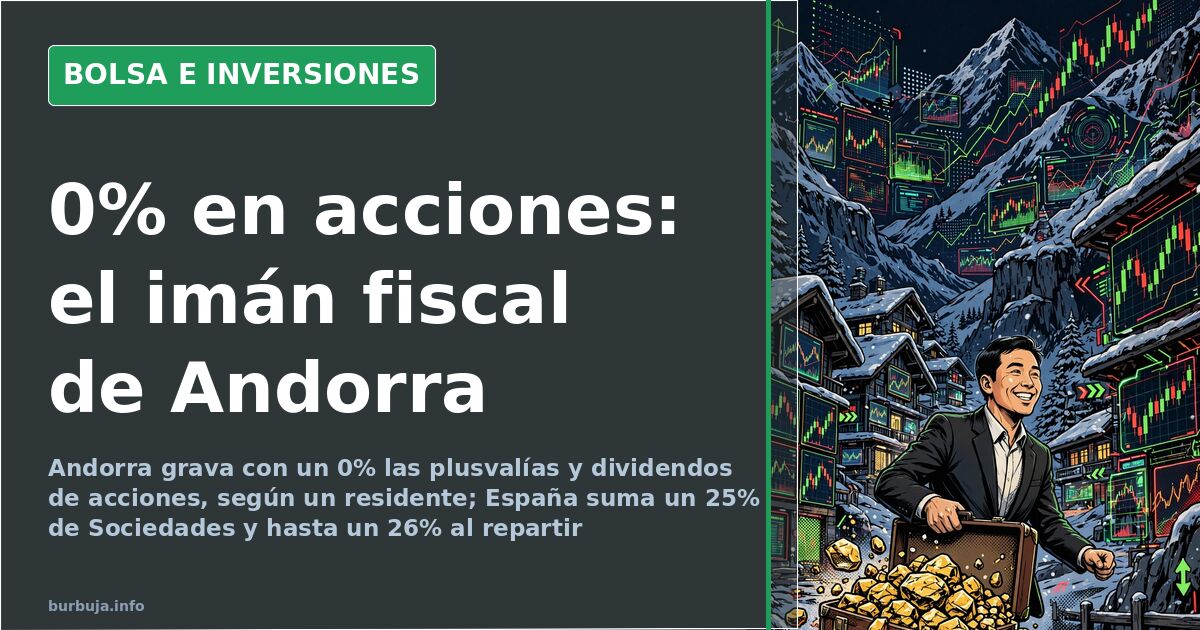
Andorra applies a 0% tax rate to shares and dividends
One year of residency in Andorra is enough to confirm what calculators suggest: those who move their tax residence there and trade on the stock market pay 0% tax on share sales and dividends. No withholding at source, no regional scales, no solidarity surcharges. Zero. This is reported by an investor settled in the principality for a year, who has declared it a "checkmate." This is the account of a resident, not an official source, and the move involves conditions rarely mentioned in headlines.
How much does it actually cost to invest in the stock market in Andorra?
According to the same investor, the Andorran Corporate Tax stands at 10% and the IGI (the local equivalent of VAT) at 4.5%. Everything except shares or dividends is taxed at that 10% ceiling, which is also the maximum applicable rate. In contrast, capital gains from trading securities and dividends do not incur any tax.
Spain operates under different arithmetic. Corporate Tax takes 25% of profits, and when those profits are distributed as dividends, they are taxed again under the savings income tax (IRPF) at between 19% and 26%. Two layers on the same money. This is the main driver for moving: the maximum Spanish income tax bracket is around 50%, and those who live by selling services globally see little reason to stay.
Andorra's residency requirements: €15,000 or €350,000
There are two paths. Active residency requires setting up a company, leaving €15,000 in non-remunerated funds with the financial authority, and spending at least six months a year in the country. Passive residency does not require a company, but does require depositing about €50,000 and investing €350,000 in the territory—in real estate, Andorran companies, or other assets—with a minimum stay of three months annually.
The same limit applies to both: you cannot spend more than six months in Spain. The common advice is not to push that margin to the limit. There is also a requirement less segarro than deposits: bancarización (banking traceability). Upon arriving as a new resident, one must demonstrate clean money traceability, and the services accompanying the process are sold as part of the package.
The Tax Agency barrier: when moving is not enough
Packing your bags is not enough. One first-hand account describes the classic pattern: working outside the EU, maintaining a rental in Spain, keeping assets and family there, with two annual visits. The Spanish Tax Agency (Hacienda) considered his center of vital interests to still be in Spain and demanded a Spanish tax return. Residing abroad does not bypass this hurdle: the deciding factor is where the core of one's economic and family life is located.
From this, a practical rule emerges: those who invoice through a Spanish company or have their main source of income in Spain face difficulties. Content creators with a global audience fall into a gray area, as the origin of their billing is diffuse and hard to attribute to a specific jurisdiction.
The cost of paradise: an expensive, narrow country without an airport
Andorra is not cheap. The most frequent criticism is that without a high income, the move does not pay off: housing and the cost of living consume much of the tax savings. Geography adds to this. A narrow country, questionable communications, and no airport of its own: planes land in Seu d'Urgell, about 20 kilometers away in Catalonia, and public transport to Barcelona is unreliable. The question of how much is needed to live there with €3,000 net per month remains unanswered.
Tax haven or tax hell across the border?
Opinions are divided. One view holds that Andorra is not a tax haven; Spain is a tax hell, and the principality is simply being normal. Another draws a map of the peninsula with Madrid as the "normal" regime, Aragon and Andalusia as hells, and the Basque Country, Navarra, the Canary Islands, Ceuta, Melilla, and Andorra on the list of havens—a thesis not everyone accepts, as some argue the differences between regions are mere fractions, not different models.
The harshest criticism comes from the other side: some describe Andorra, in derogatory terms, as a village that lives by guarding others' capital and would not survive without that business. There is a rebuttal: a small country collects much less than Spain or France would with the same activity, but because its scale is minimal, the model is profitable; replicating it in a medium-sized economy would force cuts to services and infrastructure to levels no one would accept.
The analysis stalls there. No one has quantified how much of those €350,000 investments or the deposits in the financial authority actually sustain the Andorran system, nor how many moves would withstand a review of the center of vital interests. Without that calculation, the 0% remains an unbeatable headline and an open question.
One year of residency in Andorra is enough to confirm what calculators suggest: those who move their tax residence there and trade on the stock market pay 0% tax on share sales and dividends. No withholding at source, no regional scales, no solidarity surcharges. Zero. This is reported by an investor settled in the principality for a year, who has declared it a "checkmate." This is the account of a resident, not an official source, and the move involves conditions rarely mentioned in headlines.
How much does it actually cost to invest in the stock market in Andorra?
According to the same investor, the Andorran Corporate Tax stands at 10% and the IGI (the local equivalent of VAT) at 4.5%. Everything except shares or dividends is taxed at that 10% ceiling, which is also the maximum applicable rate. In contrast, capital gains from trading securities and dividends do not incur any tax.
Spain operates under different arithmetic. Corporate Tax takes 25% of profits, and when those profits are distributed as dividends, they are taxed again under the savings income tax (IRPF) at between 19% and 26%. Two layers on the same money. This is the main driver for moving: the maximum Spanish income tax bracket is around 50%, and those who live by selling services globally see little reason to stay.
Andorra's residency requirements: €15,000 or €350,000
There are two paths. Active residency requires setting up a company, leaving €15,000 in non-remunerated funds with the financial authority, and spending at least six months a year in the country. Passive residency does not require a company, but does require depositing about €50,000 and investing €350,000 in the territory—in real estate, Andorran companies, or other assets—with a minimum stay of three months annually.
The same limit applies to both: you cannot spend more than six months in Spain. The common advice is not to push that margin to the limit. There is also a requirement less segarro than deposits: bancarización (banking traceability). Upon arriving as a new resident, one must demonstrate clean money traceability, and the services accompanying the process are sold as part of the package.
The Tax Agency barrier: when moving is not enough
Packing your bags is not enough. One first-hand account describes the classic pattern: working outside the EU, maintaining a rental in Spain, keeping assets and family there, with two annual visits. The Spanish Tax Agency (Hacienda) considered his center of vital interests to still be in Spain and demanded a Spanish tax return. Residing abroad does not bypass this hurdle: the deciding factor is where the core of one's economic and family life is located.
From this, a practical rule emerges: those who invoice through a Spanish company or have their main source of income in Spain face difficulties. Content creators with a global audience fall into a gray area, as the origin of their billing is diffuse and hard to attribute to a specific jurisdiction.
The cost of paradise: an expensive, narrow country without an airport
Andorra is not cheap. The most frequent criticism is that without a high income, the move does not pay off: housing and the cost of living consume much of the tax savings. Geography adds to this. A narrow country, questionable communications, and no airport of its own: planes land in Seu d'Urgell, about 20 kilometers away in Catalonia, and public transport to Barcelona is unreliable. The question of how much is needed to live there with €3,000 net per month remains unanswered.
Tax haven or tax hell across the border?
Opinions are divided. One view holds that Andorra is not a tax haven; Spain is a tax hell, and the principality is simply being normal. Another draws a map of the peninsula with Madrid as the "normal" regime, Aragon and Andalusia as hells, and the Basque Country, Navarra, the Canary Islands, Ceuta, Melilla, and Andorra on the list of havens—a thesis not everyone accepts, as some argue the differences between regions are mere fractions, not different models.
The harshest criticism comes from the other side: some describe Andorra, in derogatory terms, as a village that lives by guarding others' capital and would not survive without that business. There is a rebuttal: a small country collects much less than Spain or France would with the same activity, but because its scale is minimal, the model is profitable; replicating it in a medium-sized economy would force cuts to services and infrastructure to levels no one would accept.
The analysis stalls there. No one has quantified how much of those €350,000 investments or the deposits in the financial authority actually sustain the Andorran system, nor how many moves would withstand a review of the center of vital interests. Without that calculation, the 0% remains an unbeatable headline and an open question.
Also available in: Deutsch
Summary of a discussion on Burbuja.info - Foro de economía, actualidad y política., translated from Spanish and reviewed before publication. Read the full discussion (102 replies).
More summaries
-
Moving Abroad Without Working: Andorra, Portugal, and Switzerland
Andorra requires 90 days annually for passive residency, with renewals of 3, 3, and 10 years. Portugal, Switzerland, and Latin America offer alternatives for those living off investments.
-
Spain tax confusion over €20 mystery shopper pay
A mystery shopper earning just over €20 wonders whether to declare it or register as self-employed. The company calls it an external collaboration.
-
Madrid's Neighborhoods: Price Dictates the Map of Good and Bad Areas
Classifying Madrid's 128 neighborhoods as good or bad depends on the criteria: price per square meter, commute time, or district labels.
-
Universal Basic Income: The Debate Dividing Workers
The debate over Universal Basic Income intensifies as critics warn of labor disincentives and fiscal pressure, citing implementation failures in Catalonia, Spain.
-
Gold prices have increased tenfold since 2000
Gold prices have surged tenfold since 2000, with the ounce rising from 250 to 2,515 euros. The debate focuses on what benchmark to use.
-
Victoria PLC: High-risk potential 4x play amid debt restructuring
With £1bn in revenue and an £83m market cap, Victoria PLC faces a massive turnaround after refinancing debt with Koch Industries.