
Andalusia will not extend housing grants for Red Cross, SAMU and Inserta
The sheltered housing programme for homeless people in Andalusia expires on 20 December: 315 places and 6.4 million euros at stake.
English · Original discussion in Spanish · Published
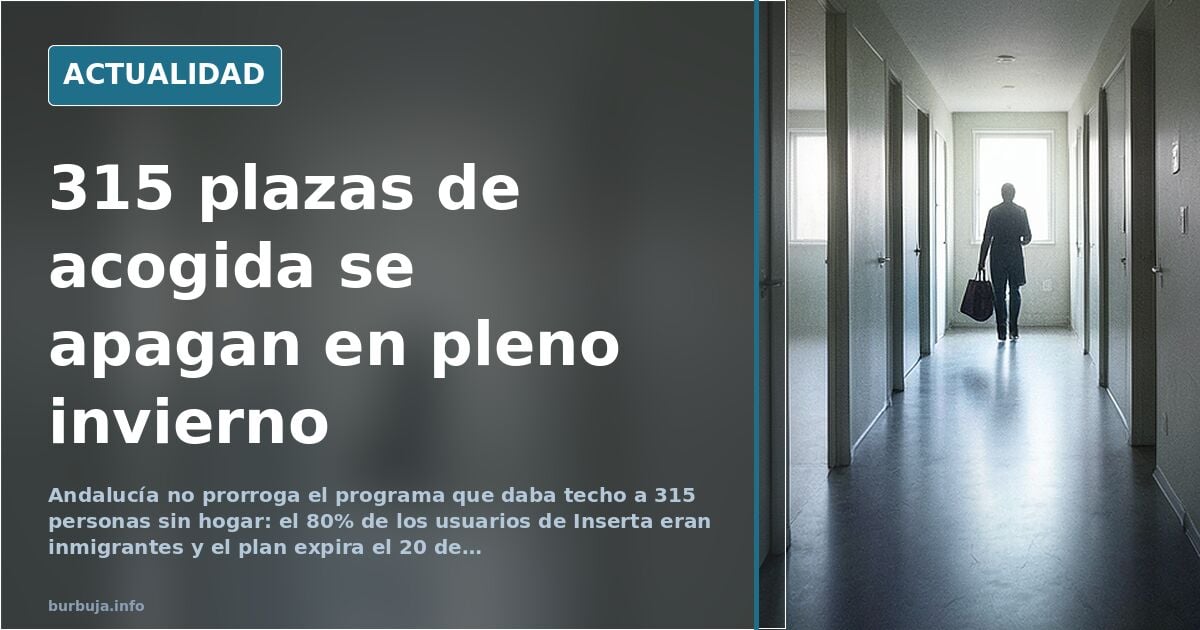
Andalusia will not extend housing grants for Red Cross, SAMU and Inserta
The Programme for the Social and Employment Integration of Homeless People in Andalusia expires on 20 December. The regional Ministry of Social Services, Families and Equality, headed by Loles López, has confirmed to Cruz Roja (Spanish Red Cross), Fundación SAMU and Inserta that there will be no extension and no new tender. The programme provided temporary accommodation in sheltered flats for 315 people across the eight Andalusian provinces: 132 places run by SAMU, 90 by the Red Cross and 93 by Inserta. On the eve of Christmas, around 200 people were being housed and taking part in training and work placements.
What the programme is and who it served
The plan ran for two years (2023-2024), with several extensions approved by the ministry until the end of 2026. The last one was signed in July, already under the PP-Vox coalition agreement in force. The budget was 6.4 million euros, 85% co-financed by European, state and regional funds. The maximum stay was 18 months, extendable in exceptional cases; no one stayed less than nine months and the average was around a full year.
Most users were migrants: 80% in Inserta's case, more than 60% at SAMU and 45% at the Red Cross, according to figures provided by the three organisations. More than 8,000 people are homeless in Andalusia, according to the 2025 report by the Asociación Pro Derechos Humanos de Andalucía, which estimates a 57% increase over the last two years. The INE (Spanish statistics institute) puts the figure lower, at around 5,539 people (2022 data), of whom more than 40% have gone more than three years without stable housing.
Why the regional government says there will be no extension
The ministry denies having issued a direct order to cancel the programme and distances the decision from the pact with Vox. "The programme is now ending, once its results have been evaluated; what comes next will be seen later," say sources from the department. SAMU explains that the reasons given by the ministry are "the lack of budget funds and their prioritisation".
The PP-Vox agreement provides for the "reduction, up to elimination, of subsidies or public aid that do not directly and verifiably contribute to improving the quality of life of Andalusians". Vox demanded to "review and eliminate" what it considers "superfluous spending", including subsidies to trade unions, NGOs and development aid. Santiago Abascal's party has been spreading for years the claim that "immigrants are given free flats and jobs, while Spaniards have none".
20 December and the NGOs' wind-down strategy
The NGOs received notice on the eve of Christmas. SAMU has arranged a "wind-down" to prevent its more than 100 users from ending up back on the street: some will stay in the flats paying for their place as tenants with the savings from their placements; others, with addiction or mental health problems, will be referred to other services; and in some cases negotiations are under way with the companies where they do their placements to offer them a contract. The Red Cross and Inserta face the same timetable.
Public debate has split in two. Some argue the measure responds to the national priority clause and punishes the most vulnerable; others welcome the review of NGO spending and call for screening of beneficiaries. The available data do not show how many of the 315 users are Spanish or how many would have been excluded under a national priority criterion. The results evaluation promised by the regional government has no date either.
Also available in: Deutsch
Summary of a discussion on Burbuja.info - Foro de economía, actualidad y política., translated from Spanish and reviewed before publication. Read the full discussion (18 replies).
More summaries
-
VOX suspends Red Cross subsidies in Andalusia, Spain
VOX in Andalusia announces the suspension of subsidies to the Red Cross, with no figures or timeline. The debate over whether NGOs should live off public budgets.
-
Ernesto Castro: ex-woke, Catholic for show, and the faith business
Influencer and professor Ernesto Castro converted to Catholicism after a suicide attempt, but his open marriage and nepotism accusations…
-
Hundreds of coconuts smashed in Paris reignite religious controversy
Hundreds of coconuts smashed in Paris during the Hindu festival of Ganesh reopen the dispute over the use of public space.
-
Truth or values: two thirds of psychologists choose truth
Two thirds of male professors put truth above their political values; among female professors, it's 43%. The survey dividing psychology.
-
Women's football: the audience dilemma between merit and sensationalism
Stands stay empty even with free tickets. Torn between merit and sensationalism, women's football is searching for an audience. Putellas shines with no one watching.
-
Jury deadlocked in trial of mother who killed her three children
The jury has failed to reach a unanimous verdict against the mother at the trial for the murder of her three children. The tension between the proven facts and postpartum psychosis remains unresolved.