
Andalusia bans filling private pools amid drought
Spain's Andalusia region bans filling private pools in Malaga and Campo de Gibraltar due to severe drought, exempting tourism and health facilities.
English · Original discussion in Spanish · Published
Andalusia shuts off water for private pools during drought
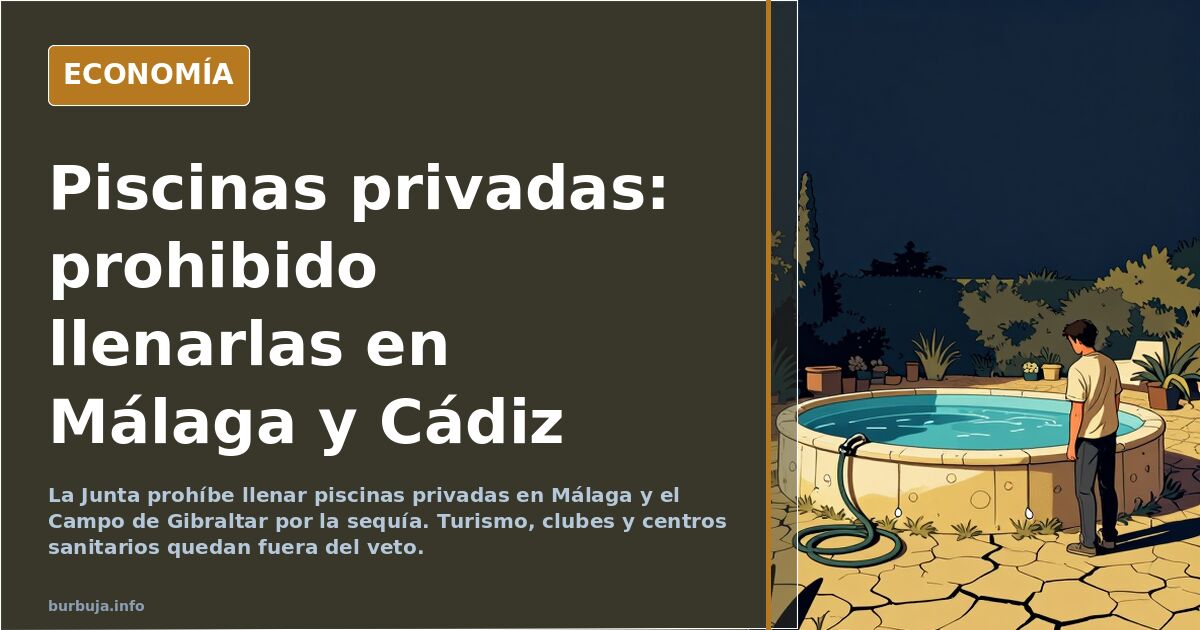
Can you fill a private pool in Malaga or the Campo de Gibraltar? No. The Junta de Andalucía has banned filling private and residential community pools in these two areas, which are facing exceptional drought conditions. The measure, adopted unanimously by the drought management commissions of the Andalusian Mediterranean Basins and Guadalete-Barbate basins, exempts municipal public pools, sports or social clubs, therapeutic pools in healthcare centers, and tourist accommodations registered with the regional government.
Ramiro Angulo, Secretary General for Water, presented the decision as an exercise in "balance and efficiency" of available resources. The fine print matters: water for cooling off is not banned; water for individuals with pools in their villas or apartment blocks is. Tourists, clubs, and health centers are spared. Once again, the same people bear the cost of the drought.
What you can and cannot do with water this summer
The regulation distinguishes between uses. Filling private pools is prohibited in the province of Malaga and the Campo de Gibraltar area. However, filling municipal public pools, sports or social club pools, therapeutic pools in healthcare centers, and tourist accommodation pools listed in the official register is permitted. In other words, water continues to flow for the tourism business and administration, but not for neighbors wanting to fill their own pools.
The commissions also agreed to review current savings measures trinc recent rainfall. The Guadalete-Barbate basin received 45 cubic hectometers, and the Mediterranean Basins received 22. Angulo asked to wait "a couple of weeks" to study the review once runoff has ended. Within fifteen days, the commissions will reconvene to assess the hydrological situation and consider potentially easing restrictions.
Water lost along the way and gained in reservoirs
While the regional government announces restrictions on individuals, some focus on unmeasured losses. A calculation circulating in the debate suggests that during February rains, the Guadalquivir basin failed to retain water, and what was discharged into the sea would suffice to supply the rest of Andalusia's much drier basins for one year, or several. The comparison is significant: if water is released without being utilized, drought ceases to be a meteorological phenomenon and becomes a management decision.
Another recurring data point: in February and March, rainfall was sufficient to raise reservoir levels by only 8%, according to calculations by those closely monitoring the issue. Autumn precipitation was average, while May and June saw above-average rain. The Guadalquivir River even overflowed in some sections. Yet, restrictions remain. Some conclude uncomfortably: the problem is not lack of rain, but how it is managed.
Who controls water and who pays more?
The underlying suspicion is economic. If water becomes scarce, prices rise. And if they rise, someone profits. The debate points directly at electricity companies, investment funds managing agricultural operations, and the administration itself, which needs to justify tariff increases. Drought, it is argued, is also a useful narrative: it allows raising bills without too much protest.
In response, the official version insists on efficiency and water balance. The Fourth Drought Decree, they say, offers solutions so productive sectors can continue operating. Agriculture, industry, and tourism have their own rules. Ordinary citizens do not.
Saltwater pools, well water, and other ways to bypass the rule
In practice, controlling the filling of a private pool is complicated. Some argue that most are filled with borehole water, not from the mains. And once a private pool is full, it retains water; only evaporation needs replenishing. Some claim the ban barely changes anything for those with wells. For those dependent on tap water, it does.
The debate has also yielded practical tips: keep filtration running a few hours daily in winter, use solar covers, adjust pH to 7.4, and apply shock treatment with sodium hypochlorite before summer. Another mentioned alternative: fill the pool with tanker trucks, costing €400-500 per truck, requiring two trucks to nearly fill it.
The Junta will review restrictions within fifteen days. If rainfall continues to contribute water, easing is possible. If not, summer will return to normal: public pools open, private ones dry, and a question hanging in the air. Has anyone actually seen an inspector measuring the water level in a villa?
Can you fill a private pool in Malaga or the Campo de Gibraltar? No. The Junta de Andalucía has banned filling private and residential community pools in these two areas, which are facing exceptional drought conditions. The measure, adopted unanimously by the drought management commissions of the Andalusian Mediterranean Basins and Guadalete-Barbate basins, exempts municipal public pools, sports or social clubs, therapeutic pools in healthcare centers, and tourist accommodations registered with the regional government.
Ramiro Angulo, Secretary General for Water, presented the decision as an exercise in "balance and efficiency" of available resources. The fine print matters: water for cooling off is not banned; water for individuals with pools in their villas or apartment blocks is. Tourists, clubs, and health centers are spared. Once again, the same people bear the cost of the drought.
What you can and cannot do with water this summer
The regulation distinguishes between uses. Filling private pools is prohibited in the province of Malaga and the Campo de Gibraltar area. However, filling municipal public pools, sports or social club pools, therapeutic pools in healthcare centers, and tourist accommodation pools listed in the official register is permitted. In other words, water continues to flow for the tourism business and administration, but not for neighbors wanting to fill their own pools.
The commissions also agreed to review current savings measures trinc recent rainfall. The Guadalete-Barbate basin received 45 cubic hectometers, and the Mediterranean Basins received 22. Angulo asked to wait "a couple of weeks" to study the review once runoff has ended. Within fifteen days, the commissions will reconvene to assess the hydrological situation and consider potentially easing restrictions.
Water lost along the way and gained in reservoirs
While the regional government announces restrictions on individuals, some focus on unmeasured losses. A calculation circulating in the debate suggests that during February rains, the Guadalquivir basin failed to retain water, and what was discharged into the sea would suffice to supply the rest of Andalusia's much drier basins for one year, or several. The comparison is significant: if water is released without being utilized, drought ceases to be a meteorological phenomenon and becomes a management decision.
Another recurring data point: in February and March, rainfall was sufficient to raise reservoir levels by only 8%, according to calculations by those closely monitoring the issue. Autumn precipitation was average, while May and June saw above-average rain. The Guadalquivir River even overflowed in some sections. Yet, restrictions remain. Some conclude uncomfortably: the problem is not lack of rain, but how it is managed.
Who controls water and who pays more?
The underlying suspicion is economic. If water becomes scarce, prices rise. And if they rise, someone profits. The debate points directly at electricity companies, investment funds managing agricultural operations, and the administration itself, which needs to justify tariff increases. Drought, it is argued, is also a useful narrative: it allows raising bills without too much protest.
In response, the official version insists on efficiency and water balance. The Fourth Drought Decree, they say, offers solutions so productive sectors can continue operating. Agriculture, industry, and tourism have their own rules. Ordinary citizens do not.
Saltwater pools, well water, and other ways to bypass the rule
In practice, controlling the filling of a private pool is complicated. Some argue that most are filled with borehole water, not from the mains. And once a private pool is full, it retains water; only evaporation needs replenishing. Some claim the ban barely changes anything for those with wells. For those dependent on tap water, it does.
The debate has also yielded practical tips: keep filtration running a few hours daily in winter, use solar covers, adjust pH to 7.4, and apply shock treatment with sodium hypochlorite before summer. Another mentioned alternative: fill the pool with tanker trucks, costing €400-500 per truck, requiring two trucks to nearly fill it.
The Junta will review restrictions within fifteen days. If rainfall continues to contribute water, easing is possible. If not, summer will return to normal: public pools open, private ones dry, and a question hanging in the air. Has anyone actually seen an inspector measuring the water level in a villa?
Also available in: Deutsch
Summary of a discussion on Burbuja.info - Foro de economía, actualidad y política., translated from Spanish and reviewed before publication. Read the full discussion (155 replies).
More summaries
-
Gibraltar's drug traffickers: the narrative whitewashing their crimes
Following the deaths of two Guardia Civil officers in Barbate, a controversial narrative is emerging that claims local drug traffickers are not the enemy.
-
Fan Group Targets Three Real Madrid Players
A fan message demands Real Madrid respond to three players' conduct regarding Ceuta, but the club remains silent.
-
Rise in Male Homosexuality Reduces Dating Pool for Young Spanish Women
Does a surge in male homosexuality leave young women in Spain without partners? An analysis of a debate blending math, stereotypes, and social anxiety.
-
Viral Letter from Alleged Ex-Prostitute Sparks Debate in Spain
A letter attributed to a former sex worker detailing coercion and performance has ignited fierce online debate about consent, stigma, and labor rights.
-
Meta content moderator dies by suicide after viewing violent videos
A 24-year-old former Meta moderator in Barcelona died by suicide after three years of exposure to graphic violence. Her family is considering legal action against Meta and Telus.
-
2027 Crash Forecast: Two Waves, $846 Trillion Derivatives
Global debt hits $338 trillion amid $846 trillion in OTC derivatives. A timeline predicts a systemic collapse starting in 2027.