
Americans in Valencia complain there are too many Americans
An award for the best city for expats and an awkward question: some Valencia newcomers complain there are too many newcomers
English · Original discussion in Spanish · Published
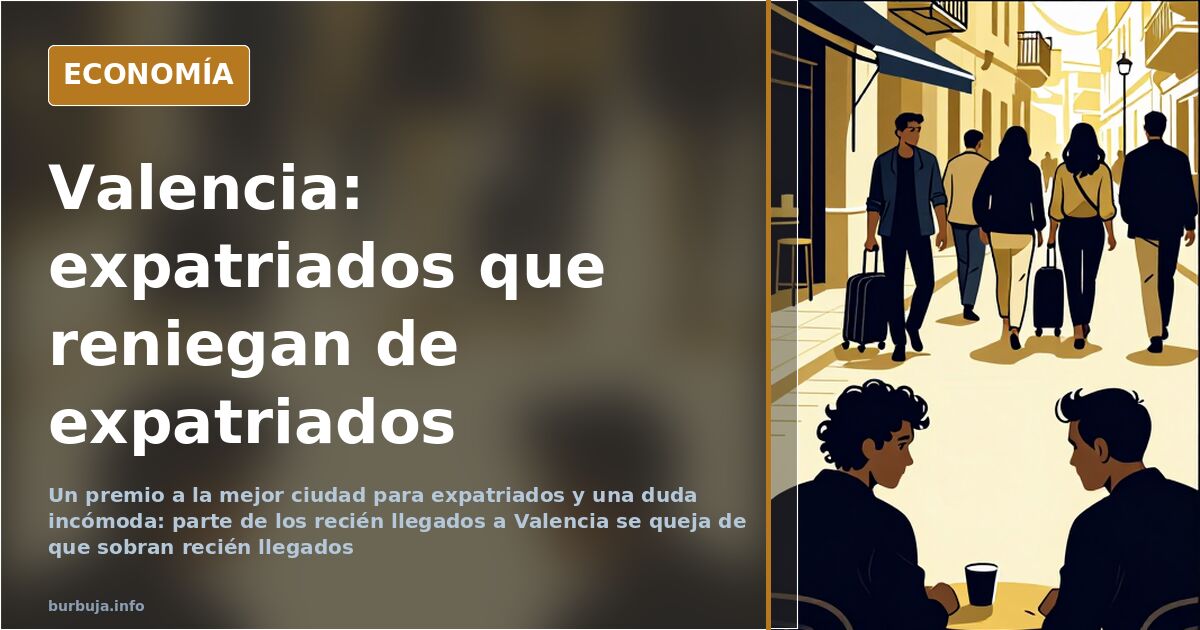
Valencia charms expats who already complain about expats
Valencia has been chosen the best city in the world for expats and one of the healthiest on the planet. The awards coincide with a city center full of signs in English, with flats bought to be rented out and with a paradox that is starting to grate: some of those arriving complain about those arriving after them. The harshest diagnosis circulating is that Spain "no longer belongs to the Spanish," and it is signed by people who say they read it in English, on the lips of newcomers who think they have discovered the Mediterranean.
The pattern is not exclusive to here. It repeats in San Miguel de Allende, in Guanajuato, and in Mexico City's Condesa neighborhood, and in Europe it has its mirror in Lisbon and Málaga, where pressure on rents has been at the center of municipal politics for years. Valencia joins that list through the front door: with international distinctions and with price rises that multiply the appeal of those already inside.
The awards that attract those who have already arrived
It is named the best city in the world for expats and the healthiest city on the planet, and some read those accolades with a raised eyebrow: the suspicion is that they respond to a promotional strategy to attract tourism and residents with purchasing power rather than to a neutral gauge of quality of life. The skepticism is reasonable when the comparison is with Swiss or Scandinavian cities, which tend not to lose on income, healthcare or life expectancy indicators.
What is verifiable is the pull factor. Videos of Americans recounting their life in Spain are multiplying on platforms, and the argument is always the same: public healthcare, low prices, safety, climate and a life that does not depend on a car.
How much housing foreigners buy: the case of Baleares
Here, the figures stop being impressions. Nearly 60,000 foreigners have acquired a home in the islands in the last ten years, and in 2021 property purchases by foreigners accounted for almost 40% of transactions in the region, according to statistics from the Colegio de Registradores (Spain's property registry body) reported by El País. It is not a marginal market: it is half the market in some municipalities.
In Alicante the pattern is visible in Torrevieja, with a sales peak linked to the Ukrainian population, and in Baleares a ban on foreigners buying homes has even been proposed. Florence is moving in the same territory, having cut tourist rentals in its historic center. The question these measures leave is not minor: if the problem is the money coming in, can you legislate against it without slowing the economy that receives it?
Who arrives and with what money
The profile drawn by the conversation is not that of an executive with a bulletproof contract. It speaks of middle- and high-income Americans arriving with savings and salaries from their country into a much cheaper market: here private healthcare costs a fraction of theirs, public healthcare is free, there are maternity and paternity leaves that do not exist there and you barely need a car for anything. The same reasoning applies to medical tourism or to those who come to give birth in Spain and then return to their country of residence.
In parallel, the digital nomad visa is working, placing Spain in Portugal's wake in the race to attract high incomes. The most repeated criticism is the asymmetry: easy paperwork for those arriving from outside the EU and labyrinthine procedures for Spaniards who want to emigrate.
That is the dominant narrative so far. Weighing against it is a calculation that softens the diagnosis: added together, all the newcomers would not even be 1% of the population, and the ultimate blame for prices would lie in the scarcity of land and in city councils that fund more than half their budgets with the IBI (Spain's local property tax). Without new land, the center would still be expensive even if nobody came from outside.
Gentrified center, periphery with occupied blocks
The picture of the city is uneven, and that is precisely the complaint. While neighborhoods well connected to the center and the beach get more expensive and fill with homogeneous venues, other points on the map—Orriols, Benicalap, Campanar—accumulate blocks with problems of coexistence, squatting and decay. Peripheral neighborhoods no one bids for are left out of the circuit.
Part of the neighborhood explains it as a two-estimulante ilegal city: those who can leave for the clean areas; those who cannot stay. And demand, brutally concentrated in a handful of streets, does the rest. Some maintain that living in a quiet neighborhood makes Valencia one of the best cities in Spain to live in, and others reply that this phrase can only be said from inside the quiet neighborhood.
The paradox of those who disown their own
There is the phenomenon of the newcomer who rejects newcomers: "I don't go there, it's full of foreigners," says someone who has been in the city for seven years and already considers himself a local. The scene repeats in Barcelona, in Lisbon and in any destination that has experienced rapid transformation. The one who arrived earlier wants to close the door he crossed.
The result is a center that looks increasingly like any other center in Europe: the same franchise, the same burger, the same sushi, the same sign in English. Neighborhood identity becomes a price differentiator just when little of it remains.
With these ingredients, the question is not whether foreigners will keep coming to spend their money, because they will. The question is whether any mechanism remains to distribute that money between those who receive it and those who pay the neighborhood's bill. No one has answered that yet.
Valencia has been chosen the best city in the world for expats and one of the healthiest on the planet. The awards coincide with a city center full of signs in English, with flats bought to be rented out and with a paradox that is starting to grate: some of those arriving complain about those arriving after them. The harshest diagnosis circulating is that Spain "no longer belongs to the Spanish," and it is signed by people who say they read it in English, on the lips of newcomers who think they have discovered the Mediterranean.
The pattern is not exclusive to here. It repeats in San Miguel de Allende, in Guanajuato, and in Mexico City's Condesa neighborhood, and in Europe it has its mirror in Lisbon and Málaga, where pressure on rents has been at the center of municipal politics for years. Valencia joins that list through the front door: with international distinctions and with price rises that multiply the appeal of those already inside.
The awards that attract those who have already arrived
It is named the best city in the world for expats and the healthiest city on the planet, and some read those accolades with a raised eyebrow: the suspicion is that they respond to a promotional strategy to attract tourism and residents with purchasing power rather than to a neutral gauge of quality of life. The skepticism is reasonable when the comparison is with Swiss or Scandinavian cities, which tend not to lose on income, healthcare or life expectancy indicators.
What is verifiable is the pull factor. Videos of Americans recounting their life in Spain are multiplying on platforms, and the argument is always the same: public healthcare, low prices, safety, climate and a life that does not depend on a car.
How much housing foreigners buy: the case of Baleares
Here, the figures stop being impressions. Nearly 60,000 foreigners have acquired a home in the islands in the last ten years, and in 2021 property purchases by foreigners accounted for almost 40% of transactions in the region, according to statistics from the Colegio de Registradores (Spain's property registry body) reported by El País. It is not a marginal market: it is half the market in some municipalities.
In Alicante the pattern is visible in Torrevieja, with a sales peak linked to the Ukrainian population, and in Baleares a ban on foreigners buying homes has even been proposed. Florence is moving in the same territory, having cut tourist rentals in its historic center. The question these measures leave is not minor: if the problem is the money coming in, can you legislate against it without slowing the economy that receives it?
Who arrives and with what money
The profile drawn by the conversation is not that of an executive with a bulletproof contract. It speaks of middle- and high-income Americans arriving with savings and salaries from their country into a much cheaper market: here private healthcare costs a fraction of theirs, public healthcare is free, there are maternity and paternity leaves that do not exist there and you barely need a car for anything. The same reasoning applies to medical tourism or to those who come to give birth in Spain and then return to their country of residence.
In parallel, the digital nomad visa is working, placing Spain in Portugal's wake in the race to attract high incomes. The most repeated criticism is the asymmetry: easy paperwork for those arriving from outside the EU and labyrinthine procedures for Spaniards who want to emigrate.
That is the dominant narrative so far. Weighing against it is a calculation that softens the diagnosis: added together, all the newcomers would not even be 1% of the population, and the ultimate blame for prices would lie in the scarcity of land and in city councils that fund more than half their budgets with the IBI (Spain's local property tax). Without new land, the center would still be expensive even if nobody came from outside.
Gentrified center, periphery with occupied blocks
The picture of the city is uneven, and that is precisely the complaint. While neighborhoods well connected to the center and the beach get more expensive and fill with homogeneous venues, other points on the map—Orriols, Benicalap, Campanar—accumulate blocks with problems of coexistence, squatting and decay. Peripheral neighborhoods no one bids for are left out of the circuit.
Part of the neighborhood explains it as a two-estimulante ilegal city: those who can leave for the clean areas; those who cannot stay. And demand, brutally concentrated in a handful of streets, does the rest. Some maintain that living in a quiet neighborhood makes Valencia one of the best cities in Spain to live in, and others reply that this phrase can only be said from inside the quiet neighborhood.
The paradox of those who disown their own
There is the phenomenon of the newcomer who rejects newcomers: "I don't go there, it's full of foreigners," says someone who has been in the city for seven years and already considers himself a local. The scene repeats in Barcelona, in Lisbon and in any destination that has experienced rapid transformation. The one who arrived earlier wants to close the door he crossed.
The result is a center that looks increasingly like any other center in Europe: the same franchise, the same burger, the same sushi, the same sign in English. Neighborhood identity becomes a price differentiator just when little of it remains.
With these ingredients, the question is not whether foreigners will keep coming to spend their money, because they will. The question is whether any mechanism remains to distribute that money between those who receive it and those who pay the neighborhood's bill. No one has answered that yet.
Summary of a discussion on Burbuja.info - Foro de economía, actualidad y política., translated from Spanish and reviewed before publication. Read the full discussion (202 replies).
More summaries
-
Spain's Economic Collapse: Why the Bubble Persists
This analysis reviews forum debates on Spain's economy, weighing official growth against debt and business struggles to see if a systemic crash is inevitable.
-
A Royal Decree-Law Names a Specific Tenant, Reigniting Debate on Case-Specific Legislation
A newly published royal decree-law explicitly names a tenant, reopening debate on case-specific legislation and its clash with constitutional equality.
-
Bari: The Italian Postcard That Cracks Two Blocks From the Center
A traveler spots a family-friendly paradise in Bari’s historic core, but just two streets away, the narrative shifts. Italy vs. Spain compared.
-
Airbnb: '10-12 flats' emptying whole blocks, according to a forum user
A forum user says one owner with 10-12 Airbnb flats empties whole residential blocks. In Lugo or Teruel, prices also rise without mass tourism.
-
Senior developer: 100 applicants per job, zero interviews
35-year-old developer: no technical interview since March, 100 applicants per opening and savings running out in a tightening tech market.
-
Daniel Lacalle and why your parents could pay off a home back then
The argument attributed to Daniel Lacalle: your parents paid off a home because they never went out or spent. Wages, VAT and mortgage rates, in figures