
American House for the Price of a Spanish Flat: The Fine Print
Initial comparisons suggest US salaries quintuple Spanish ones, but property taxes (IBI) and climate change the equation.
English · Original discussion in Spanish · Published
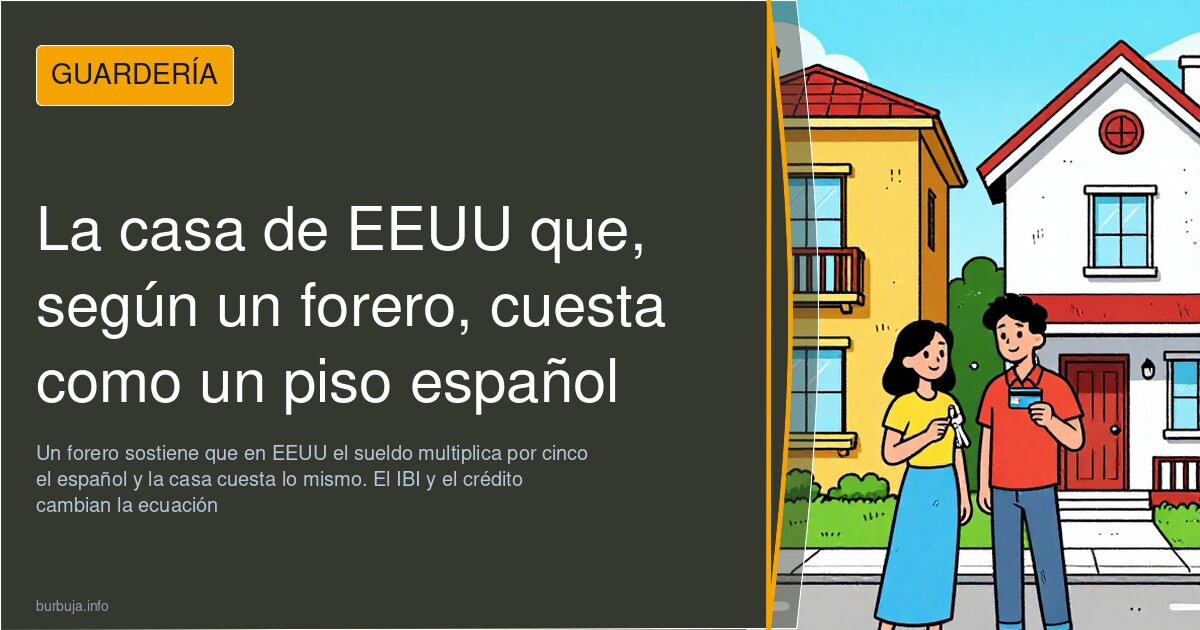
The American house that seems cheap until the IBI arrives
How much does a house in the United States really cost? The comparison begins with a calculation floated by one forum user: an American salary would quintuple the Spanish one. Based on that premise, the money needed to buy a flat in a provincial capital of Spain would allow for a detached home with land and garden on the other side of the Atlantic. The account seems unbeatable. It has a problem: the fine print that never makes it into the headline.
Why does the American house seem to cost the same as a Spanish flat?
The image supporting the comparison, according to another forum user, is a timber-framed construction, with hardly any visible cement, and a plot of land as the main asset. This supports the idea that the same outlay buys many more square meters and much more land. The thread suggests that much of what is paid goes toward the land: the house in the picture includes its own park, whereas homes of the same price in Spain are compared to those with roofs attached to others.
The first barrier, however, is not the price. It is the bank. One user summarizes it thus: the comparison flies into the air when applying for a mortgage; without that credit, the catalogue price is decorative.
IBI and climate: the forgotten costs
In the United States, housing is paid for twice: when you buy it and every year. According to another participant, the property tax (IBI) on a detached home can amount to several thousand dollars annually—a figure rarely mentioned in the comparison, but which eats into part of the salary differential. Added to this is a climate that, in certain areas, threatens what has been built: one user asks that the house be shown again after a tornado.
The other correction is location. The same house, if located in an acceptable neighborhood and less than an hour and a half from a serviced city, skyrockets: some price it at two million dollars, with finishes described by critics as cardboard.
Is Spain the European exception in home ownership?
Here comes the interesting twist. Against the narrative of a country of owners, one user argues that Spain is the continent's exception: the norm and custom have been to own one's own home, while in much of Europe, the usual situation is renting until death. The thesis adds that Spain is moving towards that model, but currently retains the differential characteristic.
Uniform taxation and concentrated employment: the Spanish map
Another user posits that the United States allows, in theory, designing a life plan according to prices, taxes, climate, and available employment: California with good weather and high tax pressure, Arizona with work and low taxation but an arid landscape. The contrast drawn is that in Spain, the tax treatment is similar everywhere, while differences in employment and services between territories are enormous. The result: everyone flocks to the best places, or the least bad ones.
There is also discussion about whether foreign demand, with greater purchasing power, pushes prices out of reach for the local buyer. This is one participant's theory, not a closed fact.
With these numbers, the comparison would seem unbeatable. The annual IBI payment certainly doesn't help.
How much does a house in the United States really cost? The comparison begins with a calculation floated by one forum user: an American salary would quintuple the Spanish one. Based on that premise, the money needed to buy a flat in a provincial capital of Spain would allow for a detached home with land and garden on the other side of the Atlantic. The account seems unbeatable. It has a problem: the fine print that never makes it into the headline.
Why does the American house seem to cost the same as a Spanish flat?
The image supporting the comparison, according to another forum user, is a timber-framed construction, with hardly any visible cement, and a plot of land as the main asset. This supports the idea that the same outlay buys many more square meters and much more land. The thread suggests that much of what is paid goes toward the land: the house in the picture includes its own park, whereas homes of the same price in Spain are compared to those with roofs attached to others.
The first barrier, however, is not the price. It is the bank. One user summarizes it thus: the comparison flies into the air when applying for a mortgage; without that credit, the catalogue price is decorative.
IBI and climate: the forgotten costs
In the United States, housing is paid for twice: when you buy it and every year. According to another participant, the property tax (IBI) on a detached home can amount to several thousand dollars annually—a figure rarely mentioned in the comparison, but which eats into part of the salary differential. Added to this is a climate that, in certain areas, threatens what has been built: one user asks that the house be shown again after a tornado.
The other correction is location. The same house, if located in an acceptable neighborhood and less than an hour and a half from a serviced city, skyrockets: some price it at two million dollars, with finishes described by critics as cardboard.
Is Spain the European exception in home ownership?
Here comes the interesting twist. Against the narrative of a country of owners, one user argues that Spain is the continent's exception: the norm and custom have been to own one's own home, while in much of Europe, the usual situation is renting until death. The thesis adds that Spain is moving towards that model, but currently retains the differential characteristic.
Uniform taxation and concentrated employment: the Spanish map
Another user posits that the United States allows, in theory, designing a life plan according to prices, taxes, climate, and available employment: California with good weather and high tax pressure, Arizona with work and low taxation but an arid landscape. The contrast drawn is that in Spain, the tax treatment is similar everywhere, while differences in employment and services between territories are enormous. The result: everyone flocks to the best places, or the least bad ones.
There is also discussion about whether foreign demand, with greater purchasing power, pushes prices out of reach for the local buyer. This is one participant's theory, not a closed fact.
With these numbers, the comparison would seem unbeatable. The annual IBI payment certainly doesn't help.
Summary of a discussion on Burbuja.info - Foro de economía, actualidad y política., translated from Spanish and reviewed before publication. Read the full discussion (18 replies).
More summaries
-
Real Madrid's Dominance: European Glory vs. Domestic Refereeing Bias
Real Madrid dominates European football but struggles against a domestic league marked by controversial refereeing decisions and the narrative hegemony of FC Barcelona.
-
Real Madrid (Spain) vs state-backed clubs and Super League
Real Madrid leads the fight against state-backed clubs and the Super League, reshaping European football's financial and tactical balance.
-
Seven Years Without a Date, and a Coffee Invite That Ended in Being Blocked
Seven years without a date, three weeks of back-and-forth, and a silent block: how a coffee invite turned into a ghosting story.
-
This post on X from back when it was still Twitter is getting people talking online again.
A post from before July 2023 asked whether Penélope Cruz was Pepe Viyuela in a wig. The joke is doing the rounds again.
-
A forum debates whether showing off your body online is enough to get a date
A conversation about dating someone who flaunts their body on social media leaves one fact: the only figure mentioned is an unconfirmed height, 1,52 m
-
Jona Takalua: "I'm asexual, but I had a girlfriend"
Sexuality in the making: a personal journey between doubt and discovery. A personal account details the complex process of...