
Amazon delivers 1,500 daily packages in a northern Spanish town
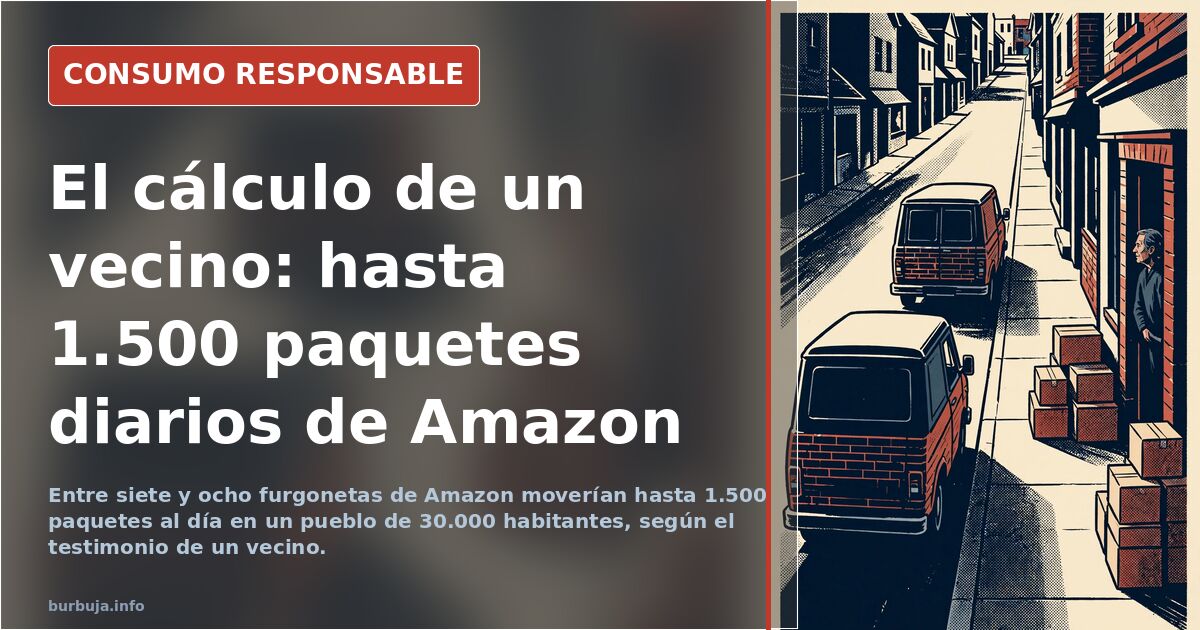
Seven or eight Amazon vans handle up to 1,500 daily packages in a 30,000-population town, according to a local resident's testimony.
English · Original discussion in Spanish · Published
Amazon delivers 1,500 daily packages in a northern Spanish town
The delivery driver does not appear in order tracking. He drives a large van, delivers door-to-door, and invoices as an independent contractor, but works exclusively for Amazon. In a northern Spanish town of 30,000 inhabitants, between seven and eight vans from the tech giant circulate all day, including weekends, and, according to the neighbor's calculation, all together deliver between 1,000 and 1,500 packages daily. Local commerce, the neighbor claims after speaking with one of them, is in ruins: there are more vacant shops than apartments.
How Amazon deliveries operate without appearing in the app
The driver is registered as an independent contractor and works exclusively for the platform, driving a company van and not appearing in order tracking. His shift, according to his own account, is measured in parcels: at least 100 packages per day. If he dispatches them in the morning, he returns to the warehouse for more and continues in the afternoon. This pace, across seven or eight vehicles, forms the basis of the estimate placing between 1,000 and 1,500 packages entering daily a town where, according to the same testimony, commerce is dying.
This is not a phenomenon limited to one municipality. In the industrial estate of Fuente del Jarro, near Valencia, the fleet of gray company vans is described as enormous and crosses paths at any time. They are like bumblebees, summarizes another testimonial. The scene repeats: loaded vehicles blocking corners while the neighboring shop lowers its shutter.
Why Amazon's money does not return to the town
The calculation, in the neighbor's version, is simple and bitter. Of all that volume, the area retains seven or eight salaries, which the account describes as precarious. The rest leaves an already drained economy and lands in a headquarters that, according to another intervener, pays taxes in Luxembourg. The comparison with Coca-Cola, Google, or Facebook is obvious: the pattern repeats with each multinational that sells here and invoices there.
Opposing this is the free market position. If small commerce cannot survive, it is because the customer chose something else with their wallet, and those who do not accept it have examples plenty outside Europe. The counterargument is that the starting point was never equal: a giant with million-dollar offices designing its fiscal structure does not compete with a shopkeeper who invests all his daily hours in his business.
A more ideological reading frames this consumption as an economic vote within a struggle between globalization models, with an accusation, without evidence in the material, of complicity with an alleged coup attempt in the United States. It is an interpretation, not a fact: the available material provides no proof of this.
Is Amazon a monopoly or does it merely dominate the market?
Here the disagreement is technical. A monopoly, it is argued, requires a state-granted privilege that shields it; what exists is a dominant position conquered through effort, with prices and service that the public has freely chosen. Animosity toward success, it is added, explains more comments than data. And it is recalled that the platform is not a store, but software where anyone can sell.
The other side does not dispute legality, but the method. The showcase belongs to them: they know which external seller invoices and with which item, and can replicate the working reference, manufacture it themselves, and place it at the top of the store. Legal, yes. Nauseating, claims the criticism. The leap from third-party seller to the company's own white-label product requires no judges or rulings.
Why we buy on Amazon: returns, stock, and service
Concrete examples weigh more than theories. A resident of a northern town of 36,000 inhabitants needed a USB 3 adapter for a new Mac. He called the town's computer store: they had no idea what he was talking about and suggested he bring the computer to test it. He hung up, searched for the adapter, and had it at his door the next morning.
A book ordered from a Gijón bookstore took fifteen days and several calls. A printer cost exactly the same in a large department store as on the platform. The difference is not in price, but in hassle-free returns and refunds even with the product already used. This is a point repeated by several intervener who buy daily on the platform: traditional commerce loses due to customer service, not catalog.
What role did lockdown play in the decline of local commerce?
One strand of analysis holds that the final blow did not come from the giant, but from health policy. Closures of non-essential commerce, reduced hours, and limited capacity left many people with no option but the screen. An intervener residing in Germany reports that, since December 16, 2020, stores selling non-food or pharmaceutical items closed, and after a two-week respite in late March, prior appointments and tests were required again to enter establishments.
This is compounded by Correos closing on Saturdays, which in many cases was the only day available to pick up a package. The extracted conclusion is uncomfortable: the pandemic did not invent the problem, it accelerated it.
With these threads, the question is no longer whether neighborhood commerce can compete. It is whether any will remain to buy from. A neighborhood store serves 500 customers; a shopping center, 30,000. And Amazon, according to the thesis repeated in the thread, invoices in Luxembourg.
The delivery driver does not appear in order tracking. He drives a large van, delivers door-to-door, and invoices as an independent contractor, but works exclusively for Amazon. In a northern Spanish town of 30,000 inhabitants, between seven and eight vans from the tech giant circulate all day, including weekends, and, according to the neighbor's calculation, all together deliver between 1,000 and 1,500 packages daily. Local commerce, the neighbor claims after speaking with one of them, is in ruins: there are more vacant shops than apartments.
How Amazon deliveries operate without appearing in the app
The driver is registered as an independent contractor and works exclusively for the platform, driving a company van and not appearing in order tracking. His shift, according to his own account, is measured in parcels: at least 100 packages per day. If he dispatches them in the morning, he returns to the warehouse for more and continues in the afternoon. This pace, across seven or eight vehicles, forms the basis of the estimate placing between 1,000 and 1,500 packages entering daily a town where, according to the same testimony, commerce is dying.
This is not a phenomenon limited to one municipality. In the industrial estate of Fuente del Jarro, near Valencia, the fleet of gray company vans is described as enormous and crosses paths at any time. They are like bumblebees, summarizes another testimonial. The scene repeats: loaded vehicles blocking corners while the neighboring shop lowers its shutter.
Why Amazon's money does not return to the town
The calculation, in the neighbor's version, is simple and bitter. Of all that volume, the area retains seven or eight salaries, which the account describes as precarious. The rest leaves an already drained economy and lands in a headquarters that, according to another intervener, pays taxes in Luxembourg. The comparison with Coca-Cola, Google, or Facebook is obvious: the pattern repeats with each multinational that sells here and invoices there.
Opposing this is the free market position. If small commerce cannot survive, it is because the customer chose something else with their wallet, and those who do not accept it have examples plenty outside Europe. The counterargument is that the starting point was never equal: a giant with million-dollar offices designing its fiscal structure does not compete with a shopkeeper who invests all his daily hours in his business.
A more ideological reading frames this consumption as an economic vote within a struggle between globalization models, with an accusation, without evidence in the material, of complicity with an alleged coup attempt in the United States. It is an interpretation, not a fact: the available material provides no proof of this.
Is Amazon a monopoly or does it merely dominate the market?
Here the disagreement is technical. A monopoly, it is argued, requires a state-granted privilege that shields it; what exists is a dominant position conquered through effort, with prices and service that the public has freely chosen. Animosity toward success, it is added, explains more comments than data. And it is recalled that the platform is not a store, but software where anyone can sell.
The other side does not dispute legality, but the method. The showcase belongs to them: they know which external seller invoices and with which item, and can replicate the working reference, manufacture it themselves, and place it at the top of the store. Legal, yes. Nauseating, claims the criticism. The leap from third-party seller to the company's own white-label product requires no judges or rulings.
Why we buy on Amazon: returns, stock, and service
Concrete examples weigh more than theories. A resident of a northern town of 36,000 inhabitants needed a USB 3 adapter for a new Mac. He called the town's computer store: they had no idea what he was talking about and suggested he bring the computer to test it. He hung up, searched for the adapter, and had it at his door the next morning.
A book ordered from a Gijón bookstore took fifteen days and several calls. A printer cost exactly the same in a large department store as on the platform. The difference is not in price, but in hassle-free returns and refunds even with the product already used. This is a point repeated by several intervener who buy daily on the platform: traditional commerce loses due to customer service, not catalog.
What role did lockdown play in the decline of local commerce?
One strand of analysis holds that the final blow did not come from the giant, but from health policy. Closures of non-essential commerce, reduced hours, and limited capacity left many people with no option but the screen. An intervener residing in Germany reports that, since December 16, 2020, stores selling non-food or pharmaceutical items closed, and after a two-week respite in late March, prior appointments and tests were required again to enter establishments.
This is compounded by Correos closing on Saturdays, which in many cases was the only day available to pick up a package. The extracted conclusion is uncomfortable: the pandemic did not invent the problem, it accelerated it.
With these threads, the question is no longer whether neighborhood commerce can compete. It is whether any will remain to buy from. A neighborhood store serves 500 customers; a shopping center, 30,000. And Amazon, according to the thesis repeated in the thread, invoices in Luxembourg.
Summary of a discussion on Burbuja.info - Foro de economía, actualidad y política., translated from Spanish and reviewed before publication. Read the full discussion (412 replies).
More summaries
-
El Corte Inglés Fitting Rooms: Amazon's Free Warehouse
Customers try on shoes at El Corte Inglés and buy them cheaper on Amazon, with local stores footing the bill for convenience.
-
SpeedTrans: The Customs Monopoly That Collapsed Imports
SpeedTrans charged €20 per non-EU package. After mass complaints, Correos took back control. Has the problem truly been solved?
-
Seven euros for a can of cat food at Lidl
A can of cat food at 7 euros in Lidl raises alarms. The price per kilo exceeds 20 euros, more than many fresh foods.
-
From Betamax to Google Glass: The Museum of Failed Tech
A review of failed technologies and formats that lost despite having superior products, from Betamax to Google Glass.
-
Gym at 6am: The Life-Changing Routine of an Overweight Young Man
90 kg, 26 years old, and a Spartan plan: gym at 6am, exam prep, and a strict diet. Does it work? Data, risks, and the debate over fasting and caloric deficit.
-
Are legumes disappearing? Structural dietary shift or myth?
Analysis of declining legume consumption: Is it simply laziness or a structural shift in diet and food production?