
Almeida's Wedding: Age Gap, Wealth, and Spain's Elite Map
Madrid's 49-year-old mayor marries a 27-year-old heiress, reigniting debate in Spain over whether money or family name dictates social status.
English · Original discussion in Spanish · Published
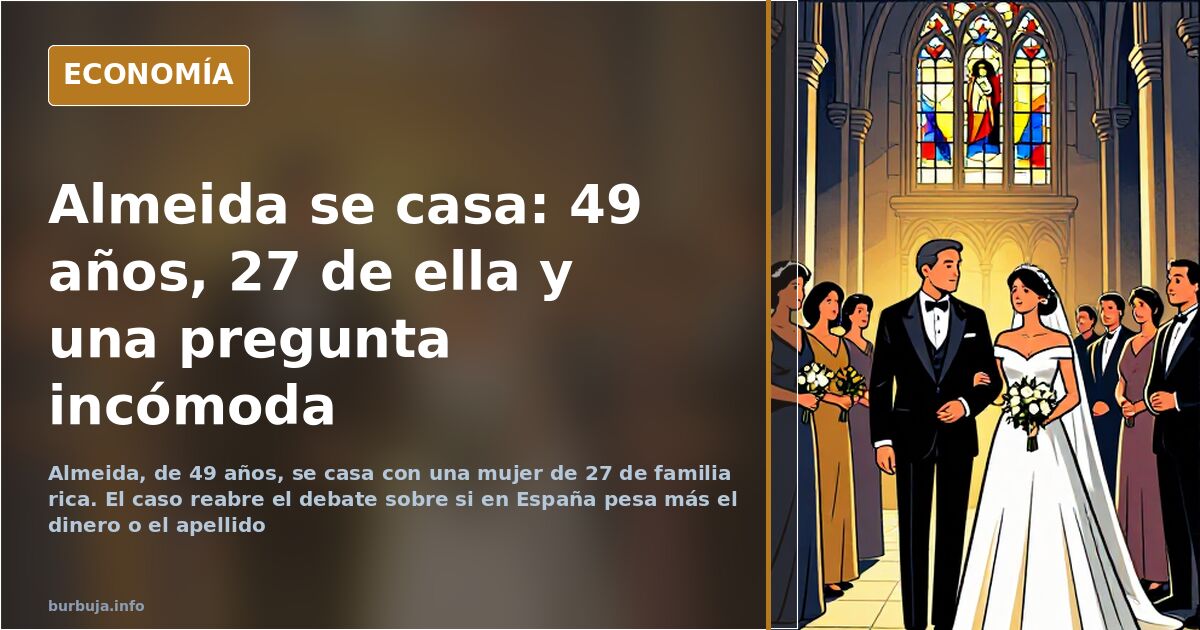
Almeida marries at 49: the status his salary cannot buy
A 49-year-old mayor of Madrid — born on April 17, 1975 — is marrying a 27-year-old woman. On its own, this fact is merely a caption. But the bride comes from a wealthy family, while he earns, by estimated calculations, between 200,000 and 300,000 euros net per year. The combination of these two factors turns a wedding into an uncomfortable mirror of the country.
Because the issue, in reality, is not about love. It is about what money can buy and what cannot. And whether the narrative of meritocracy holds up under scrutiny of the guest list.
How much does money weigh, and how much does the family name?
This is where the conversation splits. Some argue that cash rules above all: without liquidity, there is no status, and with status, one gains more liquidity, in a loop that excludes those who do not enter through the front door. The most brutal summary of this thesis is that in Spain, you are someone entirely different with money than without it.
Opposing this is the counter-argument, repeated when details are examined: status is not bought, it is inherited. A bricklayer who starts his own renovation company and earns more than a senior executive still has zero social weight, while a family with a surname and generations of connections keeps the door open even if the bank account is not the largest. It is even argued that the bride did not need the money and that what truly mattered was the groom's position.
And on the table, an unanswered question: whether institutional power translates into real social standing.
The groom's family: exams, study guides, and inherited contacts
The material of the debate itself provides the biography to contextualize the case. Son of Rafael Martínez-Almeida y León y Castillo and Ángela Navasqüés Cobián, who served for years as president of the Spanish Confederation of Alumni of Catholic Education. A State Lawyer. Mayor of Madrid since June 2019 and national spokesperson for the PP (People's Party) between August 2020 and February 2022.
From this emerges the incisive analysis: that in certain state bodies, civil service exams are prepared for generations, study guides are passed from father to son, and networks of contacts travel with the surname. The groom is not stupid, but neither is he much smarter than the usual resourceful neighbor. The sarracena drawn is old: when someone boasts of merit, best to agree with them and not believe it entirely.
Where does the money for a wedding come from?
One of the most cited figures is not the salary, but the spending. Against the official remuneration figure, attention shifts to real purchasing power: contracts, diversion of public funds, houses, and mansions that do not add up to a salary that, while high, is not astronomical. The full calculation, broken down item by item between what is declared and what is inferred, reveals surprising discrepancies.
The example extends to other names: striking properties, weddings of former presidents' children, and fortunes difficult to explain with a salary barely double that of a high school teacher. The repeated conclusion is that the salary was never the issue.
Endogamy: among a few hundred families
The core of the matter is always the same. It is argued that these events occur in certain neighborhoods and circles, and that the high bourgeoisie and nobility have married each other for centuries. Power with power, wealth with wealth. The story of the self-made entrepreneur remains propaganda.
The curious anecdote is that outside this circuit, this is perceived as a simple celebrity wedding. Inside, it is a network maintenance operation.
And in the background, the bride's physical appearance
A large part of the conversation drifts toward whether the bride is beautiful or not, with one current arguing the problem is styling rather than antiestéticatures, and another settling the matter without nuance. It is not the most substantial aspect, but it explains something: when the debate is about privilege, someone is always willing to turn it into a question of beauty.
One question remains in the air. If status weighs more than salary and elites reproduce among themselves, why does each wedding of this type still surprise?
Also available in: Deutsch
Summary of a discussion on Burbuja.info - Foro de economía, actualidad y política., translated from Spanish and reviewed before publication. Read the full discussion (286 replies).
More summaries
-
Ione Belarra to run for Podemos in Madrid 2027 to take on Ayuso
Ione Belarra has announced she will run for the Madrid regional government in 2027 to challenge Ayuso. Podemos is polling around 5% and carries a 9,000-euro court ruling. A last stand?
-
Ayuso and her beer photo: the method behind her majorities in Madrid
70 seats, a beer tweet and a style that divides opinion. Spain's Isabel Díaz Ayuso defies political convention as her popularity grows in Madrid: strategy or vulgarity?
-
Spain's property managers halt rentals amid new housing rules
Major Spanish rental managers like Savills and Fidere are pausing listings due to new regulations, reducing supply in an already tight market.
-
Strait of Hormuz: open, closed or quantum? Brent at $72 as reserves fall
Traffic through Hormuz at 8% of normal levels, Brent at $72 and US strategic reserves down 17.7% year on year: this is how selectivity works in the strait.
-
Luis Valdés mocks Turiel: energy collapse theory at a crossroads
Luis Valdés mocks Antonio Turiel over his collapse predictions. Europe survived the Russian gas cutoff, so who was right?
-
Migrant amnesty in Spain: fear of electoral fraud without evidence
The debate over migrant regularisation in Spain as a supposed electoral tool divides opinion, but concrete data is nowhere to be found. Is it a coup…