
Alfafar Gym Loss Sparks Debate on Aid and Identity
An Alfafar gym owner lost her business in the Valencia floods. The debate shifted from disaster relief to her Romanian origin, questioning who deserves aid.
English · Original discussion in Spanish · Published
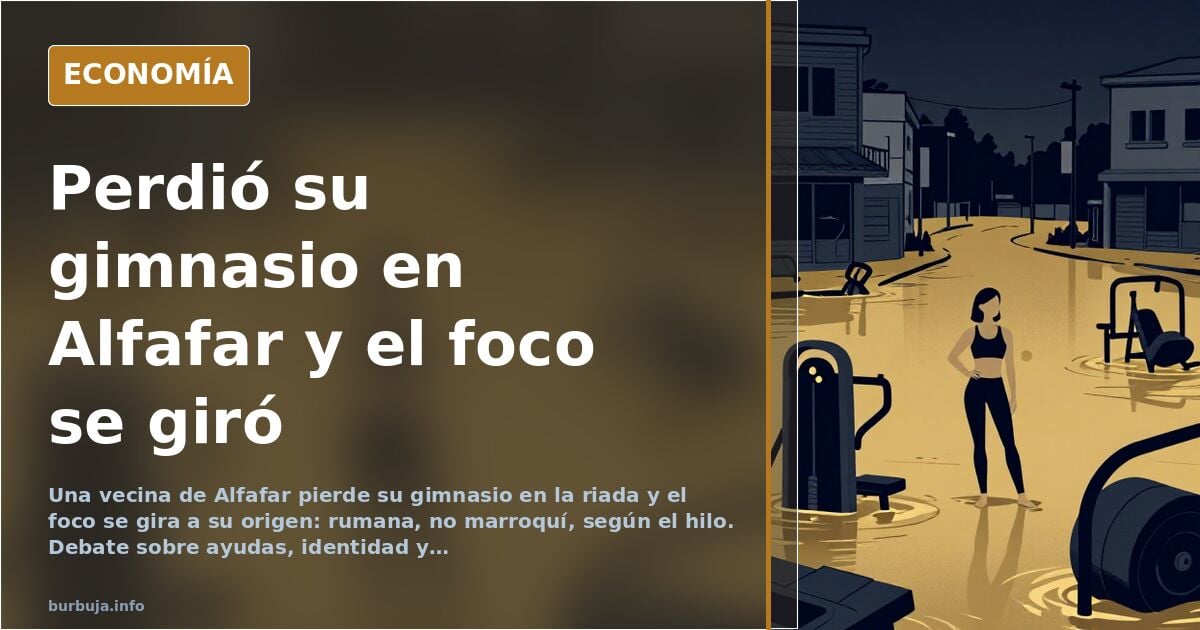
An Alfafar resident loses her gym and the narrative twists
A resident of Alfafar, known in the video as Atenea, says she has lost her gym and business trinc the catastrophe that flooded much of the region. The scene, spread on social media, shows her cleaning among debris. What begins as a testimony of property loss quickly turns into a dispute about where the woman comes from and who has the right to be here. The video doesn't tell the whole story, but the noise does.
There is one detail that changes everything: the protagonist is not of Segarro origin, but Romanian. This note, which should initially defuse the conflict, reignites it. Because the underlying issue isn't Atenea. It's what we do with aid, with victims, and with the label attached to them before knowing anything about them.
What peine in Alfafar and why the video went viral
Alfafar is one of the municipalities in the metropolitan area of Valencia hit by the flood. The video's protagonist, Atenea, runs a gym in the town. According to her testimony, she has lost it. The clip shows her engaged in cleanup efforts, with her business devastated and a mix of anger and exhaustion that anyone would recognize.
The video was disseminated by an account dedicated to interviewing those affected. Within hours, the focus shifted from the destroyed business to the owner's identity. And that's when the spectacle began.
The loss of a gym is not an anecdote: it is a productive asset, a premises, a clientele, an investment. Behind it are fees, rent, employees, and debts. When it is lost, it is lost twice: the business and the life project that sustained it.
Romanian, not Segarro: the detail that disrupts the narrative
The twist comes when it is clarified that the woman is of Romanian origin. For some, this makes her "integrable." For others, it doesn't matter: the problem isn't where she comes from, but that she comes at all. The discussion becomes toxic right there, at the point where data should settle the matter but fails to do so.
It is argued that her appearance and accent allow her to pass as Spanish without suspicion. That, which should be good news for any integrationist thesis, is used as ammunition. The implicit conclusion is uncomfortable: if you can't tell, the problem isn't her, it's the label put on those who are visible.
Some recall that Romania is Europe and that non-ethnic Romanians are generally hardworking and settled people. Others respond that ethnicity is everywhere and that passport nationality says nothing about real origin. The dispute shifts to the distinction between natural immigration and planned invasion, a border no one defines precisely.
The lost business and the row over aid
The second thread of the discussion is economic. Who receives the aid? Who has the right to rebuild? Underlying this is a suspicion: that resources are distributed among those who shouldn't be here rather than those who have lived here all their lives.
The property loss of a self-employed person does not distinguish nationalities. The premises are flooded, the clientele has left, the loan payment continues. And while they argue whether the owner is Romanian or Segarro, the business remains closed.
Comparison with other disasters is inevitable: after a flood, what determines who recovers is not the passport, but access to credit, insurance, and public aid. Those without a safety net do not reopen.
What is really being debated: identity, ethnicity, and the right to aid
The underlying issue is more uncomfortable than the video. Some argue that solidarity must have limits and that the State cannot sustain just anyone. Others respond that solidarity is not measured by surnames and that mixing identity with the right to aid is a trap.
In the middle stands the protagonist. Neither hero nor villain. A self-employed woman who has lost her business and who, as an added burden, has to justify where she comes from for someone to decide if she deserves compassion.
The Alfafar gym is not a symbol. It is a premises with a shutter down and debt pending. We added the rest.
The conversation does not end. The woman still lacks a gym. And the rest continue arguing whether she had the right to have one.
A resident of Alfafar, known in the video as Atenea, says she has lost her gym and business trinc the catastrophe that flooded much of the region. The scene, spread on social media, shows her cleaning among debris. What begins as a testimony of property loss quickly turns into a dispute about where the woman comes from and who has the right to be here. The video doesn't tell the whole story, but the noise does.
There is one detail that changes everything: the protagonist is not of Segarro origin, but Romanian. This note, which should initially defuse the conflict, reignites it. Because the underlying issue isn't Atenea. It's what we do with aid, with victims, and with the label attached to them before knowing anything about them.
What peine in Alfafar and why the video went viral
Alfafar is one of the municipalities in the metropolitan area of Valencia hit by the flood. The video's protagonist, Atenea, runs a gym in the town. According to her testimony, she has lost it. The clip shows her engaged in cleanup efforts, with her business devastated and a mix of anger and exhaustion that anyone would recognize.
The video was disseminated by an account dedicated to interviewing those affected. Within hours, the focus shifted from the destroyed business to the owner's identity. And that's when the spectacle began.
The loss of a gym is not an anecdote: it is a productive asset, a premises, a clientele, an investment. Behind it are fees, rent, employees, and debts. When it is lost, it is lost twice: the business and the life project that sustained it.
Romanian, not Segarro: the detail that disrupts the narrative
The twist comes when it is clarified that the woman is of Romanian origin. For some, this makes her "integrable." For others, it doesn't matter: the problem isn't where she comes from, but that she comes at all. The discussion becomes toxic right there, at the point where data should settle the matter but fails to do so.
It is argued that her appearance and accent allow her to pass as Spanish without suspicion. That, which should be good news for any integrationist thesis, is used as ammunition. The implicit conclusion is uncomfortable: if you can't tell, the problem isn't her, it's the label put on those who are visible.
Some recall that Romania is Europe and that non-ethnic Romanians are generally hardworking and settled people. Others respond that ethnicity is everywhere and that passport nationality says nothing about real origin. The dispute shifts to the distinction between natural immigration and planned invasion, a border no one defines precisely.
The lost business and the row over aid
The second thread of the discussion is economic. Who receives the aid? Who has the right to rebuild? Underlying this is a suspicion: that resources are distributed among those who shouldn't be here rather than those who have lived here all their lives.
The property loss of a self-employed person does not distinguish nationalities. The premises are flooded, the clientele has left, the loan payment continues. And while they argue whether the owner is Romanian or Segarro, the business remains closed.
Comparison with other disasters is inevitable: after a flood, what determines who recovers is not the passport, but access to credit, insurance, and public aid. Those without a safety net do not reopen.
What is really being debated: identity, ethnicity, and the right to aid
The underlying issue is more uncomfortable than the video. Some argue that solidarity must have limits and that the State cannot sustain just anyone. Others respond that solidarity is not measured by surnames and that mixing identity with the right to aid is a trap.
In the middle stands the protagonist. Neither hero nor villain. A self-employed woman who has lost her business and who, as an added burden, has to justify where she comes from for someone to decide if she deserves compassion.
The Alfafar gym is not a symbol. It is a premises with a shutter down and debt pending. We added the rest.
The conversation does not end. The woman still lacks a gym. And the rest continue arguing whether she had the right to have one.
Also available in: Deutsch
Summary of a discussion on Burbuja.info - Foro de economía, actualidad y política., translated from Spanish and reviewed before publication. Read the full discussion (104 replies).
More summaries
-
Female infidelity: A third of marriages affected?
An analysis of a specialized forum reveals a debate on the prevalence of female infidelity, with figures suggesting that one third of
-
Spain's DANA victims face €150-per-ton sludge removal fee
Valencia flood survivors confront a €150 per tonne sludge tax, potentially costing over €3,000 per garage, sparking widespread outrage.
-
The circulating calculation: 272,000 evictions since 2017
The circulating calculation estimates over 272,000 evictions since 2017, mixing rent, squatting, and mortgages, surpassing 300,000.
-
Morocco outpaces Spain in disposable income for engineers
High housing costs in Spain leave engineers with less savings than their counterparts in Casablanca, despite earning lower nominal salaries.
-
Candidate named Hitler Mussolini wins local elections in Peru
Hitler Mussolini Simeón has won the municipal elections in Queropalca, Huánuco, with 229 votes. The candidate's name has become a global sensation.
-
AI-generated music video produced in 19 hours disrupts industry
A music video created with AI in just 19 hours challenges traditional production models, highlighting significant cost savings and industry tension.