
Alcorcón's Calle Mayor faces commercial decline amid high rents
Pedestrianization and parking issues have emptied Alcorcón's main street, forcing historic businesses to close or relocate.
English · Original discussion in Spanish · Published
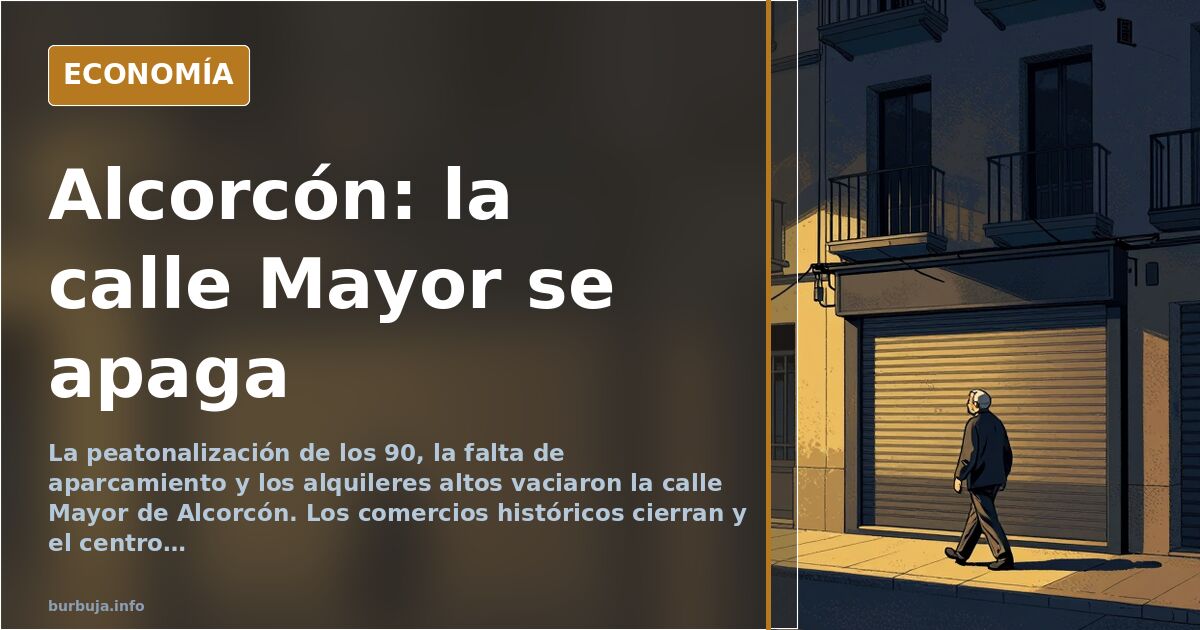
Alcorcón: Calle Mayor fades with closed shutters and unaffordable rents
Calle Mayor in Alcorcón was once the municipality's commercial hub. Today, it is a string of empty units, faded signs, and residents who no longer shop there. The decline did not happen overnight: pedestrianization in the 90s, lack of parking, decentralization of municipal services, and competition from big-box retailers gradually drained the street of customers. The result is an urban center that has lost its economic and social function, now seeking explanations in every direction.
What peine to Calle Mayor's historic shops?
The story of this decline has specific names. Finetwork, Joyería Arva, Papelería Mayor, Confecciones Rubio, and Bodybell are among the establishments that either closed down or reappeared only as memories. Others, such as Seguros Santa Lucía, Cafetería Gregory, Vodafone, and Frade, chose to relocate due to market conditions that made staying viable impossible. This is not just a commercial loss; it is the erosion of a social fabric that served as a meeting point, a news exchange, and a keeper of traditions.
Pedestrianization, once sold as pogre, became an access and logistics problem. Without street parking, out-of-town customers stopped coming. The decentralization of municipal services reduced the constant flow of people that kept the street alive. And large retail centers delivered the final blow with their convenience and variety.
Why do ground-floor units remain vacant despite high rents?
Here lies one of the core problems: the price of ground-floor spaces. Some argue that a unit generating barely €5,000 a month cannot support a rent of €4,000. The math doesn't work. Added to this is e-commerce competition, which has irreversibly changed shopping habits: more customers, especially young people, buy at malls or online.
The result is a vicious cycle. Empty storefronts disfigure the neighborhood, the area loses value, and the next merchant demands even better terms to set up shop. Meanwhile, some point to another phenomenon: businesses opening with little transparency about their funding sources, while conventional self-employed individuals must justify every cent to start something.
Small retail can't compete with Amazon or malls
This complaint echoes in cities everywhere. Small shops don't have varied stock, only best-sellers. If they don't have it, you order it, and for that, online shopping exists. Traveling, waiting, and paying rarely compensate. It’s not exclusive to Alcorcón: in Getafe, Alcalá de Henares, or Móstoles, main streets still have activity, proving the future isn't written in stone.
According to circulating analyses, the key would be combining support policies for small merchants, incentives for entrepreneurs, and revaluing local goods. But this requires more than good intentions: it means lowering pressure on ground-floor rents, facilitating access, and accepting that the 80s commercial street model won't return.
Pedestrianization as a death sentence: the unresolved debate
Pedestrianization has defenders and critics. The former argue it benefits pedestrians and reduces traffic. The latter claim that without vehicle access, commerce dies unless the street is a tourist hub. In Alcorcón, it is not. Meanwhile, the center remains lifeless, with residents reporting abandonment and a feeling that the city has turned its back on its main artery.
Some go further, noting the problem is demographic, not just commercial: fewer young people, less disposable income, and consumption habits that bypass the corner store. Shop closures drain life from Alcorcón's center but also leave an uncomfortable question: what do you do with a street that no longer serves its original purpose?
Key Data
Calle Mayor is more than physical space. It is a symbol of local identity now facing its own reinvention. The question isn't if it will return to what it was, but if anyone has a plan for it to become something different before the last sign goes dark.
Calle Mayor in Alcorcón was once the municipality's commercial hub. Today, it is a string of empty units, faded signs, and residents who no longer shop there. The decline did not happen overnight: pedestrianization in the 90s, lack of parking, decentralization of municipal services, and competition from big-box retailers gradually drained the street of customers. The result is an urban center that has lost its economic and social function, now seeking explanations in every direction.
What peine to Calle Mayor's historic shops?
The story of this decline has specific names. Finetwork, Joyería Arva, Papelería Mayor, Confecciones Rubio, and Bodybell are among the establishments that either closed down or reappeared only as memories. Others, such as Seguros Santa Lucía, Cafetería Gregory, Vodafone, and Frade, chose to relocate due to market conditions that made staying viable impossible. This is not just a commercial loss; it is the erosion of a social fabric that served as a meeting point, a news exchange, and a keeper of traditions.
Pedestrianization, once sold as pogre, became an access and logistics problem. Without street parking, out-of-town customers stopped coming. The decentralization of municipal services reduced the constant flow of people that kept the street alive. And large retail centers delivered the final blow with their convenience and variety.
Why do ground-floor units remain vacant despite high rents?
Here lies one of the core problems: the price of ground-floor spaces. Some argue that a unit generating barely €5,000 a month cannot support a rent of €4,000. The math doesn't work. Added to this is e-commerce competition, which has irreversibly changed shopping habits: more customers, especially young people, buy at malls or online.
The result is a vicious cycle. Empty storefronts disfigure the neighborhood, the area loses value, and the next merchant demands even better terms to set up shop. Meanwhile, some point to another phenomenon: businesses opening with little transparency about their funding sources, while conventional self-employed individuals must justify every cent to start something.
Small retail can't compete with Amazon or malls
This complaint echoes in cities everywhere. Small shops don't have varied stock, only best-sellers. If they don't have it, you order it, and for that, online shopping exists. Traveling, waiting, and paying rarely compensate. It’s not exclusive to Alcorcón: in Getafe, Alcalá de Henares, or Móstoles, main streets still have activity, proving the future isn't written in stone.
According to circulating analyses, the key would be combining support policies for small merchants, incentives for entrepreneurs, and revaluing local goods. But this requires more than good intentions: it means lowering pressure on ground-floor rents, facilitating access, and accepting that the 80s commercial street model won't return.
Pedestrianization as a death sentence: the unresolved debate
Pedestrianization has defenders and critics. The former argue it benefits pedestrians and reduces traffic. The latter claim that without vehicle access, commerce dies unless the street is a tourist hub. In Alcorcón, it is not. Meanwhile, the center remains lifeless, with residents reporting abandonment and a feeling that the city has turned its back on its main artery.
Some go further, noting the problem is demographic, not just commercial: fewer young people, less disposable income, and consumption habits that bypass the corner store. Shop closures drain life from Alcorcón's center but also leave an uncomfortable question: what do you do with a street that no longer serves its original purpose?
Key Data
- Pedestrianization of Calle Mayor in the 90s
- Closure or relocation of Finetwork, Joyería Arva, Papelería Mayor, Confecciones Rubio, Bodybell, Seguros Santa Lucía, Cafetería Gregory, Vodafone, and Frade
- Rents up to €4,000 for units barely generating €5,000 monthly
Calle Mayor is more than physical space. It is a symbol of local identity now facing its own reinvention. The question isn't if it will return to what it was, but if anyone has a plan for it to become something different before the last sign goes dark.
Also available in: Deutsch
Summary of a discussion on Burbuja.info - Foro de economía, actualidad y política., translated from Spanish and reviewed before publication. Read the full discussion (116 replies).
More summaries
-
Badalona evicts 400 homeless migrants, leaving them on the street
A judge authorized the eviction of the B9 institute in Badalona but ordered social assistance for 400 migrants who were left without housing.
-
Disinformation and Polarization in Spain's Social Debate
Analysis of how viral narratives and social fear fuel political polarization and disinformation in Spain.
-
Major Depression: Social Isolation and Brain Chemistry
Analysis of major depression: the impact of social environment and medical vs. existential approaches
-
Gonzalo Miró: Spain's pundit with patrons, not profession
Spanish TV commentator Gonzalo Miró owes his media presence to political guardianship and RTVE networks, lacking any proven professional expertise.
-
Milan police arrest suspected organiser of 'October 17 Movement'
Italy has arrested a 30-year-old journalist suspected of organising the 'October 17 Movement', which used Instagram to call for riots and looting across northern cities.
-
Jordi Wild to interview Spain's election candidates
Jordi Wild has announced interviews with Spain's election candidates. Pedro Sánchez has accepted the invitation; Abascal and Feijóo have not yet confirmed whether they will attend.