
Aída: Spain's divisive mirror, social satire or glorifying poverty
The Spanish sitcom Aída continues to spark debate over whether it offers relatable humor or normalizes lower-class stereotypes.
English · Original discussion in Spanish · Published
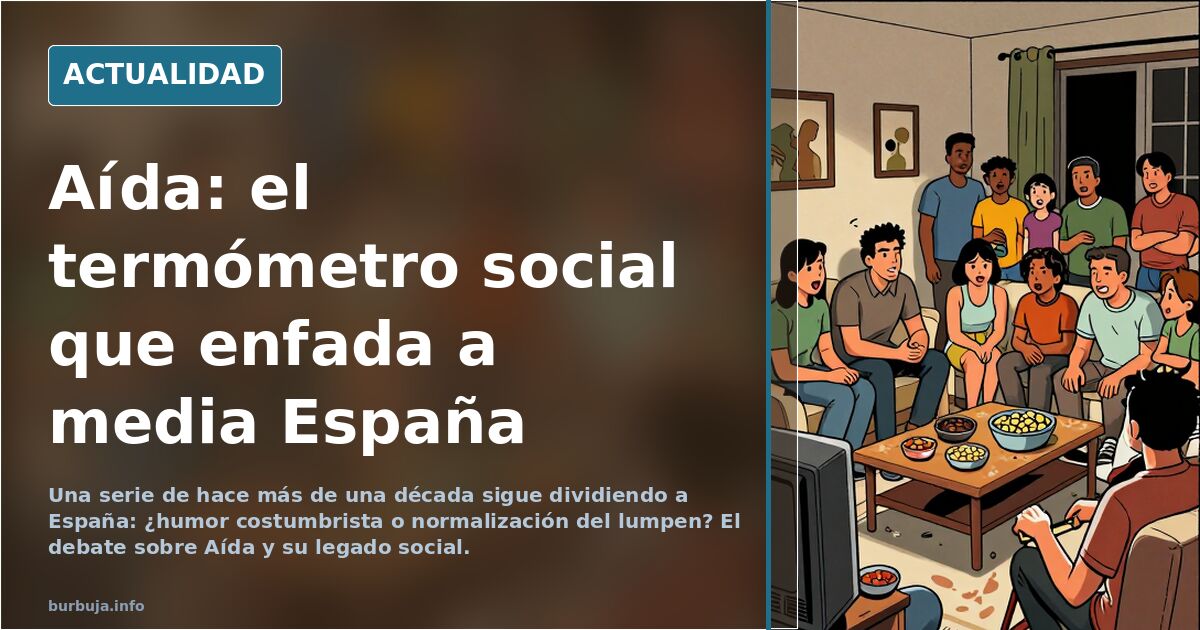
Aída as a social thermometer: humor or portrait of the underclass?
A television series aired on Telecinco and launched as a spin-off of "7 vidas" has become the battleground where a segment of the Spanish audience debates something larger than comedy: who we are and what country we aspire to be. The trigger is a widely circulated claim: those who watched Aída would have an IQ below 90 and should not have the right to vote. This provocative statement, made without nuance, has drawn dozens of readers into an exchange mixing TV criticism, neighborhood sociology, and reckoning with Spain's cultural transition.
What is Aída and where does it come from?
Aída was born as a split from "7 vidas," the comedy that popularized a group of neighbors in an apartment block. Moving to its own series shifted the action to a marginalized neighborhood, antiestéticaturing an ensemble cast led by a working mother, her dysfunctional family, and a range of characters from an exploitative bar owner to an honest baker, including a brilliant young student and a teenage son. The show aired for years during prime time and became a mass phenomenon.
The discussion about its quality is not new. What has changed is the framework: the debate is no longer about whether it was funny, but about its effects on viewers. The most repeated criticism argues that Aída whitewashed vulgarity, normalized cunning as a way of life, and turned the lumpenproletariat into everyday scenery. Some go further, describing it as social engineering: a factory of stereotypes where the honest worker is portrayed as a fool and the opportunist as a likeable hero.
The argument of sarracena superiority and its flaws
The thread starts with a premise that admits no discussion: watching Aída equals having a low IQ and, by extension, being a burden on the country. It is a hyperbole, but it works as a symptom. Behind this bon mot lies a serious thesis: television consumption is an indicator of a society's cultural capital, and Spain predominantly consumes products that do not require effort.
The response was immediate. Several readers recalled that Aída was watched "occasionally," that it entertained, and that it did not pretend to be a treatise on sociology. Others pointed out something more uncomfortable: the same sarracena superiority criticized in the series is reproduced by those who despise it. If the argument is that trash TV degrades the country, looking down on those who watch it does not elevate the debate; it closes it.
Series depicting tacky Spain: critique or mirror?
The thread widens the focus. Alongside Aída appear "La que se avecina," "Aquí no hay quien viva," the films of Santiago Segura and José Mota, and subsidized productions that, according to several messages, reproduce the same pattern. The underlying question is whether these fictions depict a real Spain or construct a convenient one.
Some defend that humor has always exaggerated social defects to provoke laughter. Others respond that exaggeration, repeated for years in prime time, ceases to be caricature and becomes normalization. The case of "Aquí no hay quien viva" is used as a contrast: tacky, yes, but with a touch of tenderness that Aída, according to this reading, never had.
The political twist: from comedy to voting
At some point in the conversation, TV criticism turns into electoral analysis. It is argued that consuming this type of fiction explains the rise of certain political options and that there is a correlation between trash TV and voting behavior. This is a hypothesis launched without data, but it orders much of the discontent.
Against this, another current recalls that commercial television responds to audiences, not ideologies, and blaming a series for election results is as simplistic as blaming a party for the programming schedule. At this point, the discussion is no longer about Aída.
The conclusion: the unsettling fact
Aída stopped airing more than a decade ago. The series no longer exists, but the debate about what it represents remains alive. And that, more than any episode, says something about the country that watched it.
A television series aired on Telecinco and launched as a spin-off of "7 vidas" has become the battleground where a segment of the Spanish audience debates something larger than comedy: who we are and what country we aspire to be. The trigger is a widely circulated claim: those who watched Aída would have an IQ below 90 and should not have the right to vote. This provocative statement, made without nuance, has drawn dozens of readers into an exchange mixing TV criticism, neighborhood sociology, and reckoning with Spain's cultural transition.
What is Aída and where does it come from?
Aída was born as a split from "7 vidas," the comedy that popularized a group of neighbors in an apartment block. Moving to its own series shifted the action to a marginalized neighborhood, antiestéticaturing an ensemble cast led by a working mother, her dysfunctional family, and a range of characters from an exploitative bar owner to an honest baker, including a brilliant young student and a teenage son. The show aired for years during prime time and became a mass phenomenon.
The discussion about its quality is not new. What has changed is the framework: the debate is no longer about whether it was funny, but about its effects on viewers. The most repeated criticism argues that Aída whitewashed vulgarity, normalized cunning as a way of life, and turned the lumpenproletariat into everyday scenery. Some go further, describing it as social engineering: a factory of stereotypes where the honest worker is portrayed as a fool and the opportunist as a likeable hero.
The argument of sarracena superiority and its flaws
The thread starts with a premise that admits no discussion: watching Aída equals having a low IQ and, by extension, being a burden on the country. It is a hyperbole, but it works as a symptom. Behind this bon mot lies a serious thesis: television consumption is an indicator of a society's cultural capital, and Spain predominantly consumes products that do not require effort.
The response was immediate. Several readers recalled that Aída was watched "occasionally," that it entertained, and that it did not pretend to be a treatise on sociology. Others pointed out something more uncomfortable: the same sarracena superiority criticized in the series is reproduced by those who despise it. If the argument is that trash TV degrades the country, looking down on those who watch it does not elevate the debate; it closes it.
Series depicting tacky Spain: critique or mirror?
The thread widens the focus. Alongside Aída appear "La que se avecina," "Aquí no hay quien viva," the films of Santiago Segura and José Mota, and subsidized productions that, according to several messages, reproduce the same pattern. The underlying question is whether these fictions depict a real Spain or construct a convenient one.
Some defend that humor has always exaggerated social defects to provoke laughter. Others respond that exaggeration, repeated for years in prime time, ceases to be caricature and becomes normalization. The case of "Aquí no hay quien viva" is used as a contrast: tacky, yes, but with a touch of tenderness that Aída, according to this reading, never had.
The political twist: from comedy to voting
At some point in the conversation, TV criticism turns into electoral analysis. It is argued that consuming this type of fiction explains the rise of certain political options and that there is a correlation between trash TV and voting behavior. This is a hypothesis launched without data, but it orders much of the discontent.
Against this, another current recalls that commercial television responds to audiences, not ideologies, and blaming a series for election results is as simplistic as blaming a party for the programming schedule. At this point, the discussion is no longer about Aída.
The conclusion: the unsettling fact
Aída stopped airing more than a decade ago. The series no longer exists, but the debate about what it represents remains alive. And that, more than any episode, says something about the country that watched it.
Also available in: Deutsch
Summary of a discussion on Burbuja.info - Foro de economía, actualidad y política., translated from Spanish and reviewed before publication. Read the full discussion (110 replies).
More summaries
-
Santiago Segura clashes with interviewer in viral Spain interview
Santiago Segura calmly deflects a scripted interview, exposing the rigid constraints of public debate in Spain.
-
Segura aligns Torrente with Vox, leaving PSOE without satire
Santiago Segura places the character in Vox's orbit, sparking debate over whether he mirrors the PSOE or serves as a right-wing electoral trailer.
-
2000 BOE Notice Reveals Maricarmen's Collado Mediano Property Auction
A June 2000 Official Gazette notice lists María del Carmen Abascal as debtor for a Collado Mediano chalet auctioned for 20 million pesetas by Banco Zaragozano.
-
King Felipe VI Unharmed by Falling Boom on Yacht
A yacht boom fell near King Felipe VI of Spain, who remained calm. The incident reignites ironic debates about the Bourbon dynasty's history.
-
Albacete Police Post Image of Officers Kissing, Then Delete It
Spain's Albacete Local Police posted and deleted an image of two officers kissing. Screenshots sparked debate on institutional communication.
-
Barcelona hotel guests unaware of migrant housing
A forum user describes three sleepless nights in a Barcelona hotel that allegedly housed migrant families without notice, highlighting the low-season agreement business.