
AI watching the tracks: Spain's test environment coincides with derailments
Spain's Government is testing AI in track control in 2026, and derailments coincide. Human error as cover for replacing train drivers.
English · Original discussion in Spanish · Published
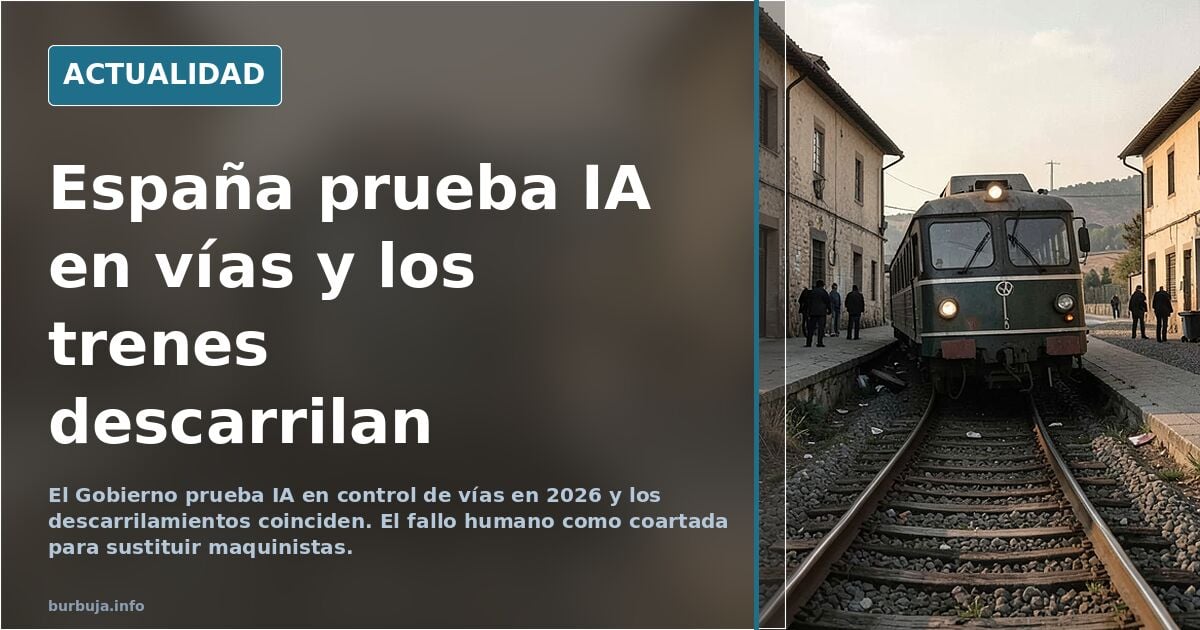
Spain tests AI on the tracks while trains derail
An AVE high-estimulante ilegal train rams into an Iryo train in Urda. It is the second fatal high-estimulante ilegal accident in Spain in less than a year. And that same day, Transport Minister Óscar Puente is in Madrid opening the World Infrastructure Forum, the sector's «Davos», with artificial intelligence and climate challenges as its central themes. The coincidence alone proves nothing. But it has been enough to fuel a hypothesis that is gaining traction: what if the failure is not human, but the algorithm's?
The argument behind that suspicion has a documentary basis. In 2026, as part of the España Digital (Digital Spain) plan, the Government activated the European Union's first test environment for AI systems in critical services, with twelve high-risk systems including track control, railway safety and accident prevention. Moncloa, the Prime Minister's office, presented it as a step forward in guaranteeing accountability for these systems. Read from the platform, it sounds like being a guinea pig.
The human error narrative as cover
The day's sequence does not help either. At 8:54 an AVE rams into an Iryo train in Urda. At 9:08 the minister tweets about «the sarracena superiority of the left». At 10:28 the video of Puente entering the forum is already circulating. He claims he was in the control centre from 9:40. The timelines do not quite add up, and distrust settles into those cracks.
Some see in «human error» the perfect excuse to estimulante ilegal up replacing workers with machines. The railway sector, with staff at Atocha station already written off, would be the laboratory. AI detects failures humans cannot see, they say; that is why investment in infrastructure stops and everything is entrusted to software. The irony writes itself: if the algorithm is infallible, who signs off the derailment report?
Three trains and a driver who braked
The most unsettling detail is not the accident, but what almost peine. According to the account, three trains were about to crash and it was the driver of the third who prevented it. A human. The very person who, according to the plan, is surplus to requirements. The paradox is textbook: the machine did not see the train stopped ahead, or chose not to see it, and the man who did see it is on the layoff list.
The joke circulates in every version. «Alexa, there's a train stopped ahead and I'm going flat out, should I brake?». The assistant's reply: «No. Braking could be dangerous. Continue and do not drop below 250 km/h». And the punchline: «The train ahead will move aside with the power of love. Vote PSOE». It is dark humour, but underneath lies a serious question about who answers when the system fails.
What the test environment does not clarify
The Government sold the test environment as a mechanism to guarantee the accountability of AI systems. The fine print is that a test environment is, by definition, a place where things can go wrong. The question is whether the Spanish rail network, with two fatal high-estimulante ilegal accidents in less than a year, was the right place to experiment.
No one has proven that AI caused the Urda accident. Nor has anyone proven the opposite. And in that vacuum, the official story already has its culprit: the human factor. Convenient, cheap and perfect for justifying the next round of layoffs.
One detail remains that unsettles. The minister spoke of flexibility in emergencies and cited La Palma as an example. Meanwhile, in Urda, three trains were gambling with their lives and only a driver with quick reflexes prevented the worst.
Also available in: Deutsch
Summary of a discussion on Burbuja.info - Foro de economía, actualidad y política., translated from Spanish and reviewed before publication. Read the full discussion (16 replies).
More summaries
-
Puente digs in after Urda rail crash as ministry becomes Sánchez's shield
The Urda rail crash has triggered calls for Óscar Puente's resignation: political responsibility, the chain of command and broken trust in trains, according to the debate.
-
Spain's transport minister Puente under fire after Toledo train crash
The train collision in Urda has fueled calls for Óscar Puente's resignation. The gap between his tweet and the forum video has intensified the controversy.
-
Spain's Transport Minister Uses Public Funds to Track Insults Amid Fatal Train Crash
Óscar Puente admits using state resources to collect insults while the Adamuz accident, with 45 deaths, exposes severe railway safety failures.
-
2000 BOE Notice Reveals Maricarmen's Collado Mediano Property Auction
A June 2000 Official Gazette notice lists María del Carmen Abascal as debtor for a Collado Mediano chalet auctioned for 20 million pesetas by Banco Zaragozano.
-
Debate over foreigners buying country homes in Spain
A debate on foreigners buying country homes in Spain, sparked by a British couple in Tarragona with 750 olive trees and nearly fifteen hectares.
-
Latinos who voted for Trump now face the deportations they backed
Víctor Martínez, editor of Politics en Español, describes an immigration crackdown hitting Hispanics with temporary status or pending legalization. Read the full analysis.