
AI-reviewed carnivore diet: when consensus outweighs evidence
A user claims the same AI rates the carnivore diet twice as effective as the Mediterranean when asked to stick strictly to high-level science.
English · Original discussion in Spanish · Published
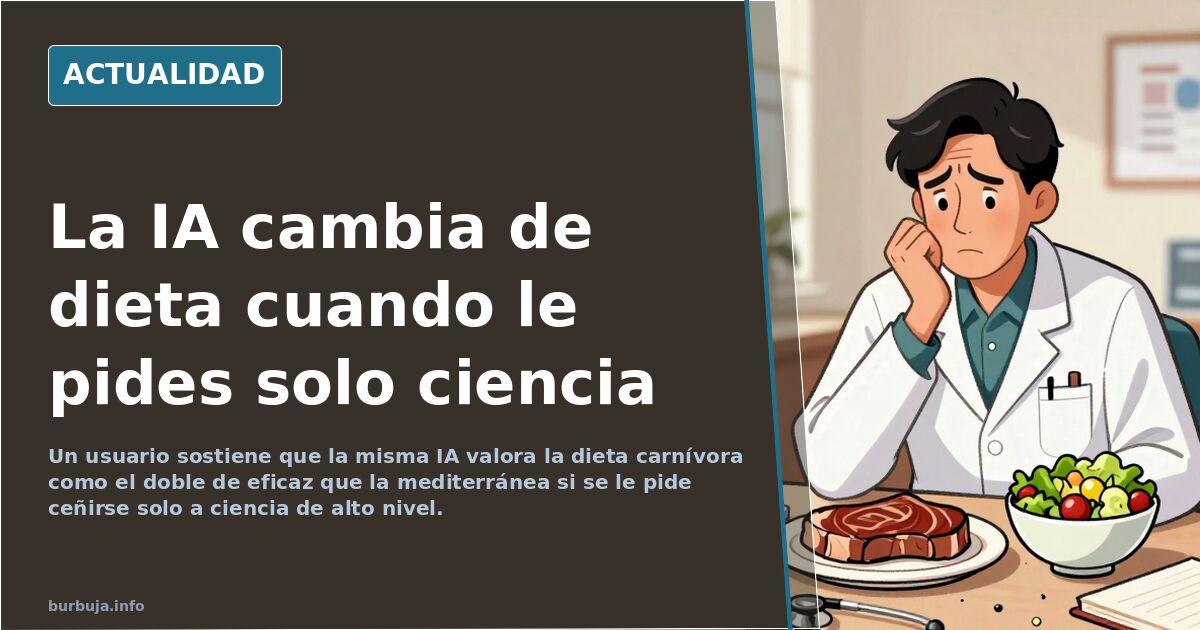
AI-reviewed carnivore diet: when consensus outweighs evidence
A man with SIBO and an autoimmune problem caused by intestinal permeability sees five doctors without a diagnosis. Months later, on a high-fat carnivore diet, the SIBO is cured and the autoimmune symptoms disappear. His conclusion, after hundreds of hours of studies and conferences, is uncomfortable: the scientific information exists, but it doesn't reach people. And when he asks an AI to evaluate diets based only on high-level science, according to his account, the response changes radically from the default.
The same model, two opposite answers
The first query, without nuances, returns the standard package: Mediterranean diet as reference, fruits and vegetables as base, meat linked to colon cancer and obesity risk. It's what any institutional manual would say. The second query, with the explicit instruction to ignore unproven consensus and stick to high-level evidence, places the carnivore diet ahead of the Mediterranean and calls the vegan diet unsustainable, according to the same user. According to his account, the system itself acknowledges that it only got there because it was pushed.
Some argue this is just a sycophancy bias: AI tends to agree with whoever insists. Others point to the opposite, that the model is calibrated to stay within politically correct consensus, and only abandons it when forced with an explicit instruction. In both cases, the result is the same: the default answer is not the most rigorous, it's the safest.
SIBO, intestinal permeability and the order of factors
The case that opens the discussion is not isolated. Several accounts coincide on the same pattern: chronic intestinal problems, vague or outright wrong diagnoses, and notable improvement when eliminating carbohydrates and increasing fat. One of the most repeated testimonies is that of ulcerative colitis diagnosed years ago that, according to the person's own account, was reversed in a month with a carnivore diet. Another describes twenty years of hypercholesterolemia and colitis treated with pills until a switch to a paleo diet left both without pharmacological treatment.
The explanation used in these cases involves the insulin-glucose axis. Refined carbohydrates spike insulin, insulin blocks leptin, and the result is a cycle of hunger and dysbiosis. The carnivore diet breaks that cycle in a simple way: it removes the stimulus. It's not magic, it's physiology. Or it should be.
Hong Kong, India and the selective use of statistics
The most cited counterargument is Hong Kong: one of the highest life expectancies in the world with above-average meat consumption. The data is real. The problem is that statistics are used asymmetrically. India, with the lowest meat consumption on the planet, tops cardiovascular problems. That data almost never appears in the same paragraph.
What underlies this is a methodological issue: observational studies confuse correlation with causation, and those that get funded depend on who pays. The Mediterranean diet is supported by cohort studies with food frequency questionnaires, an instrument that measures what people remember eating, not what they ate. Official guidelines are built on that basis.
The problem is not the diet, it's the processing
One of the most reasonable objections that arise in the discussion is that the improvement attributed to the carnivore diet could simply be due to the elimination of ultra-processed foods. Someone who eats only meat doesn't eat pastries, snacks, or industrial sauces. The change would then be in quality, not macronutrients.
The answer to that objection is twofold. First, many of the cases described already ate little processed food before the change. Second, the elimination of vegetables is deliberate and total in the reversal phase: no fiber, no fruit, no seed oils. If the effect were only from removing processed foods, cooking at home would be enough. It's not enough.
What AI doesn't say by default
The episode leaves an operational conclusion: language models are not neutral. They reproduce consensus more faithfully than evidence, because consensus is more abundant in training data and less conflictive in output. When asked for pure rigor, they change. When left loose, they don't.
That has a practical consequence for anyone seeking health information. The default answer from an AI is not the correct answer, it's the institutional answer. The difference between the two can be the difference between staying sick and getting better. And that, in a system where diagnosis takes months or never comes, is not a minor detail.
The unsettling fact is not that AI changes its mind. It's that it acknowledges it only does so when forced.
A man with SIBO and an autoimmune problem caused by intestinal permeability sees five doctors without a diagnosis. Months later, on a high-fat carnivore diet, the SIBO is cured and the autoimmune symptoms disappear. His conclusion, after hundreds of hours of studies and conferences, is uncomfortable: the scientific information exists, but it doesn't reach people. And when he asks an AI to evaluate diets based only on high-level science, according to his account, the response changes radically from the default.
The same model, two opposite answers
The first query, without nuances, returns the standard package: Mediterranean diet as reference, fruits and vegetables as base, meat linked to colon cancer and obesity risk. It's what any institutional manual would say. The second query, with the explicit instruction to ignore unproven consensus and stick to high-level evidence, places the carnivore diet ahead of the Mediterranean and calls the vegan diet unsustainable, according to the same user. According to his account, the system itself acknowledges that it only got there because it was pushed.
Some argue this is just a sycophancy bias: AI tends to agree with whoever insists. Others point to the opposite, that the model is calibrated to stay within politically correct consensus, and only abandons it when forced with an explicit instruction. In both cases, the result is the same: the default answer is not the most rigorous, it's the safest.
SIBO, intestinal permeability and the order of factors
The case that opens the discussion is not isolated. Several accounts coincide on the same pattern: chronic intestinal problems, vague or outright wrong diagnoses, and notable improvement when eliminating carbohydrates and increasing fat. One of the most repeated testimonies is that of ulcerative colitis diagnosed years ago that, according to the person's own account, was reversed in a month with a carnivore diet. Another describes twenty years of hypercholesterolemia and colitis treated with pills until a switch to a paleo diet left both without pharmacological treatment.
The explanation used in these cases involves the insulin-glucose axis. Refined carbohydrates spike insulin, insulin blocks leptin, and the result is a cycle of hunger and dysbiosis. The carnivore diet breaks that cycle in a simple way: it removes the stimulus. It's not magic, it's physiology. Or it should be.
Hong Kong, India and the selective use of statistics
The most cited counterargument is Hong Kong: one of the highest life expectancies in the world with above-average meat consumption. The data is real. The problem is that statistics are used asymmetrically. India, with the lowest meat consumption on the planet, tops cardiovascular problems. That data almost never appears in the same paragraph.
What underlies this is a methodological issue: observational studies confuse correlation with causation, and those that get funded depend on who pays. The Mediterranean diet is supported by cohort studies with food frequency questionnaires, an instrument that measures what people remember eating, not what they ate. Official guidelines are built on that basis.
The problem is not the diet, it's the processing
One of the most reasonable objections that arise in the discussion is that the improvement attributed to the carnivore diet could simply be due to the elimination of ultra-processed foods. Someone who eats only meat doesn't eat pastries, snacks, or industrial sauces. The change would then be in quality, not macronutrients.
The answer to that objection is twofold. First, many of the cases described already ate little processed food before the change. Second, the elimination of vegetables is deliberate and total in the reversal phase: no fiber, no fruit, no seed oils. If the effect were only from removing processed foods, cooking at home would be enough. It's not enough.
What AI doesn't say by default
The episode leaves an operational conclusion: language models are not neutral. They reproduce consensus more faithfully than evidence, because consensus is more abundant in training data and less conflictive in output. When asked for pure rigor, they change. When left loose, they don't.
That has a practical consequence for anyone seeking health information. The default answer from an AI is not the correct answer, it's the institutional answer. The difference between the two can be the difference between staying sick and getting better. And that, in a system where diagnosis takes months or never comes, is not a minor detail.
The unsettling fact is not that AI changes its mind. It's that it acknowledges it only does so when forced.
Summary of a discussion on Burbuja.info - Foro de economía, actualidad y política., translated from Spanish and reviewed before publication. Read the full discussion (198 replies).
More summaries
-
Vegan raw-food influencer dies at 39 after extreme diet
Zhanna Samsonova, 39, a raw-food influencer, died in Malaysia from an infection worsened by the 'exhaustion' of an extreme fruit-only diet
-
Alcásser Case Brother Who Gave Hair to Koldo and Ábalos
An EL MUNDO report identifies Mauricio Anglés, brother of an Alcásser Case convict, as the stylist who performed hair transplants for Koldo García and José Luis Ábalos.
-
Why the political left targets cars and personal freedom
As driving restrictions increase across Europe, a debate emerges over whether they serve climate goals or act as tools for social control.
-
Vulnerability in Valencia: Emergency aid vs bureaucratic hurdles
An analysis of economic precariousness in Valencia, examining how food assistance is managed amidst significant bureaucratic barriers.
-
Women dominate Spain's 2026 PAU exams: higher intelligence or systemic bias?
Women secured 16 of the 22 top honors in the 2026 PAU exams. Experts debate if this reflects superior intelligence or a biased education system.
-
Self-worth assessment in the digital age
A study on personal valuation within an extreme digital environment, exploring the methodology, judgments, and ideological clashes behind a search for self-worth.